
Some international ocean freight operations fall outside the usual framework. This is especially true when a vehicle or piece of cargo cannot be loaded into a standard container.
Recently, Camille Lassus, Sales Executive at Nexline Group, received a specific request: organise the shipment of a truck from Le Havre to Mayotte.
For this operation, the solution chosen was a Flat Rack, an equipment type adapted to oversized or out-of-gauge cargo.
But before seeing the truck loaded and ready to go, several stages had to be coordinated.
An international ocean freight operation outside the standard
Not every transport project is the same.
In this case, the dimensions of the vehicle required a different solution from a standard container.
A Flat Rack makes it possible to transport cargo whose size or shape does not fit inside a closed container.
This type of equipment is often used for vehicles, industrial equipment and other oversized goods.
However, selecting the right equipment is only one part of the job.
In an international ocean freight operation, the different stakeholders also need to be coordinated so that each stage can move forward correctly.
An operation that required close coordination
A special transport request quickly involves several actions.
For this shipment, the teams had to contact the terminal, organise the appointment and collect the necessary documents.
Some information also had to be checked with the client.
At the same time, exchanges with the customs declarant were needed to keep the file moving forward.
Each element had to be collected and confirmed at the right time.
This meant checking, following up and adjusting the organisation when necessary.
Following the file through to loading
To keep the operation moving, Kalthoum Ferri and her team followed the file closely.
The objective was simple: maintain a clear view of the progress and keep communication flowing between the different stakeholders.
When information was missing, it had to be collected.
When a point needed confirmation, the team contacted the relevant person again.
This follow-up is an essential part of a freight forwarder’s role.
In international ocean freight, the quality of an operation depends as much on the chosen solution as on the coordination between the people involved.
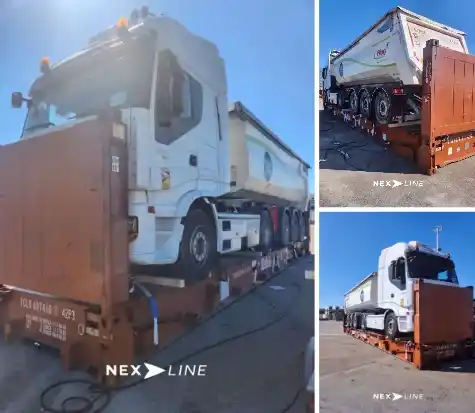
A truck finally loaded onto its Flat Rack
Once the different stages were completed, the vehicle could finally be loaded onto its Flat Rack.
The teams then received the final loading photos.
After all the exchanges, checks and adjustments, the result was clear: the truck was in place and the operation could continue.
Next destination: Mayotte.
This type of shipment reflects the variety of requests that can arise in international freight forwarding.
Some operations follow a standard process. Others require a more tailored solution and additional coordination.
International ocean freight is also a team effort
Behind every operation, there are people.
Sales teams, operations teams, terminals, customs declarants and clients all need to communicate to keep the shipment moving.
At Nexline Group, this collaboration is part of the way we work.
Our teams share their experience, check information and look for solutions together when a challenge appears.
This human dimension helps us support an operation from the initial request through to loading.
Finding the right solution for each shipment
International ocean freight is not simply about moving cargo from one port to another.
Every project comes with its own constraints.
The type of cargo, its dimensions, weight and destination can all influence the transport solution.
For this truck bound for Mayotte, the Flat Rack provided a suitable response to the vehicle’s specific characteristics.
For our teams, the objective remains the same: understand the need, coordinate the stakeholders and support the operation through to completion.
The human touch to your supply chain.
Do you have an out-of-gauge shipment?
Do you need to transport a vehicle, equipment or oversized cargo?
Contact Nexline Group to discuss your international ocean freight project and identify the most suitable solution.
The human touch to your supply chain