
Logistics in China: Nexline Group Celebrates Two Years at Its Guangzhou Office

Two years ago, Nexline Group opened the doors of its Guangzhou office. The objective was simple: strengthen our presence in China and stay closer to markets, suppliers and the realities on the ground. Two years later, this office has become a key support point for our logistics in China activities and for assisting our clients internationally. Why Nexline Group established an office in Guangzhou Guangzhou plays an important role in China’s economy and international trade. Located at the heart of one of the country’s main industrial and logistics hubs, the city provides direct access to a wide range of suppliers, manufacturers and transport operators. For Nexline Group, having a local team allows us to stay closer to day-to-day operations. This proximity makes communication with local partners easier. It also helps us better understand market constraints and respond more quickly when required. In logistics in China, this first-hand knowledge of the market is a real advantage. Teams closer to suppliers and partners Our Guangzhou office is much more than just a workplace. It provides a direct point of contact with the different stakeholders involved in our clients’ operations. Our teams can communicate with suppliers, follow projects locally and maintain regular contact with our partners. This presence also gives us a better understanding of the challenges encountered on the ground. Direct communication can sometimes help resolve an issue more quickly or identify a suitable solution before it affects the wider supply chain. Located close to the Canton Fair Nexline Group’s presence in Guangzhou also places us close to the Canton Fair. Held twice a year, this event is one of the major international trade events in China. Companies and buyers from around the world attend to meet suppliers, discover new products and develop business relationships. For companies working with China, Guangzhou is therefore much more than a major city. It is also a meeting point for industry, trade and international logistics. This proximity helps us stay connected to market developments and to the needs of companies importing from China. Proximity: an essential part of logistics in China Technology has made international communication much easier. However, it cannot always replace a local presence. In transport and logistics, some situations require direct communication with the people involved. Being based in Guangzhou allows our teams to build closer relationships with suppliers and partners. It also helps us better anticipate operational realities. This approach fully reflects the Nexline Group philosophy: combining international expertise with human proximity. Greater responsiveness for our clients Our presence in China also allows us to support our clients more responsively. When a question arises regarding a shipment, supplier or local operation, our teams have contacts directly on the ground. This structure makes it easier for information to flow between China and the teams supporting our clients in Europe. It also helps ensure better continuity between the different stages of transport. In an international supply chain, the quality of information is essential. The faster information circulates, the easier it becomes to anticipate difficulties and adapt operations. Two years in Guangzhou Two years after opening our office, we are proud of how far we have come. This presence has helped us strengthen our position in Asia and deepen our understanding of the Chinese market. But above all, behind this development is a team. Our colleagues bring the Guangzhou office to life every day, develop relationships with our partners and support our operations on the ground. We would therefore like to take this anniversary as an opportunity to thank everyone who contributes to this journey. Happy second anniversary to our Guangzhou team. And this is only the beginning. Are you developing your business with China? Do you import from China or want to better organise your international flows? Nexline Group supports you with your transport and logistics projects between China and Europe. The human touch to your supply chain
Flat Rack Containers: what are they and when should you use them?
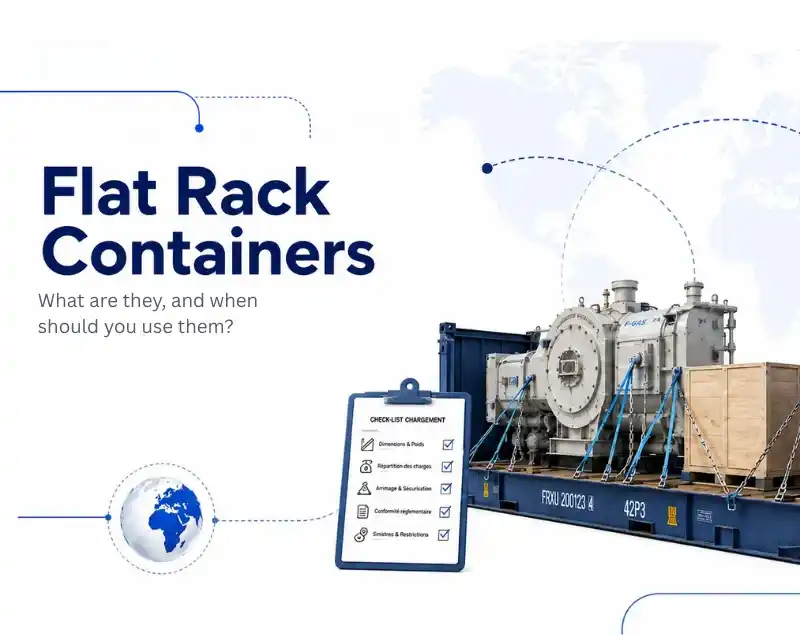
Not all goods fit into a standard sea freight container. Some cargo is too high, too wide, too heavy, or impossible to load through the standard rear doors of a dry container. In this case, sea freight may require a specific type of equipment: the Flat Rack container. What is a Flat Rack container? A Flat Rack container is a sea freight container that is open on the sides and has no roof. It mainly consists of a reinforced floor and two end walls. Depending on the model, these end walls may be fixed or collapsible. Unlike a standard dry container, a Flat Rack does not fully protect the cargo with closed side walls. However, it allows cargo to be loaded when it exceeds the usual dimensions of a standard container. It is therefore especially useful when the cargo cannot be loaded through the rear doors of a standard container, or when it exceeds the usual height, width, or sometimes length limits. In sea freight, this type of container is often used for out-of-gauge cargo. Why use a Flat Rack in sea freight? A Flat Rack answers a simple need: transporting cargo that cannot travel inside a closed standard container. It allows you to: It is a very useful type of equipment when the cargo can still be shipped as containerized freight, but its dimensions or loading method do not allow the use of a standard container. In simple terms, the Flat Rack is an intermediate solution between a standard container and conventional breakbulk transport. What cargo can be transported on a Flat Rack? A Flat Rack container is suitable for heavy, bulky, or difficult-to-load cargo. It can be used for: The objective is to make sea freight possible for goods that cannot fit inside a closed container. However, every shipment must be checked case by case. Dimensions, weight, center of gravity, lashing points, and handling method must all be reviewed before booking. Flat Rack 20 ft or 40 ft: what is the difference? In sea freight, there are mainly two common formats: A 20 ft container is roughly 6 meters long. A 40 ft container is roughly 12 meters long. However, the exact usable dimensions are not always identical from one model to another. ISO codes help identify container families. For example, the code 22P3 generally refers to a 20 ft Flat Rack with collapsible end walls. The code 45P3 generally refers to a 40 ft High Cube Flat Rack with collapsible end walls. In practice: Format Common use 20 ft Flat Rack Heavy, compact, short, or dense cargo 40 ft Flat Rack Long, bulky cargo or cargo requiring more support surface The choice does not depend only on length. It also depends on the weight, the shape of the cargo, its support points, the loading method, and the feasibility of the full transport chain. What are the dimensions of a 20 ft Flat Rack? A 20 ft Flat Rack is often used for heavy but relatively short cargo. It can be suitable for compact machinery, industrial equipment, dense parts, or cargo that is difficult to load into a standard container. As a general indication, a 20 ft Flat Rack usually has: Technical data Indicative range External length around 6 m External width around 2.44 m External height often around 2.59 m Usable length around 5.6 to 6 m depending on the model Usable width around 2.2 to 2.4 m depending on the model Indicative payload often 25 to 30 tonnes, sometimes more depending on the model These values are indicative. Usable dimensions, tare weight, and admissible payload may vary depending on the model, the fleet, and the shipping line. Before any shipment, the technical data sheet of the actual Flat Rack allocated must always be checked. How should these dimensions be understood? The external length gives the general format of the container. The usable length indicates the space actually available for placing the cargo. The usable width may differ from the external width because parts of the structure take up space. The indicative payload gives an order of magnitude, but it is not enough to validate the shipment. Weight distribution, support points, center of gravity, and handling capacity must also be checked. What are the dimensions of a 40 ft Flat Rack? A 40 ft Flat Rack offers more length. It is therefore often used for long, bulky cargo or cargo that is difficult to distribute over a smaller surface. It can be suitable for steel structures, long industrial parts, certain vehicles, construction equipment, or technical cargo. As a general indication, a 40 ft Flat Rack usually has: Technical data Indicative range External length around 12 m External width around 2.44 m External height often around 2.59 m or 2.90 m in High Cube version Usable length around 11.6 to 12 m depending on the model Usable width around 2.2 to 2.4 m depending on the model Indicative payload often around 40 tonnes, sometimes more depending on the model These values must also be confirmed before booking. A 40 ft Flat Rack may seem more practical because it is longer. However, it is not always the best choice. If the cargo is very heavy and short, a 20 ft Flat Rack may sometimes be more suitable. If the cargo is long or requires a larger support surface, a 40 ft Flat Rack may be more logical. The right choice always depends on the actual cargo. Are Flat Rack dimensions always exactly the same? No. This is an essential point. Dimensions, tare weight, and payload may vary depending on: The tables should therefore be used as reference points, not as a universal guarantee. Before any shipment, the technical data sheet of the actual Flat Rack allocated must always be checked. This is especially important if the cargo is very heavy, very wide, very high, or close to the accepted limits. Flat Rack, Open Top, or standard container: what is the difference? The right container depends on the type
International Ocean Freight: A Truck from Le Havre to Mayotte
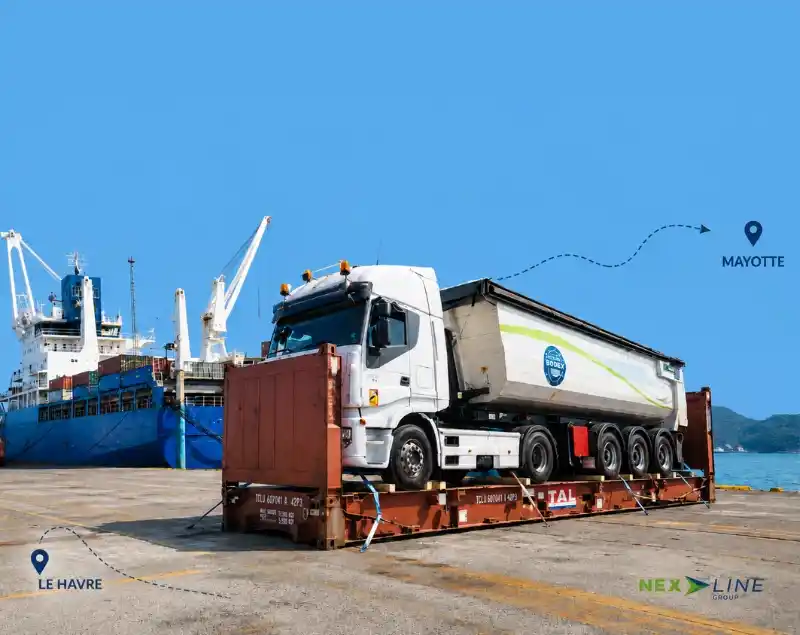
Some international ocean freight operations fall outside the usual framework. This is especially true when a vehicle or piece of cargo cannot be loaded into a standard container. Recently, Camille Lassus, Sales Executive at Nexline Group, received a specific request: organise the shipment of a truck from Le Havre to Mayotte. For this operation, the solution chosen was a Flat Rack, an equipment type adapted to oversized or out-of-gauge cargo. But before seeing the truck loaded and ready to go, several stages had to be coordinated. An international ocean freight operation outside the standard Not every transport project is the same. In this case, the dimensions of the vehicle required a different solution from a standard container. A Flat Rack makes it possible to transport cargo whose size or shape does not fit inside a closed container. This type of equipment is often used for vehicles, industrial equipment and other oversized goods. However, selecting the right equipment is only one part of the job. In an international ocean freight operation, the different stakeholders also need to be coordinated so that each stage can move forward correctly. An operation that required close coordination A special transport request quickly involves several actions. For this shipment, the teams had to contact the terminal, organise the appointment and collect the necessary documents. Some information also had to be checked with the client. At the same time, exchanges with the customs declarant were needed to keep the file moving forward. Each element had to be collected and confirmed at the right time. This meant checking, following up and adjusting the organisation when necessary. Following the file through to loading To keep the operation moving, Kalthoum Ferri and her team followed the file closely. The objective was simple: maintain a clear view of the progress and keep communication flowing between the different stakeholders. When information was missing, it had to be collected. When a point needed confirmation, the team contacted the relevant person again. This follow-up is an essential part of a freight forwarder’s role. In international ocean freight, the quality of an operation depends as much on the chosen solution as on the coordination between the people involved. A truck finally loaded onto its Flat Rack Once the different stages were completed, the vehicle could finally be loaded onto its Flat Rack. The teams then received the final loading photos. After all the exchanges, checks and adjustments, the result was clear: the truck was in place and the operation could continue. Next destination: Mayotte. This type of shipment reflects the variety of requests that can arise in international freight forwarding. Some operations follow a standard process. Others require a more tailored solution and additional coordination. International ocean freight is also a team effort Behind every operation, there are people. Sales teams, operations teams, terminals, customs declarants and clients all need to communicate to keep the shipment moving. At Nexline Group, this collaboration is part of the way we work. Our teams share their experience, check information and look for solutions together when a challenge appears. This human dimension helps us support an operation from the initial request through to loading. Finding the right solution for each shipment International ocean freight is not simply about moving cargo from one port to another. Every project comes with its own constraints. The type of cargo, its dimensions, weight and destination can all influence the transport solution. For this truck bound for Mayotte, the Flat Rack provided a suitable response to the vehicle’s specific characteristics. For our teams, the objective remains the same: understand the need, coordinate the stakeholders and support the operation through to completion. The human touch to your supply chain. Do you have an out-of-gauge shipment? Do you need to transport a vehicle, equipment or oversized cargo? Contact Nexline Group to discuss your international ocean freight project and identify the most suitable solution. The human touch to your supply chain
Continuous Improvement in Supply Chain: 7 Japanese Principles to Apply
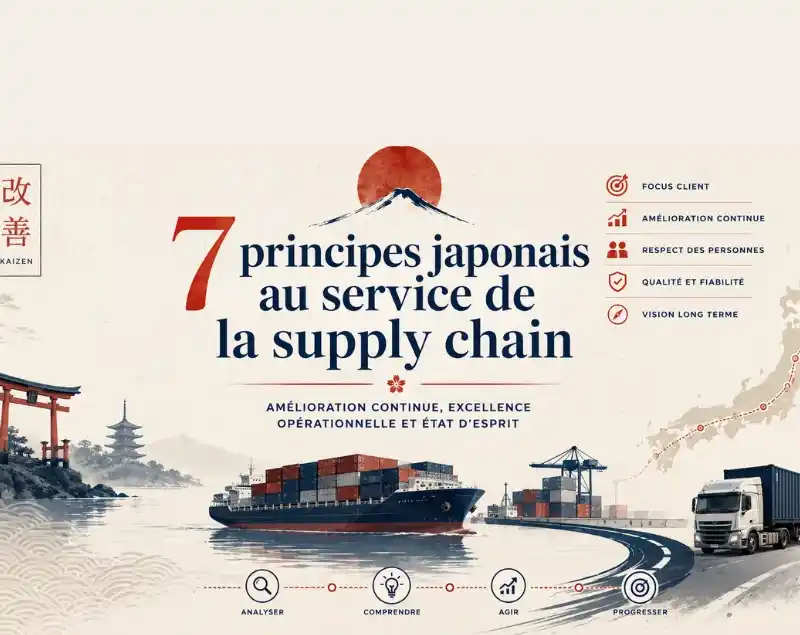
What if the best logistics performance did not start with a new tool, but with a mindset? Technology speeds up operations. Data improves decision-making. Automation reduces repetitive tasks. However, no tool can replace a genuine culture of continuous improvement in Supply Chain. For decades, Japanese companies have developed principles that go far beyond the industrial world. Today, some of these ideas are particularly relevant to logistics and transport. At Nexline Group, 7 Japanese principles inspire us in particular. Why is continuous improvement essential in Supply Chain? A Supply Chain operates in a complex environment. Volumes change. Lead times vary. Customer needs evolve. In addition, external events can disrupt operations at any time. In this context, trying to create a perfectly stable system is rarely realistic. The objective is instead to identify areas for improvement and make processes more efficient over time. This is exactly what continuous improvement in Supply Chain is about. The following 7 Japanese principles offer different ways to approach this mindset. The human touch to your supply chain 1. Wabi-Sabi: accept that a process will never be perfect Wabi-Sabi is based on the acceptance of imperfection. Applied to logistics, this principle encourages us not to wait for the perfect solution before taking action. A process can already work well and still have room for improvement. It can be simplified, accelerated or better coordinated. The key is to improve what already exists. This approach also prevents organisations from becoming stuck while searching endlessly for a perfect solution that may not exist. 2. Shoshin: keep a beginner’s mindset Shoshin literally means “beginner’s mind”. With experience, certain habits become automatic. Yet they are not always the most efficient. Keeping a fresh perspective means continuing to ask simple questions. Why do we work this way? Is this step still useful? Could we do it differently? In Supply Chain, questioning established habits can reveal new opportunities for improvement. It also encourages teams to listen to the people who work closest to day-to-day operations. 3. Shokunin: pursue excellence in every action Shokunin represents dedication to one’s craft and the constant pursuit of quality. In Supply Chain, strong performance often depends on many small tasks being carried out correctly. Order preparation, data analysis, transport documentation or delivery planning all deserve the same level of attention. Every detail can affect the next stage of the process. Maintaining this level of discipline therefore contributes directly to the reliability of the entire operation. 4. Kaizen: improve through small, continuous changes Kaizen is probably one of the best-known Japanese principles in the business world. Its idea is simple: major transformation can begin with small, regular improvements. One minute saved on an operation. A few kilometres reduced on a delivery route. One mistake avoided thanks to a better process. Taken individually, these improvements may seem minor. However, when repeated across several stages, they can transform an organisation over time. This is one of the foundations of continuous improvement in Supply Chain. 5. Kintsugi: turn difficulties into learning opportunities Kintsugi is the Japanese art of repairing broken pottery while highlighting its cracks. In logistics, this philosophy can be interpreted in another way. An incident should not only be corrected. It should also become an opportunity to learn. A delay, a supply shortage or an operational error can reveal a weakness in a process. The goal is then to understand what happened and adapt the organisation. In this way, today’s problem can help create a stronger Supply Chain tomorrow. 6. Ikigai: give meaning to logistics performance Ikigai is often associated with the idea of purpose or reason for being. This principle reminds us that performance is not only about numbers. A Supply Chain is not simply about moving goods from point A to point B. It enables companies to manufacture, sell and meet their commitments. It also creates value for customers, suppliers, partners and employees. Understanding this broader purpose gives more meaning to the improvements made every day. 7. Shikata ga Nai: accept what cannot be controlled Not every event can be anticipated or avoided. A storm can delay a vessel. A geopolitical situation can change a shipping route. A supply shortage can disrupt a schedule. Shikata ga Nai encourages us to accept this reality. That does not mean remaining passive. Instead, the objective is to focus energy on what can actually be controlled. In Supply Chain, the difference often lies in the speed and quality of the response. Continuous improvement starts with people Software, data and automation are now essential to logistics performance. However, these tools only reach their full potential when supported by the right culture. Continuous improvement in Supply Chain depends first and foremost on the ability of teams to observe, question, learn and adapt. It does not necessarily mean transforming everything. Often, the most sustainable progress starts with small decisions made every day. At Nexline Group, we share this vision: keep improving, learn from challenges and stay close to operational realities. Because beyond flows, systems and KPIs, a Supply Chain remains above all a human journey. The human touch to your supply chain. Which principle inspires you the most? Wabi-Sabi, Shoshin, Shokunin, Kaizen, Kintsugi, Ikigai or Shikata ga Nai? These 7 Japanese principles offer different ways to think about performance and continuous improvement. And sometimes, changing the way we work simply starts by changing the way we look at a problem.
Ocean freight: congestion in Chinese ports is intensifying
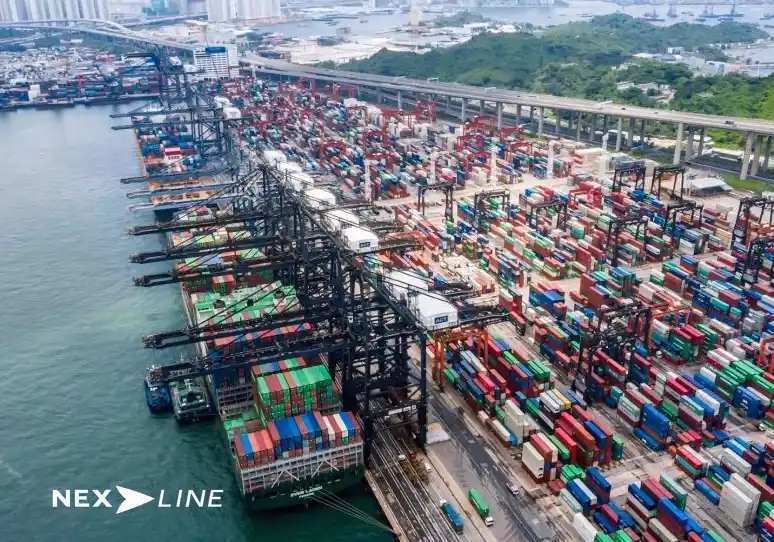
In August 2026, ocean freight in China is facing a period of significant disruption. Several of the country’s major ports are dealing with a combination of issues that are slowing down shipments. Shanghai, Ningbo-Zhoushan, Qingdao, Yantian, Shekou and Nansha are among the ports affected. The causes include ongoing tensions in the Red Sea, vessel rerouting, successive typhoons, rising freight rates and cargo volumes exceeding available capacity. By mid-August, congestion remained particularly severe in eastern China. At Shanghai Yangshan, some vessels were facing waiting times of up to 12 days before berthing. At Waigaoqiao, reported delays reached around 7 to 8 days, compared with 3 to 5 days at Ningbo. As a result, some containers are entering terminals but are unable to secure space on the vessel originally planned. A situation worsened by disruptions in August 2026 The current difficulties are not linked to a single event. In early August, Typhoon Dolphin led to restrictions and temporary suspensions at several terminals in Shanghai and Ningbo. Operations gradually resumed from August 10 and 11. However, reopening does not mean an immediate return to normal. Vessels, trucks and containers accumulated during the interruptions still need to be processed. This continues to put pressure on ocean freight schedules. Up to 12 days of waiting time in Shanghai By mid-August 2026, some vessels were waiting up to 12 days to berth at Shanghai Yangshan. Shipping lines may also cancel or reorganise some port calls. Transshipment solutions through other ports can then be introduced. These changes directly affect ocean freight schedules. A delay at origin can quickly impact the expected arrival date and, ultimately, the final delivery. The human touch to your supply chain Restrictions in southern Chinese ports In southern China, some terminals are also restricting the early entry of containers. At Shekou, acceptance capacity can be limited when terminals reach specific thresholds. The objective is to prevent further terminal congestion. However, this situation makes shipment planning more complex. Cargo may need to wait before entering the port. Road transport then has to be rescheduled and logistics plans adjusted. When containers enter the terminal but cannot leave The current situation creates a significant risk for shippers. Cargo may enter the terminal but fail to be loaded onto the vessel originally scheduled. In ocean freight, this type of delay can quickly lead to several consequences. Containers may remain at the terminal for longer periods. Trucks can also be immobilised. Storage, parking or secondary transport costs may then arise. On top of this, delays can also affect delivery at destination. For companies, the impact can therefore go far beyond the initial maritime delay. How can the impact on ocean freight be reduced? In the current environment, anticipation is essential. For urgent shipments, it is important to consider alternative solutions in advance. Consignees should also be informed as early as possible about potential delays. This allows logistics teams to adjust stock levels, schedules and deliveries more effectively. Finally, regular monitoring of the port situation remains essential. Availability and shipping schedules can change quickly. Nexline Group monitors the situation daily At Nexline Group, our teams monitor developments across Chinese ports every day. Our objective is to identify available routes, adjust schedules and limit additional costs for our clients. When a disruption occurs, we assess the available solutions and adapt the transport plan accordingly. In such a challenging environment, anticipation remains the best way to stay in control of your flows. The human touch to your supply chain. Need to anticipate your upcoming shipments? Do you have cargo departing from China or need to adapt your logistics solutions?