
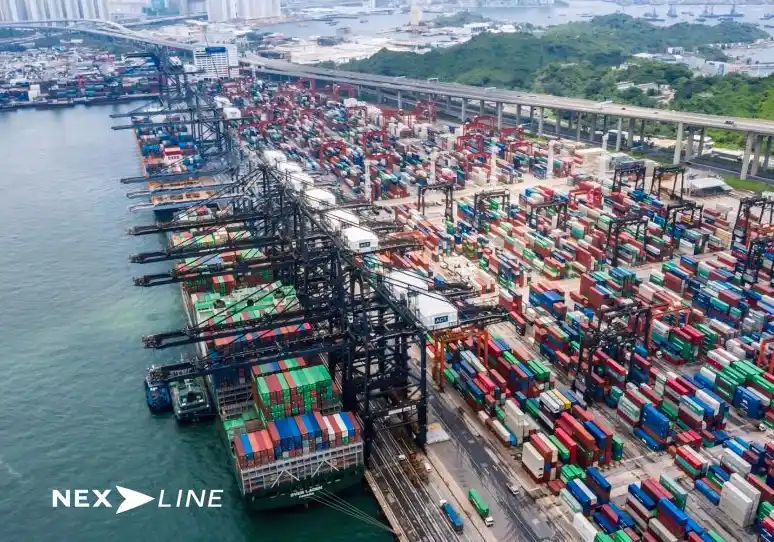
In August 2026, ocean freight in China is facing a period of significant disruption. Several of the country’s major ports are dealing with a combination of issues that are slowing down shipments.
Shanghai, Ningbo-Zhoushan, Qingdao, Yantian, Shekou and Nansha are among the ports affected.
The causes include ongoing tensions in the Red Sea, vessel rerouting, successive typhoons, rising freight rates and cargo volumes exceeding available capacity.
By mid-August, congestion remained particularly severe in eastern China. At Shanghai Yangshan, some vessels were facing waiting times of up to 12 days before berthing. At Waigaoqiao, reported delays reached around 7 to 8 days, compared with 3 to 5 days at Ningbo.
As a result, some containers are entering terminals but are unable to secure space on the vessel originally planned.
A situation worsened by disruptions in August 2026
The current difficulties are not linked to a single event.
In early August, Typhoon Dolphin led to restrictions and temporary suspensions at several terminals in Shanghai and Ningbo. Operations gradually resumed from August 10 and 11.
However, reopening does not mean an immediate return to normal.
Vessels, trucks and containers accumulated during the interruptions still need to be processed. This continues to put pressure on ocean freight schedules.
Up to 12 days of waiting time in Shanghai
By mid-August 2026, some vessels were waiting up to 12 days to berth at Shanghai Yangshan.
Shipping lines may also cancel or reorganise some port calls. Transshipment solutions through other ports can then be introduced.
These changes directly affect ocean freight schedules.
A delay at origin can quickly impact the expected arrival date and, ultimately, the final delivery.
The human touch to your supply chain
Restrictions in southern Chinese ports
In southern China, some terminals are also restricting the early entry of containers.
At Shekou, acceptance capacity can be limited when terminals reach specific thresholds.
The objective is to prevent further terminal congestion.
However, this situation makes shipment planning more complex.
Cargo may need to wait before entering the port. Road transport then has to be rescheduled and logistics plans adjusted.
When containers enter the terminal but cannot leave
The current situation creates a significant risk for shippers.
Cargo may enter the terminal but fail to be loaded onto the vessel originally scheduled.
In ocean freight, this type of delay can quickly lead to several consequences.
Containers may remain at the terminal for longer periods. Trucks can also be immobilised.
Storage, parking or secondary transport costs may then arise.
On top of this, delays can also affect delivery at destination.
For companies, the impact can therefore go far beyond the initial maritime delay.
How can the impact on ocean freight be reduced?
In the current environment, anticipation is essential.
For urgent shipments, it is important to consider alternative solutions in advance.
Consignees should also be informed as early as possible about potential delays.
This allows logistics teams to adjust stock levels, schedules and deliveries more effectively.
Finally, regular monitoring of the port situation remains essential.
Availability and shipping schedules can change quickly.
Nexline Group monitors the situation daily
At Nexline Group, our teams monitor developments across Chinese ports every day.
Our objective is to identify available routes, adjust schedules and limit additional costs for our clients.
When a disruption occurs, we assess the available solutions and adapt the transport plan accordingly.
In such a challenging environment, anticipation remains the best way to stay in control of your flows.
The human touch to your supply chain.
Need to anticipate your upcoming shipments?
Do you have cargo departing from China or need to adapt your logistics solutions?