
What if the best logistics performance did not start with a new tool, but with a mindset?
Technology speeds up operations. Data improves decision-making. Automation reduces repetitive tasks.
However, no tool can replace a genuine culture of continuous improvement in Supply Chain.
For decades, Japanese companies have developed principles that go far beyond the industrial world. Today, some of these ideas are particularly relevant to logistics and transport.
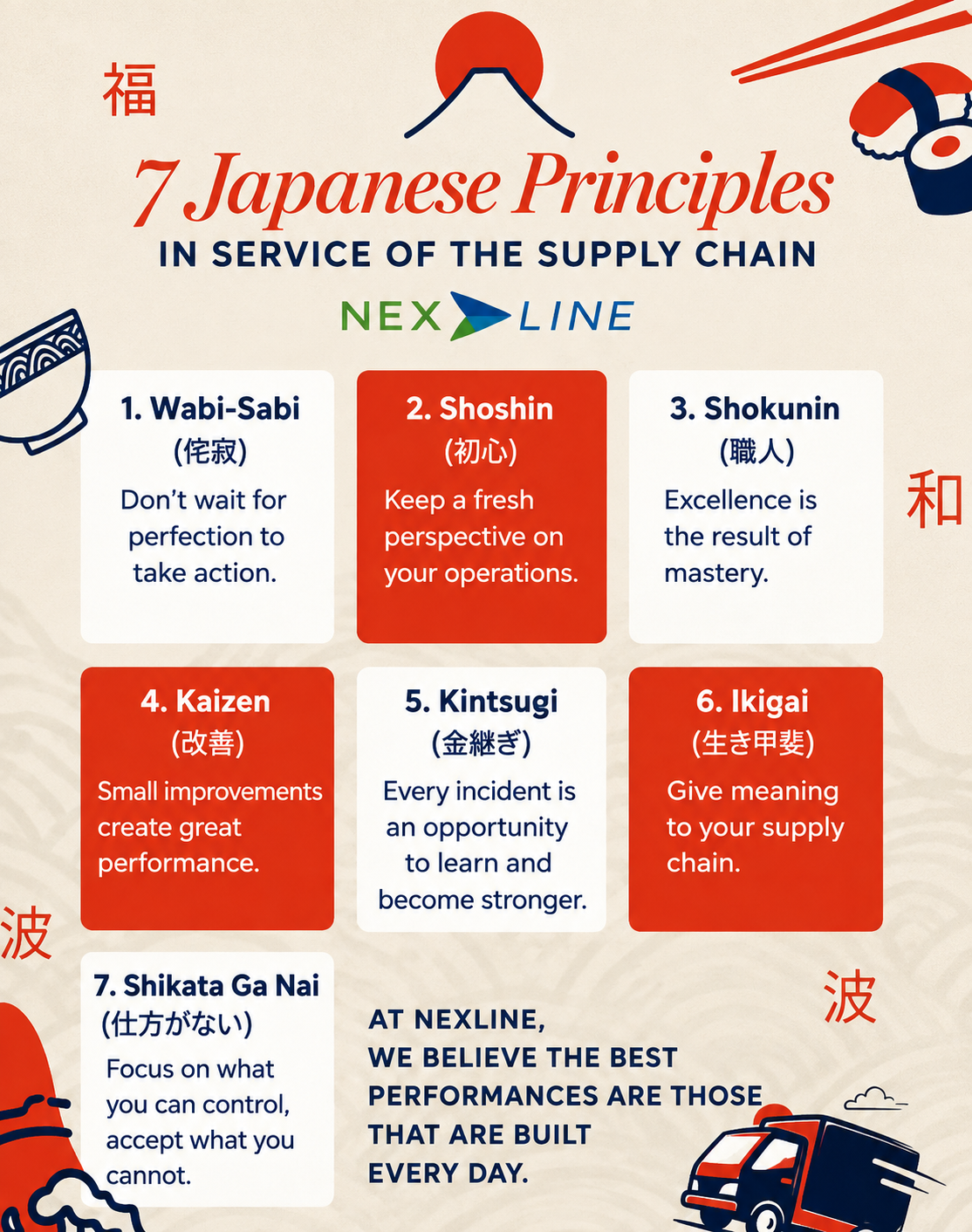
At Nexline Group, 7 Japanese principles inspire us in particular.
Why is continuous improvement essential in Supply Chain?
A Supply Chain operates in a complex environment.
Volumes change. Lead times vary. Customer needs evolve. In addition, external events can disrupt operations at any time.
In this context, trying to create a perfectly stable system is rarely realistic.
The objective is instead to identify areas for improvement and make processes more efficient over time.
This is exactly what continuous improvement in Supply Chain is about.
The following 7 Japanese principles offer different ways to approach this mindset.
The human touch to your supply chain
1. Wabi-Sabi: accept that a process will never be perfect
Wabi-Sabi is based on the acceptance of imperfection.
Applied to logistics, this principle encourages us not to wait for the perfect solution before taking action.
A process can already work well and still have room for improvement.
It can be simplified, accelerated or better coordinated.
The key is to improve what already exists.
This approach also prevents organisations from becoming stuck while searching endlessly for a perfect solution that may not exist.
2. Shoshin: keep a beginner’s mindset
Shoshin literally means “beginner’s mind”.
With experience, certain habits become automatic. Yet they are not always the most efficient.
Keeping a fresh perspective means continuing to ask simple questions.
Why do we work this way?
Is this step still useful?
Could we do it differently?
In Supply Chain, questioning established habits can reveal new opportunities for improvement.
It also encourages teams to listen to the people who work closest to day-to-day operations.
3. Shokunin: pursue excellence in every action
Shokunin represents dedication to one’s craft and the constant pursuit of quality.
In Supply Chain, strong performance often depends on many small tasks being carried out correctly.
Order preparation, data analysis, transport documentation or delivery planning all deserve the same level of attention.
Every detail can affect the next stage of the process.
Maintaining this level of discipline therefore contributes directly to the reliability of the entire operation.
4. Kaizen: improve through small, continuous changes
Kaizen is probably one of the best-known Japanese principles in the business world.
Its idea is simple: major transformation can begin with small, regular improvements.
One minute saved on an operation.
A few kilometres reduced on a delivery route.
One mistake avoided thanks to a better process.
Taken individually, these improvements may seem minor.
However, when repeated across several stages, they can transform an organisation over time.
This is one of the foundations of continuous improvement in Supply Chain.
5. Kintsugi: turn difficulties into learning opportunities
Kintsugi is the Japanese art of repairing broken pottery while highlighting its cracks.
In logistics, this philosophy can be interpreted in another way.
An incident should not only be corrected.
It should also become an opportunity to learn.
A delay, a supply shortage or an operational error can reveal a weakness in a process.
The goal is then to understand what happened and adapt the organisation.
In this way, today’s problem can help create a stronger Supply Chain tomorrow.
6. Ikigai: give meaning to logistics performance
Ikigai is often associated with the idea of purpose or reason for being.
This principle reminds us that performance is not only about numbers.
A Supply Chain is not simply about moving goods from point A to point B.
It enables companies to manufacture, sell and meet their commitments.
It also creates value for customers, suppliers, partners and employees.
Understanding this broader purpose gives more meaning to the improvements made every day.
7. Shikata ga Nai: accept what cannot be controlled
Not every event can be anticipated or avoided.
A storm can delay a vessel. A geopolitical situation can change a shipping route. A supply shortage can disrupt a schedule.
Shikata ga Nai encourages us to accept this reality.
That does not mean remaining passive.
Instead, the objective is to focus energy on what can actually be controlled.
In Supply Chain, the difference often lies in the speed and quality of the response.
Continuous improvement starts with people
Software, data and automation are now essential to logistics performance.
However, these tools only reach their full potential when supported by the right culture.
Continuous improvement in Supply Chain depends first and foremost on the ability of teams to observe, question, learn and adapt.
It does not necessarily mean transforming everything.
Often, the most sustainable progress starts with small decisions made every day.
At Nexline Group, we share this vision: keep improving, learn from challenges and stay close to operational realities.
Because beyond flows, systems and KPIs, a Supply Chain remains above all a human journey.
The human touch to your supply chain.
Which principle inspires you the most?
Wabi-Sabi, Shoshin, Shokunin, Kaizen, Kintsugi, Ikigai or Shikata ga Nai?
These 7 Japanese principles offer different ways to think about performance and continuous improvement.
And sometimes, changing the way we work simply starts by changing the way we look at a problem.