Not all goods fit into a standard sea freight container.
Some cargo is too high, too wide, too heavy, or impossible to load through the standard rear doors of a dry container.
In this case, sea freight may require a specific type of equipment: the Flat Rack container.
What is a Flat Rack container?
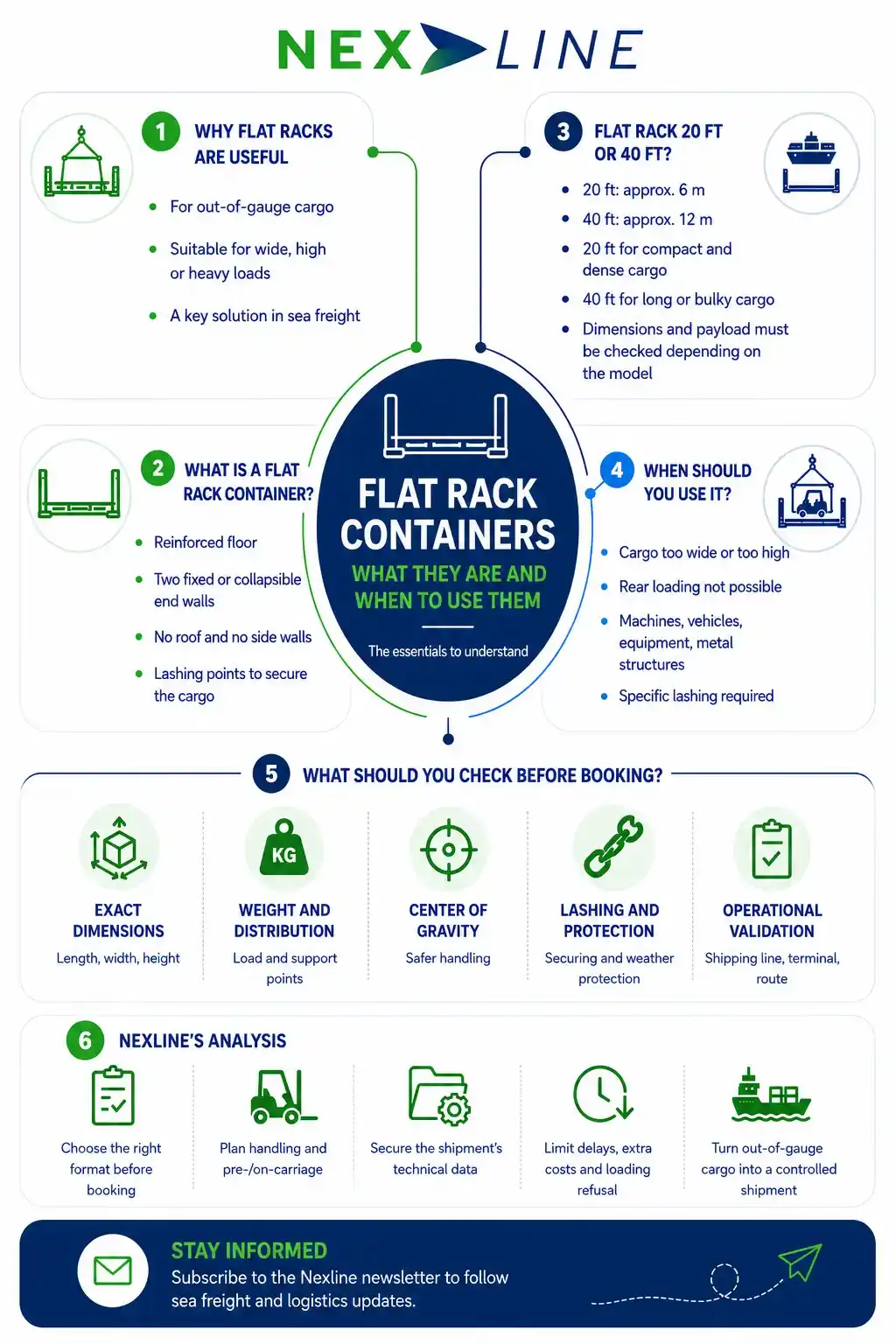
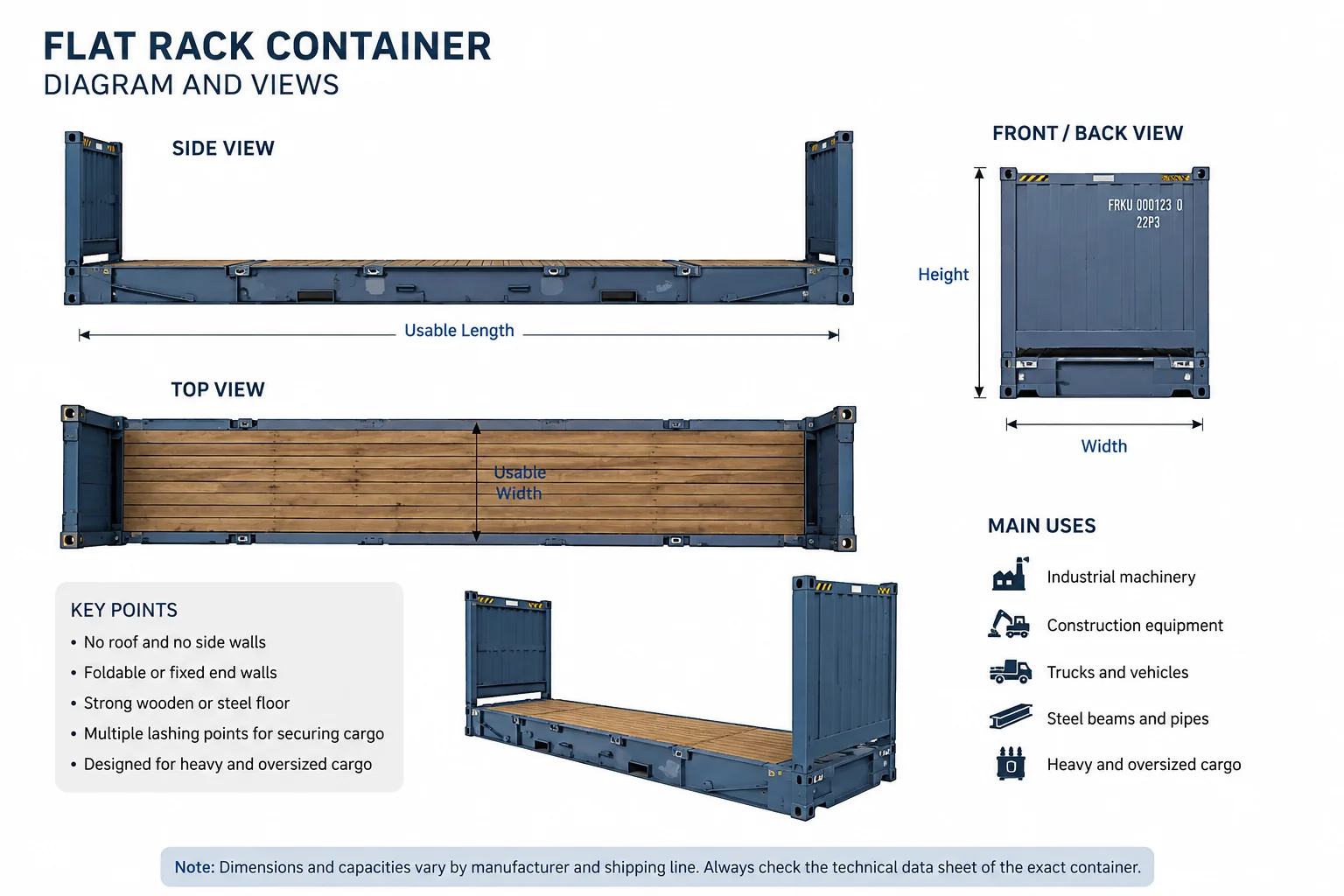
A Flat Rack container is a sea freight container that is open on the sides and has no roof.
It mainly consists of a reinforced floor and two end walls. Depending on the model, these end walls may be fixed or collapsible.
Unlike a standard dry container, a Flat Rack does not fully protect the cargo with closed side walls.
However, it allows cargo to be loaded when it exceeds the usual dimensions of a standard container.
It is therefore especially useful when the cargo cannot be loaded through the rear doors of a standard container, or when it exceeds the usual height, width, or sometimes length limits.
In sea freight, this type of container is often used for out-of-gauge cargo.
Why use a Flat Rack in sea freight?
A Flat Rack answers a simple need: transporting cargo that cannot travel inside a closed standard container.
It allows you to:
- load cargo from the top or from the sides;
- transport wide or high cargo;
- secure heavy loads on a reinforced floor;
- fasten cargo using suitable lashing points;
- move out-of-gauge cargo within a containerized shipping solution.
It is a very useful type of equipment when the cargo can still be shipped as containerized freight, but its dimensions or loading method do not allow the use of a standard container.
In simple terms, the Flat Rack is an intermediate solution between a standard container and conventional breakbulk transport.
What cargo can be transported on a Flat Rack?
A Flat Rack container is suitable for heavy, bulky, or difficult-to-load cargo.
It can be used for:
- industrial machinery;
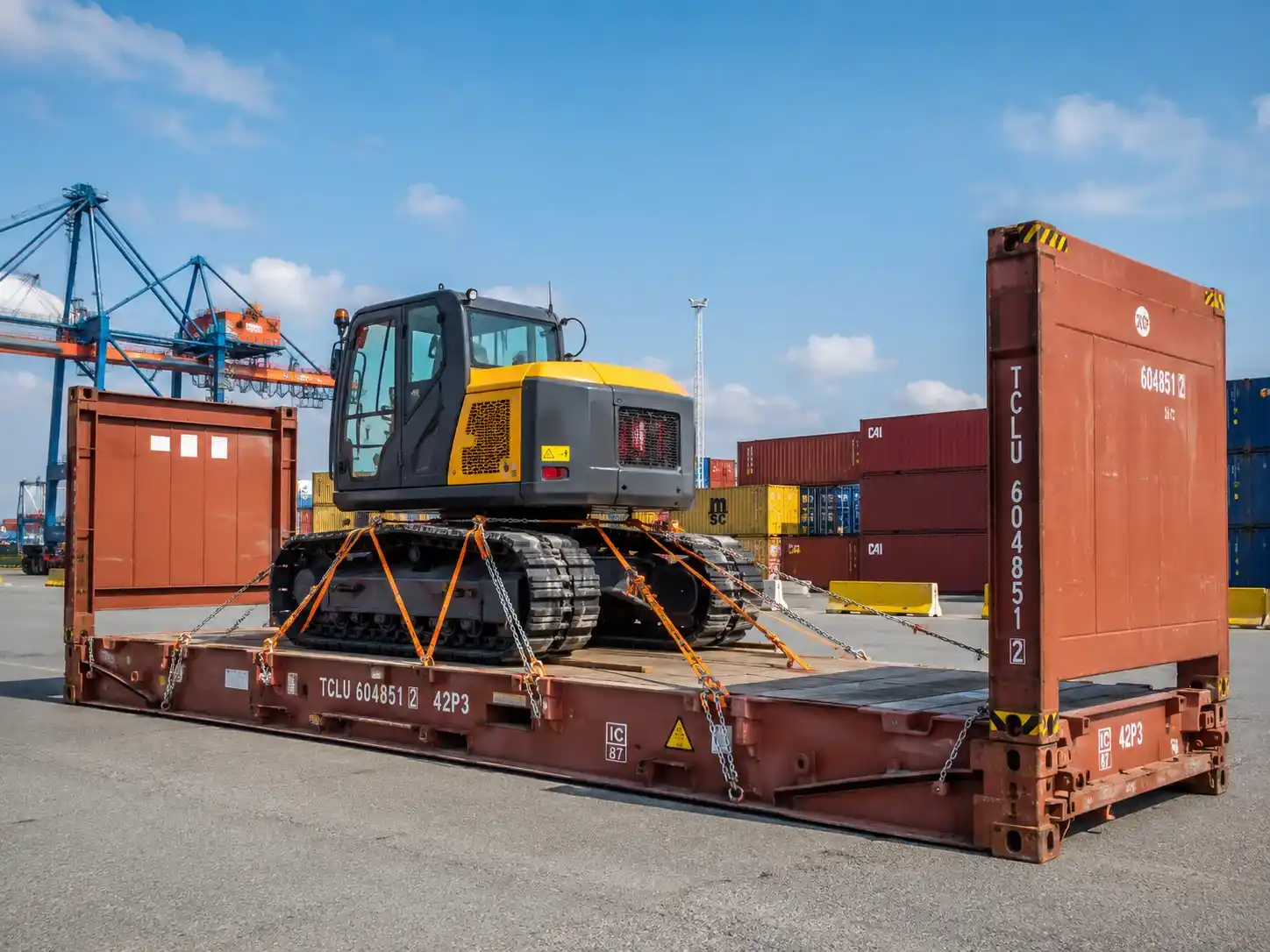
- construction equipment;
- special vehicles;
- trucks;
- boats;
- long steel parts;
- transformers;
- coils;
- agricultural equipment;
- prefabricated structures;
- cargo exceeding standard height or width.
The objective is to make sea freight possible for goods that cannot fit inside a closed container.
However, every shipment must be checked case by case.
Dimensions, weight, center of gravity, lashing points, and handling method must all be reviewed before booking.
Flat Rack 20 ft or 40 ft: what is the difference?
In sea freight, there are mainly two common formats:
- the 20 ft Flat Rack;
- the 40 ft Flat Rack.
A 20 ft container is roughly 6 meters long.
A 40 ft container is roughly 12 meters long.
However, the exact usable dimensions are not always identical from one model to another.
ISO codes help identify container families. For example, the code 22P3 generally refers to a 20 ft Flat Rack with collapsible end walls. The code 45P3 generally refers to a 40 ft High Cube Flat Rack with collapsible end walls.
In practice:
| Format | Common use |
|---|---|
| 20 ft Flat Rack | Heavy, compact, short, or dense cargo |
| 40 ft Flat Rack | Long, bulky cargo or cargo requiring more support surface |
The choice does not depend only on length.
It also depends on the weight, the shape of the cargo, its support points, the loading method, and the feasibility of the full transport chain.
What are the dimensions of a 20 ft Flat Rack?
A 20 ft Flat Rack is often used for heavy but relatively short cargo.
It can be suitable for compact machinery, industrial equipment, dense parts, or cargo that is difficult to load into a standard container.
As a general indication, a 20 ft Flat Rack usually has:
| Technical data | Indicative range |
|---|---|
| External length | around 6 m |
| External width | around 2.44 m |
| External height | often around 2.59 m |
| Usable length | around 5.6 to 6 m depending on the model |
| Usable width | around 2.2 to 2.4 m depending on the model |
| Indicative payload | often 25 to 30 tonnes, sometimes more depending on the model |
These values are indicative.
Usable dimensions, tare weight, and admissible payload may vary depending on the model, the fleet, and the shipping line.
Before any shipment, the technical data sheet of the actual Flat Rack allocated must always be checked.
How should these dimensions be understood?
The external length gives the general format of the container.
The usable length indicates the space actually available for placing the cargo.
The usable width may differ from the external width because parts of the structure take up space.
The indicative payload gives an order of magnitude, but it is not enough to validate the shipment.
Weight distribution, support points, center of gravity, and handling capacity must also be checked.
What are the dimensions of a 40 ft Flat Rack?
A 40 ft Flat Rack offers more length.
It is therefore often used for long, bulky cargo or cargo that is difficult to distribute over a smaller surface.
It can be suitable for steel structures, long industrial parts, certain vehicles, construction equipment, or technical cargo.
As a general indication, a 40 ft Flat Rack usually has:
| Technical data | Indicative range |
|---|---|
| External length | around 12 m |
| External width | around 2.44 m |
| External height | often around 2.59 m or 2.90 m in High Cube version |
| Usable length | around 11.6 to 12 m depending on the model |
| Usable width | around 2.2 to 2.4 m depending on the model |
| Indicative payload | often around 40 tonnes, sometimes more depending on the model |
These values must also be confirmed before booking.
A 40 ft Flat Rack may seem more practical because it is longer. However, it is not always the best choice.
If the cargo is very heavy and short, a 20 ft Flat Rack may sometimes be more suitable.
If the cargo is long or requires a larger support surface, a 40 ft Flat Rack may be more logical.
The right choice always depends on the actual cargo.
Are Flat Rack dimensions always exactly the same?
No.
This is an essential point.
Dimensions, tare weight, and payload may vary depending on:
- the manufacturer;
- the fleet owner;
- the shipping line;
- the exact model;
- the type of end walls;
- the year of manufacture;
- operational constraints.
The tables should therefore be used as reference points, not as a universal guarantee.
Before any shipment, the technical data sheet of the actual Flat Rack allocated must always be checked.
This is especially important if the cargo is very heavy, very wide, very high, or close to the accepted limits.
Flat Rack, Open Top, or standard container: what is the difference?
The right container depends on the type of cargo and the loading method.
| Container type | What it is used for | When to use it |
|---|---|---|
| Standard dry container | Standard, protected, palletized cargo | When the cargo fits through the doors and respects internal dimensions |
| Open Top container | Container without a rigid roof, allowing loading from above | When the cargo mainly exceeds in height but remains within the width |
| Flat Rack container | Container without side walls and without a roof | When the cargo is wide, heavy, bulky, or difficult to load |
| Platform container | Platform without vertical end walls | For very specific cargo, subject to technical validation |
A Flat Rack is therefore more open than an Open Top container.
It offers more flexibility for loading, but it also requires more preparation: lashing, protection, handling, dimension validation, and weight control.
What information should be provided for a Flat Rack shipment?
To study a Flat Rack shipment, precise information must be provided.
It is not enough to write:
- “industrial machinery”;
- “vehicle”;
- “construction equipment”;
- “heavy cargo”.
You should provide:
- exact length;
- exact width;
- exact height;
- total weight;
- photos of the cargo;
- technical drawing if available;
- number of support points;
- position of the support points;
- center of gravity if known;
- lifting points;
- lashing points;
- protection requirements;
- planned loading method.
This information helps choose the right format, check feasibility, and avoid mistakes at the booking stage.

Why does a Flat Rack require more anticipation?
A Flat Rack offers more flexibility, but it also requires more coordination.
The cargo may exceed the container. It may require specific lifting equipment. It may also take up more space on board the vessel.
As a result, the shipping line must validate feasibility before shipment.
The terminal must also be able to handle the cargo.
Road transport before or after the sea freight leg must be compatible with the cargo dimensions.
Finally, the documents must match the physical reality of the cargo.
Any discrepancy in weight, dimensions, or description can create a blockage at booking, collection, terminal entry, or loading on board.
Nexline’s analysis
The Flat Rack is a very useful solution in sea freight, but it should not be chosen only because cargo does not fit inside a standard container.
The full shipment must be analyzed: dimensions, weight, handling, lashing, sea route, pre-carriage, on-carriage, and terminal constraints.
At Nexline, the objective is to help companies choose the right equipment before the cargo becomes an operational problem.
A well-prepared Flat Rack shipment helps secure the transport of complex cargo.
On the other hand, a poorly anticipated shipment can generate delays, additional costs, or a refusal to load.
The challenge is simple: turning non-standard cargo into a controlled sea freight shipment.
The human touch to your supply chain
FAQ
What is a Flat Rack container?
A Flat Rack container is a sea freight container that is open on the sides and has no roof. It is designed to transport heavy, bulky, or out-of-gauge cargo.
What is a Flat Rack used for in sea freight?
A Flat Rack is used to transport cargo that cannot fit inside a standard container, or cargo that needs to be loaded from the top or from the sides.
How many tonnes can a Flat Rack carry?
As a general indication, a 20 ft Flat Rack can often carry 25 to 30 tonnes, sometimes more depending on the model. A 40 ft Flat Rack can often carry around 40 tonnes, sometimes more depending on the model. In all cases, load distribution must be validated.
What is the difference between a Flat Rack and an Open Top container?
An Open Top container is open at the top but keeps its side walls. A Flat Rack is open on the sides and has no roof. It is therefore better suited to very wide or difficult-to-load cargo.
Can a vehicle be transported on a Flat Rack?
Yes, some vehicles can be transported on a Flat Rack, especially when they are too bulky or too specific for a standard container. However, the shipment must be validated according to dimensions, weight, and lashing requirements.
Does a Flat Rack protect the cargo?
No, not like a closed container. The cargo is more exposed to weather conditions. Suitable protection must therefore be planned when necessary.
Is Flat Rack transport more expensive?
Often, yes. The cost may be higher because of handling, space used, lashing, out-of-gauge constraints, and the validations required.
In summary