
Demurrage vs Detention: What Is the Difference and How Can You Avoid Container Charges?
You are importing goods by sea. The vessel arrives at the port. The container is discharged. You might think that the most important part of the transportation process is over. Yet, a few days later, your company may receive an additional invoice. Why? Because a container is not simply a box used to transport your goods. It is also equipment provided by a shipping line that needs to be collected, moved, unloaded and returned to circulation. When a container remains in use beyond the agreed period, additional charges may apply. This is where two terms regularly appear in ocean freight: demurrage and detention. They are often confused. Yet, they do not refer to exactly the same situation. The most common distinction is: Demurrage: the container remains beyond the free time at the terminal. Detention: the container remains beyond the free time outside the terminal, before it is returned. But this definition alone is not enough to understand an invoice. You also need to know what free time means, when the clock starts, when it stops, and why the rules can vary depending on the country, port or contract. What happens when a container arrives at the port? Let’s take a simple example. A French company orders goods from a supplier in Asia. The goods are loaded into a container. The container is then transported to the port of departure, loaded onto a vessel and shipped to France. After several weeks at sea, the vessel arrives at the destination port. But the container’s journey is not over. Why does the shipping line charge these fees? A container needs to be available for reuse. When it remains idle for too long, the shipping line cannot use it for another shipment. Demurrage and detention mechanisms are therefore designed, among other things, to encourage the efficient movement of cargo and the return of equipment within the agreed timeframes. To understand how they work, we first need to look at one simple concept. What is free time? Free time is the period during which the applicable tariff conditions allow the customer to keep or use the container without paying the corresponding demurrage and/or detention charges. Let’s imagine, purely to illustrate the principle, that your contract provides 5 days of free time. Your container arrives at the terminal on a Monday. You then have a defined period, according to the applicable tariff, to complete the required operations. If you stay within this timeframe, the relevant charges do not apply. If you exceed it, charges may start to apply. Once the applicable deadline is exceeded → charges may apply Important: the 5 days used in this example are not a general rule. Actual free time depends on the shipping line, country, port, container type and contractual terms. So, what is the difference between demurrage and detention? Now that the principle of free time is clear, the distinction becomes much easier to understand. In the standard model: What is demurrage? Demurrage generally refers to charges related to keeping a container at the terminal beyond the applicable free time. For an import shipment, the situation can be very straightforward. The container arrives. It is discharged from the vessel. It remains at the terminal. The company then needs to arrange its release. Several operations may be required: If these operations take too long and the container exceeds the applicable deadline, additional charges may arise. A practical example A company imports a container from China. The vessel arrives as scheduled. However, the customs declaration requires an additional document. The goods cannot be released. The truck therefore cannot collect the container. The container remains at the terminal. The customs delay may then result in demurrage or storage charges, depending on the applicable charging mechanism. The vessel itself is therefore not necessarily responsible for the additional cost. The problem may arise after the vessel has arrived. What is detention? Detention generally applies when the container is outside the terminal and is not returned within the agreed timeframe. The situation is different. The container leaves the port. It is delivered to the customer. The goods need to be unloaded. The empty container must then be returned to the location specified by the carrier. If the empty container is returned too late, detention charges may apply. A practical example The container is collected from the terminal on Monday. Delivery takes place on Tuesday. The warehouse was supposed to unload the container that day. However, no unloading slot is available. The unloading is postponed. The loaded container remains at the warehouse for several days. Then, once empty, its return to the designated depot is not arranged immediately. The additional time spent outside the terminal may then generate detention charges. Can the same container generate both demurrage and detention? Yes, depending on the applicable terms. Let’s take a practical example. One container, two different problems Why can demurrage and detention charges increase so quickly? Once free time has expired, charges may be applied on a daily basis and can increase depending on the length of the delay. The amount may depend on: There is therefore no single worldwide price for demurrage or detention. Even a company that regularly imports by sea cannot automatically apply the same rate to every shipment. The applicable tariff must always be checked. Why can a container generate demurrage? There are many possible causes. Customs clearance takes too long A document is missing. An item of information needs to be corrected. The shipment is subject to inspection. The container therefore remains at the terminal. The truck is not available The container is ready for collection, but no road transport is available within the required timeframe. The terminal is congested Collection operations may take longer than expected. The company did not anticipate the vessel’s arrival The vessel ETA has changed. The information has not been communicated. Transport has not been booked. The warehouse is not ready. The container arrives, but the operations surrounding the container are not ready. Why can a container generate
Flat Rack Containers: what are they and when should you use them?
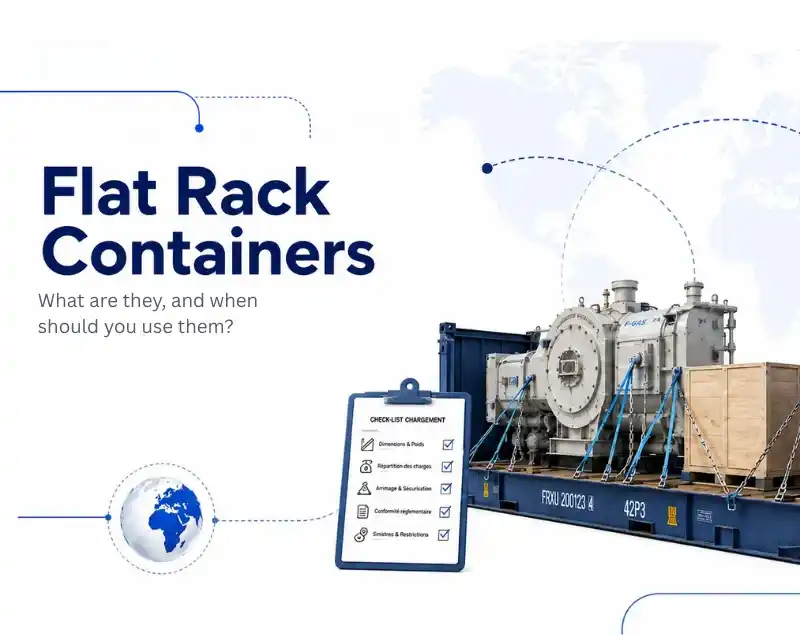
Not all goods fit into a standard sea freight container. Some cargo is too high, too wide, too heavy, or impossible to load through the standard rear doors of a dry container. In this case, sea freight may require a specific type of equipment: the Flat Rack container. What is a Flat Rack container? A Flat Rack container is a sea freight container that is open on the sides and has no roof. It mainly consists of a reinforced floor and two end walls. Depending on the model, these end walls may be fixed or collapsible. Unlike a standard dry container, a Flat Rack does not fully protect the cargo with closed side walls. However, it allows cargo to be loaded when it exceeds the usual dimensions of a standard container. It is therefore especially useful when the cargo cannot be loaded through the rear doors of a standard container, or when it exceeds the usual height, width, or sometimes length limits. In sea freight, this type of container is often used for out-of-gauge cargo. Why use a Flat Rack in sea freight? A Flat Rack answers a simple need: transporting cargo that cannot travel inside a closed standard container. It allows you to: It is a very useful type of equipment when the cargo can still be shipped as containerized freight, but its dimensions or loading method do not allow the use of a standard container. In simple terms, the Flat Rack is an intermediate solution between a standard container and conventional breakbulk transport. What cargo can be transported on a Flat Rack? A Flat Rack container is suitable for heavy, bulky, or difficult-to-load cargo. It can be used for: The objective is to make sea freight possible for goods that cannot fit inside a closed container. However, every shipment must be checked case by case. Dimensions, weight, center of gravity, lashing points, and handling method must all be reviewed before booking. Flat Rack 20 ft or 40 ft: what is the difference? In sea freight, there are mainly two common formats: A 20 ft container is roughly 6 meters long. A 40 ft container is roughly 12 meters long. However, the exact usable dimensions are not always identical from one model to another. ISO codes help identify container families. For example, the code 22P3 generally refers to a 20 ft Flat Rack with collapsible end walls. The code 45P3 generally refers to a 40 ft High Cube Flat Rack with collapsible end walls. In practice: Format Common use 20 ft Flat Rack Heavy, compact, short, or dense cargo 40 ft Flat Rack Long, bulky cargo or cargo requiring more support surface The choice does not depend only on length. It also depends on the weight, the shape of the cargo, its support points, the loading method, and the feasibility of the full transport chain. What are the dimensions of a 20 ft Flat Rack? A 20 ft Flat Rack is often used for heavy but relatively short cargo. It can be suitable for compact machinery, industrial equipment, dense parts, or cargo that is difficult to load into a standard container. As a general indication, a 20 ft Flat Rack usually has: Technical data Indicative range External length around 6 m External width around 2.44 m External height often around 2.59 m Usable length around 5.6 to 6 m depending on the model Usable width around 2.2 to 2.4 m depending on the model Indicative payload often 25 to 30 tonnes, sometimes more depending on the model These values are indicative. Usable dimensions, tare weight, and admissible payload may vary depending on the model, the fleet, and the shipping line. Before any shipment, the technical data sheet of the actual Flat Rack allocated must always be checked. How should these dimensions be understood? The external length gives the general format of the container. The usable length indicates the space actually available for placing the cargo. The usable width may differ from the external width because parts of the structure take up space. The indicative payload gives an order of magnitude, but it is not enough to validate the shipment. Weight distribution, support points, center of gravity, and handling capacity must also be checked. What are the dimensions of a 40 ft Flat Rack? A 40 ft Flat Rack offers more length. It is therefore often used for long, bulky cargo or cargo that is difficult to distribute over a smaller surface. It can be suitable for steel structures, long industrial parts, certain vehicles, construction equipment, or technical cargo. As a general indication, a 40 ft Flat Rack usually has: Technical data Indicative range External length around 12 m External width around 2.44 m External height often around 2.59 m or 2.90 m in High Cube version Usable length around 11.6 to 12 m depending on the model Usable width around 2.2 to 2.4 m depending on the model Indicative payload often around 40 tonnes, sometimes more depending on the model These values must also be confirmed before booking. A 40 ft Flat Rack may seem more practical because it is longer. However, it is not always the best choice. If the cargo is very heavy and short, a 20 ft Flat Rack may sometimes be more suitable. If the cargo is long or requires a larger support surface, a 40 ft Flat Rack may be more logical. The right choice always depends on the actual cargo. Are Flat Rack dimensions always exactly the same? No. This is an essential point. Dimensions, tare weight, and payload may vary depending on: The tables should therefore be used as reference points, not as a universal guarantee. Before any shipment, the technical data sheet of the actual Flat Rack allocated must always be checked. This is especially important if the cargo is very heavy, very wide, very high, or close to the accepted limits. Flat Rack, Open Top, or standard container: what is the difference? The right container depends on the type
Cross docking, fulfillment, warehousing: what’s the difference?
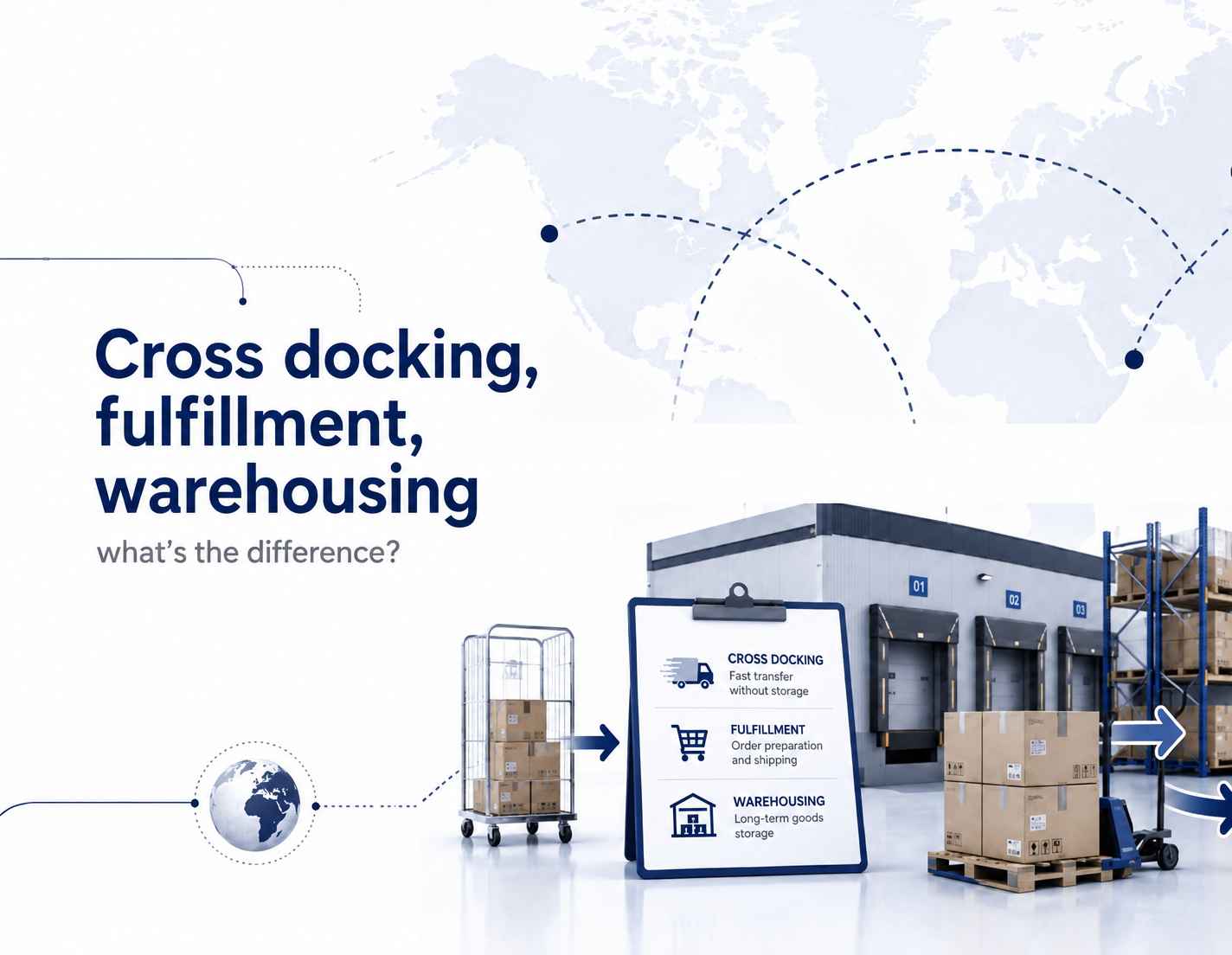
Cross docking, fulfillment, warehousing… These three terms often come up when a company wants to better organise its logistics. However, they do not mean the same thing. What is cross docking? Cross docking is a logistics method that moves goods from an inbound flow to an outbound flow, without prolonged storage. In practice, products arrive on a logistics platform. Teams receive them, check them, sort them, and then quickly reship them to their final destination. The objective is simple: reduce the time goods remain immobilised. In a cross docking operation, the company does not use the warehouse as a traditional storage space. Instead, it uses it as a transit point for sorting and redistribution. Cross docking can be useful when goods need to move quickly, when the company plans volumes properly or when orders are already known before the products arrive. How does cross docking work? The process relies on precise coordination between inbound and outbound flows. In general, it follows several steps: The key point is timing. If the goods arrive but the outbound transport is not ready, the flow gets blocked. In contrast, if the outbound transport is ready but the goods are not yet available, the truck waits. Therefore, cross docking works very well when the supply chain is properly synchronised. What is fulfillment? Fulfillment refers to all the operations needed to process a customer order. Indeed, it is not only about storing a product. Fulfillment can include: Companies often use fulfillment in e-commerce, distribution, marketplaces or activities that handle many individual orders. Here, the objective is not only to move goods. Above all, the goal is to turn available stock into an order ready to be delivered to the final customer. What is warehousing? Warehousing means storing goods in a warehouse for a given period of time. This can include pallets, boxes, finished products, raw materials, spare parts or safety stock. Therefore, warehousing answers a different need from cross docking. Here, the goods do not move through the platform immediately. Instead, they remain available for future use: production, replenishment, customer delivery, regional distribution or seasonal demand. The objective is to secure product availability. However, warehousing also has a cost: space, handling, insurance, stock immobilisation, inventory, possible order preparation and administrative management. Cross docking, fulfillment, warehousing: what’s the difference? In practice, these three solutions answer different needs in the supply chain. Solution Main function Storage duration Objective Cross docking Receive, sort and reship quickly Very short Speed up flows and reduce storage Fulfillment Prepare and ship orders Variable Process customer orders end to end Warehousing Store goods Medium or long Keep stock available Therefore, the main difference lies in how the platform is used. With cross docking, the goods move through. With fulfillment, teams prepare the order. In the case of warehousing, the goods wait for the right moment to move again. Why are cross docking and fulfillment often confused? Cross docking and fulfillment often cause confusion because both can take place on a logistics platform. In both cases, goods arrive, teams handle them, and then they leave for a customer, a store, a warehouse or another site. However, the logic is not the same. With cross docking, the priority is the flow. The goods do not stay on site for long. Teams receive them, sort them, consolidate them if necessary, and then reship them quickly. The objective is to avoid storage and speed up the movement of goods. With fulfillment, the priority is the order. The goods may remain in stock, and then teams prepare them when a customer places an order. This means managing picking, packaging, labelling, shipping, tracking and sometimes returns. The difference is therefore simple: Question to ask Cross docking Fulfillment Do the goods leave quickly after arrival? Yes Not necessarily Is there storage? Very little or none Yes, often Is the main objective to streamline flows? Yes Not only Is the main objective to prepare orders? No Yes Does the model strongly depend on customer orders? Sometimes Yes In other words, cross docking follows a fast transit logic. Fulfillment, on the other hand, follows an order processing logic. A company may need both. For example, part of the goods may leave immediately through cross docking to several sites, while another part remains in stock for fulfillment preparation according to customer orders. That is why the choice should not depend on the name of the solution, but on the real functioning of the supply chain: rotation speed, stock level, order type, expected lead time and preparation needs. When should you choose cross docking? Cross docking is relevant when a company works with predictable flows, short deadlines and planned outbound movements. It can be suitable in several cases: This solution is also useful when a company wants to avoid multiplying handling operations. The less time goods remain stored, the less space they occupy. However, this approach requires strong coordination between transport, receiving, sorting and shipping. When should you choose fulfillment? Fulfillment is more suitable when the company needs to manage many individual or personalised orders. For example, this is often the case for: In this case, value does not come only from storage. It also comes from the ability to prepare orders correctly, meet deadlines, manage errors, track shipments and maintain a good customer experience. Therefore, fulfillment is an operational order processing solution. When should you choose warehousing? Warehousing is relevant when the company needs to keep goods available over a longer period. This may be necessary to: Warehousing offers flexibility. However, it must be managed properly. A stock level that is too high immobilises capital. In addition, poorly monitored stock can create errors, shortages or unnecessary costs. What are the advantages of cross docking? Cross docking can bring several benefits to the supply chain. It can help to: However, cross docking is not a magic solution. It works only when the company prepares its flows properly. Without coordination, it can create the opposite effect: waiting time, delays, poor allocation of goods or