You are importing goods by sea.
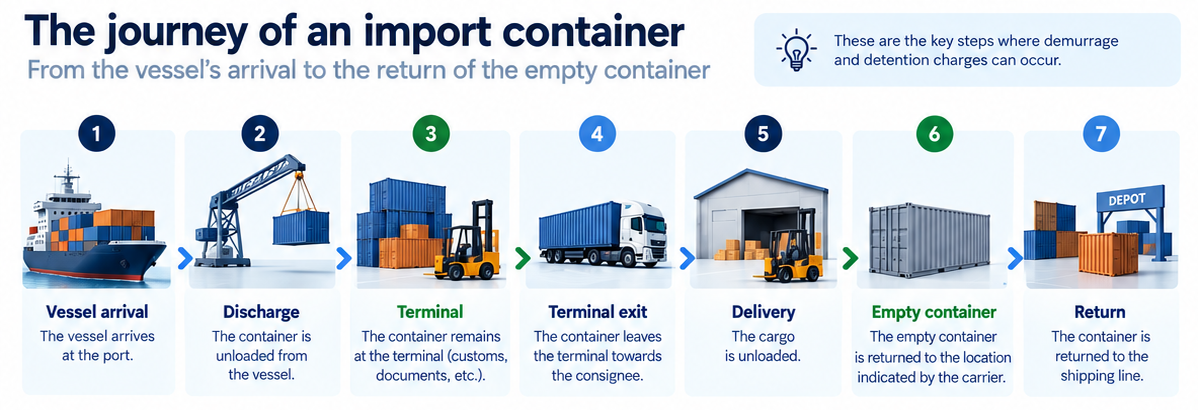
The vessel arrives at the port. The container is discharged.
You might think that the most important part of the transportation process is over.
Yet, a few days later, your company may receive an additional invoice.
Why?
Because a container is not simply a box used to transport your goods. It is also equipment provided by a shipping line that needs to be collected, moved, unloaded and returned to circulation.
When a container remains in use beyond the agreed period, additional charges may apply.
This is where two terms regularly appear in ocean freight:
demurrage and detention.
They are often confused.
Yet, they do not refer to exactly the same situation.
The most common distinction is:
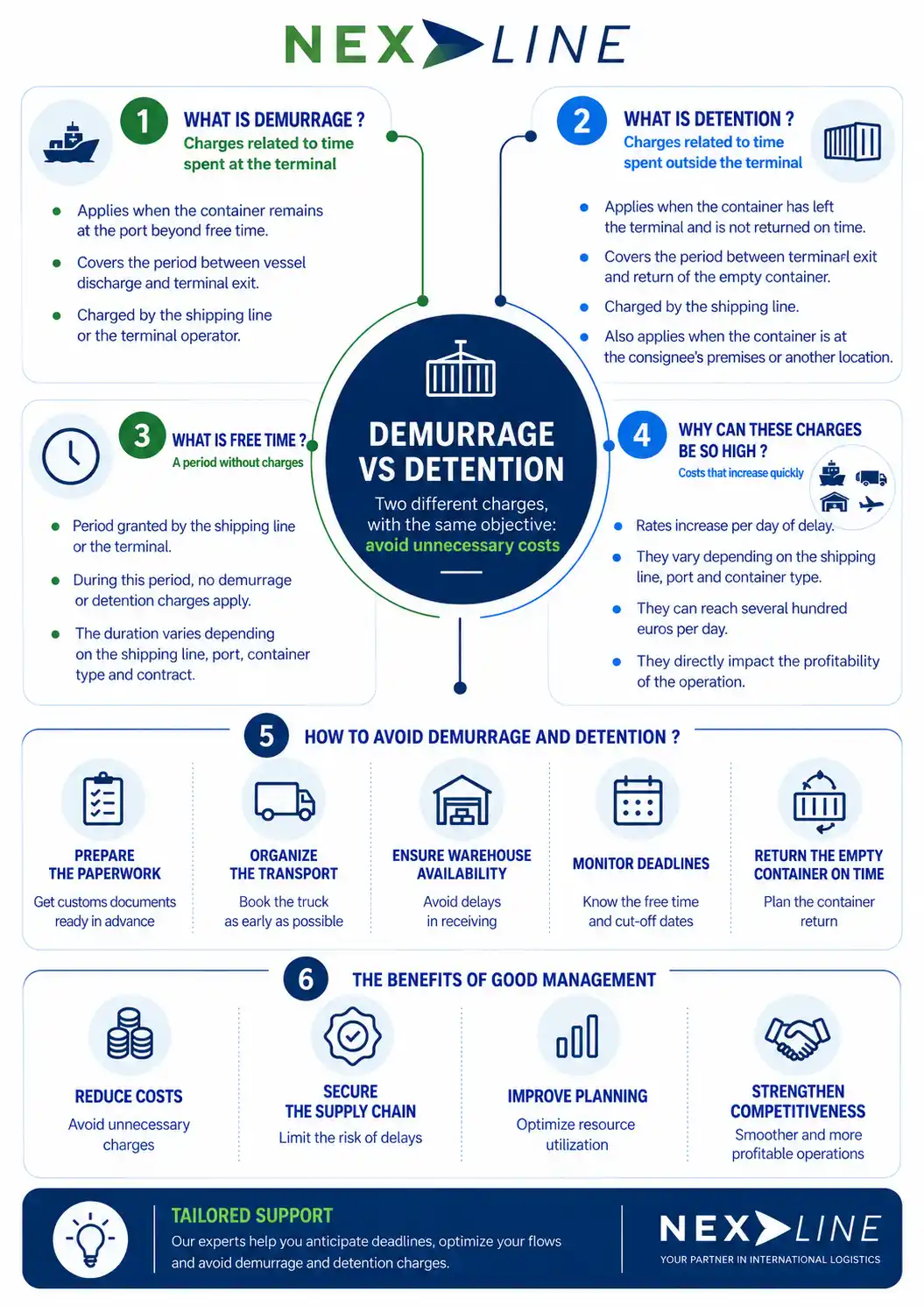
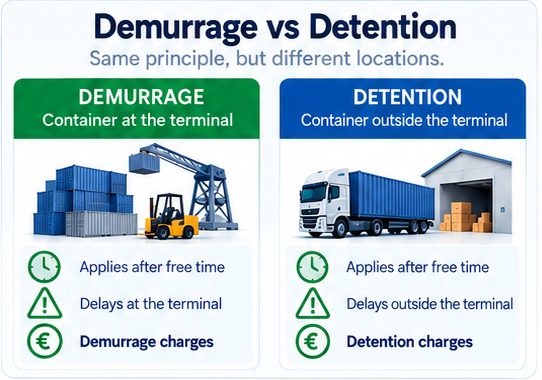
Demurrage: the container remains beyond the free time at the terminal.
Detention: the container remains beyond the free time outside the terminal, before it is returned.
But this definition alone is not enough to understand an invoice.
You also need to know what free time means, when the clock starts, when it stops, and why the rules can vary depending on the country, port or contract.
What happens when a container arrives at the port?
Let’s take a simple example.
A French company orders goods from a supplier in Asia.
The goods are loaded into a container.
The container is then transported to the port of departure, loaded onto a vessel and shipped to France.
After several weeks at sea, the vessel arrives at the destination port.
But the container’s journey is not over.
Why does the shipping line charge these fees?
A container needs to be available for reuse.
When it remains idle for too long, the shipping line cannot use it for another shipment.
Demurrage and detention mechanisms are therefore designed, among other things, to encourage the efficient movement of cargo and the return of equipment within the agreed timeframes.
To understand how they work, we first need to look at one simple concept.
What is free time?
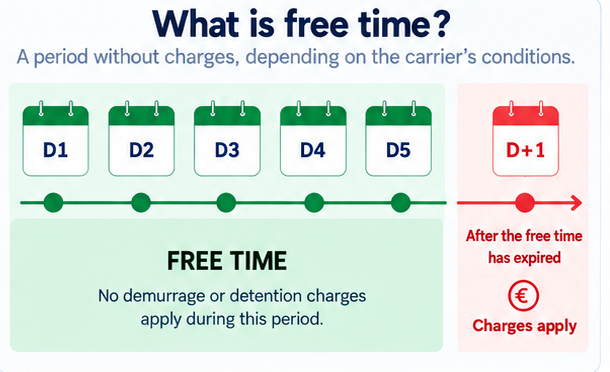
Free time is the period during which the applicable tariff conditions allow the customer to keep or use the container without paying the corresponding demurrage and/or detention charges.
Let’s imagine, purely to illustrate the principle, that your contract provides 5 days of free time.
Your container arrives at the terminal on a Monday.
You then have a defined period, according to the applicable tariff, to complete the required operations.
If you stay within this timeframe, the relevant charges do not apply.
If you exceed it, charges may start to apply.
Once the applicable deadline is exceeded
→ charges may apply
Important: the 5 days used in this example are not a general rule.
Actual free time depends on the shipping line, country, port, container type and contractual terms.
So, what is the difference between demurrage and detention?
Now that the principle of free time is clear, the distinction becomes much easier to understand.
In the standard model:
What is demurrage?
Demurrage generally refers to charges related to keeping a container at the terminal beyond the applicable free time.
For an import shipment, the situation can be very straightforward.
The container arrives.
It is discharged from the vessel.
It remains at the terminal.
The company then needs to arrange its release.
Several operations may be required:
- preparing the necessary documents;
- customs clearance;
- obtaining customs release;
- paying duties and taxes where applicable;
- booking the truck;
- arranging collection;
- coordinating with the warehouse.
If these operations take too long and the container exceeds the applicable deadline, additional charges may arise.
A practical example
A company imports a container from China.
The vessel arrives as scheduled.
However, the customs declaration requires an additional document.
The goods cannot be released.
The truck therefore cannot collect the container.
The container remains at the terminal.
The customs delay may then result in demurrage or storage charges, depending on the applicable charging mechanism.
The vessel itself is therefore not necessarily responsible for the additional cost.
The problem may arise after the vessel has arrived.
What is detention?
Detention generally applies when the container is outside the terminal and is not returned within the agreed timeframe.
The situation is different.
The container leaves the port.
It is delivered to the customer.
The goods need to be unloaded.
The empty container must then be returned to the location specified by the carrier.
If the empty container is returned too late, detention charges may apply.
A practical example
The container is collected from the terminal on Monday.
Delivery takes place on Tuesday.
The warehouse was supposed to unload the container that day.
However, no unloading slot is available.
The unloading is postponed.
The loaded container remains at the warehouse for several days.
Then, once empty, its return to the designated depot is not arranged immediately.
The additional time spent outside the terminal may then generate detention charges.
Can the same container generate both demurrage and detention?
Yes, depending on the applicable terms.
Let’s take a practical example.
One container, two different problems
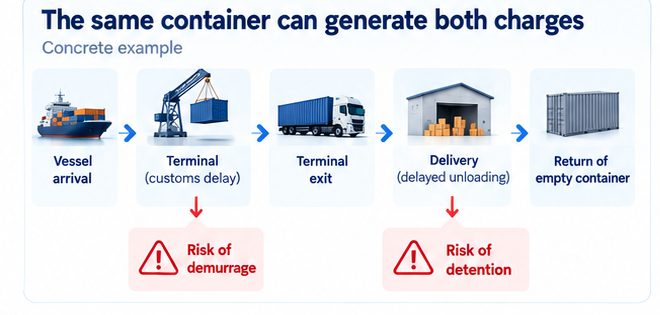
Why can demurrage and detention charges increase so quickly?
Once free time has expired, charges may be applied on a daily basis and can increase depending on the length of the delay.
The amount may depend on:
- container type;
- container size;
- country;
- port;
- terminal;
- shipping line;
- number of days exceeded;
- applicable tariff for the shipment.
There is therefore no single worldwide price for demurrage or detention.
Even a company that regularly imports by sea cannot automatically apply the same rate to every shipment.
The applicable tariff must always be checked.
Why can a container generate demurrage?
There are many possible causes.
Customs clearance takes too long
A document is missing.
An item of information needs to be corrected.
The shipment is subject to inspection.
The container therefore remains at the terminal.
The truck is not available
The container is ready for collection, but no road transport is available within the required timeframe.
The terminal is congested
Collection operations may take longer than expected.
The company did not anticipate the vessel’s arrival
The vessel ETA has changed.
The information has not been communicated.
Transport has not been booked.
The warehouse is not ready.
The container arrives, but the operations surrounding the container are not ready.
Why can a container generate detention?
Once the container has left the terminal, other problems can arise.
The warehouse cannot receive the container
The planned unloading slot is no longer available.
Unloading takes longer than expected
The goods require more time than anticipated to be unloaded.
The return transport has not been arranged
The container is empty but remains at the customer’s premises.
The empty return location has not been clearly identified
The carrier needs to know where the empty container must be returned.
The delivery schedule is not properly coordinated
The truck, warehouse and empty-container return are not planned together.
How can you avoid demurrage and detention charges?
The best time to avoid these charges is not when the invoice arrives.
It is before the container arrives.
A company should ideally know in advance:
| What to check | Why it matters |
|---|---|
| Vessel ETA | Prepare the required operations |
| Free time | Know the applicable deadline |
| Customs status | Avoid unnecessary delays |
| Documents | Speed up cargo release |
| Truck availability | Organize collection |
| Warehouse availability | Prepare for delivery |
| Unloading time | Plan the empty return |
| Empty return location | Avoid additional delays |
The objective is to turn tariff information into a concrete operational deadline.
Can you negotiate more free time?
In some situations, free-time conditions can be negotiated or extensions may be available.
However, additional free days should not be considered the only solution.
If a company regularly exceeds its free time because its documents arrive too late, simply increasing the number of free days does not necessarily solve the underlying problem.
Free time should therefore be considered both as part of the total transportation cost and as a constraint that needs to be integrated into planning.
When comparing two shipping offers, it is therefore not enough to look only at:
the ocean freight rate.
You should also consider:
the free-time conditions and the potential consequences of exceeding them.

The Nexline analysis
Demurrage vs detention is ultimately more than a question of maritime terminology.
It is a question of time management.
A container can remain at the terminal for too long.
It can then remain at the consignee’s premises for too long.
In both cases, the additional time can generate a cost.
At Nexline, the analysis of an ocean freight flow therefore needs to go beyond the freight rate alone.
The entire journey needs to be considered:
THE JOURNEY TO MANAGE
| Stage | Key point to monitor |
|---|---|
| Vessel arrival | ETA and container availability |
| Terminal | Customs, documents and collection |
| Road transport | Truck availability |
| Warehouse | Delivery slot and unloading capacity |
| Empty container | Return arrangements |
| Return | Compliance with the applicable deadline |
The objective is to identify where time is being consumed, where the risk of exceeding the applicable deadline appears and what actions can be taken before the cost materializes.
Because a demurrage or detention charge is often only the visible consequence of a problem that started several days earlier.
The best D&D charge to pay is the one that was never triggered.
Would you like to analyse your ocean freight costs?
FAQ
What is the difference between demurrage and detention?
Demurrage generally refers to charges related to a container remaining at the terminal beyond the applicable free time. Detention generally refers to charges related to a container remaining outside the terminal beyond the agreed period before it is returned. Exact rules depend on the carrier, country and contractual terms.
What is free time?
Free time is the period defined in the carrier’s terms during which the relevant charges are not due. Its duration varies depending on the market, carrier and shipment conditions.
Can the same container incur both demurrage and detention?
Yes, depending on the applicable system. Under a separate charging system, a container can exceed the applicable timeframe at the terminal and then, after leaving the terminal, exceed the timeframe applicable outside the terminal.
What is Combined D&D?
Combined Demurrage & Detention combines the periods inside and outside the terminal into a single calculation. Some markets use this mechanism.
Is demurrage the same as terminal storage?
Not necessarily. Depending on the country and carrier, terminal storage may be charged separately or included in a specific tariff mechanism.
How can you avoid demurrage and detention charges?
You should anticipate the free time, prepare customs documents, monitor the vessel ETA, organize inland transport, check warehouse availability and plan the empty-container return before the applicable deadline.
Why are demurrage and detention charges important for a company?
Because they can reveal broader supply-chain issues, such as slow customs clearance, poor planning, lack of inland transport, poorly coordinated warehouse reception or late container return.
Can a demurrage or detention invoice be disputed?
It depends on the country, carrier and contract. The dates, free time, tariff, type of charge and events used to calculate the amount should be checked.
In summary