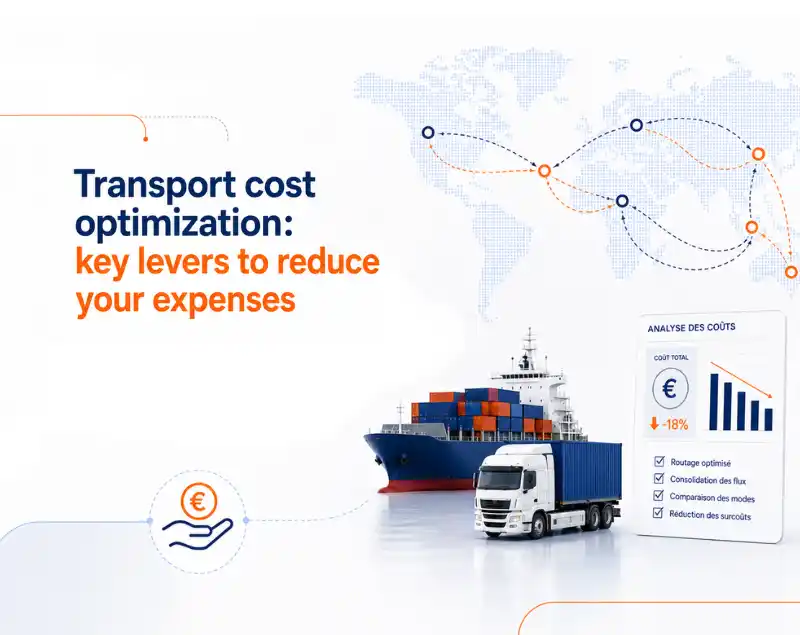
Reducing transport costs does not mean reducing service quality.
For a company, the objective is to better control its expenditure while maintaining reliable lead times, monitored flows and compliant deliveries.
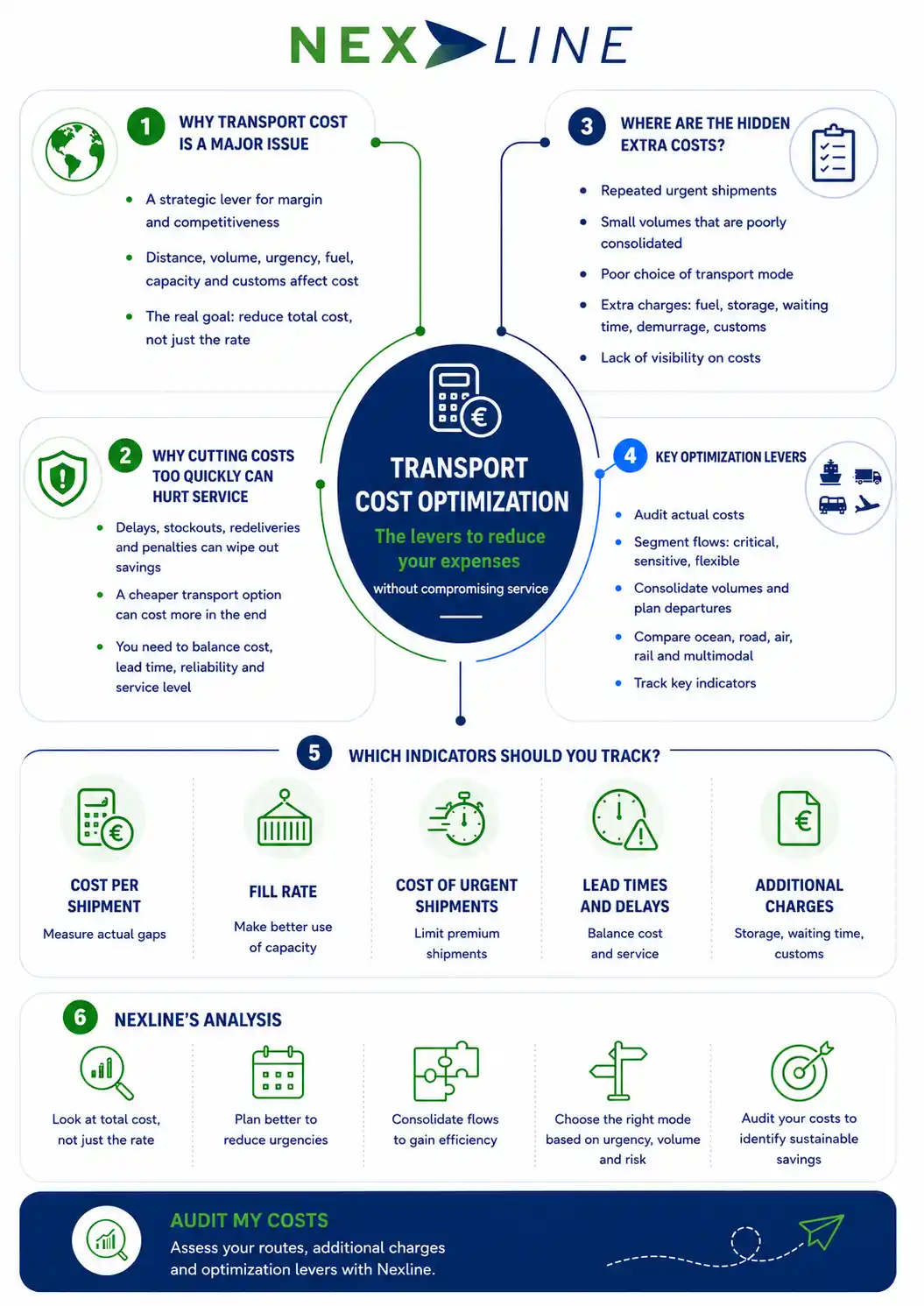
Transport cost optimisation is based on a simple analysis: which flows cost too much, which charges can be avoided and which modes of transport are truly appropriate?
The right approach is to act on the right levers: consolidation, route selection, anticipation of urgent shipments, comparison of transport modes and monitoring of additional charges.
Choosing the cheapest transport option can prove counterproductive when delays, shortages, unexpected costs or a poorer customer experience increase its actual cost.
The right question is therefore not:
How can we pay less?
The real question is:
Which transport costs can be reduced without weakening my operations?
Why do transport costs have such a strong impact on the profitability of French companies?
Transport is a strategic item in the supply chain.
It depends on many factors: distance, weight, volume, mode of transport, urgency, fuel, capacity availability, tolls, customs, insurance, storage, delays and the expected level of service.
In Europe, transport remains a key sector for companies and supply chains. The European Commission notes that it represents approximately 5% of the European Union’s GDP and employs more than 10 million people.
Volumes also remain significant. Eurostat indicates that, in 2024, road freight transport in the European Union reached approximately 1,869 billion tonne-kilometres, a slight increase compared with 2023.
In other words, transport costs are not a minor issue.
They directly affect margins, competitiveness and service quality.
Why can reducing transport costs affect service quality?
Reducing costs too quickly can have the opposite effect.
A company may save money on the transport price but lose more elsewhere: delays, repeat deliveries, storage costs, penalties, dissatisfied customers or immobilised inventory.
This is often the trap.
A transport cost should never be analysed on its own. It must be compared with the total cost of the operation.
For example:
- cheaper but slower transport can cause a stock shortage;
- an unreliable carrier can increase delays;
- poor consolidation can extend lead times;
- choosing the wrong mode can generate additional costs on arrival;
- a poorly prepared shipment can create storage or customs clearance charges.
Transport cost optimisation must therefore seek a balance between cost, lead time, reliability and service level.
Which hidden costs are increasing your transport budget?
Additional costs are not always visible in the initial rate.
They often appear after the shipment.
1. Urgent shipments
Insufficient anticipation can, in some situations, lead to higher transport costs.
Using express, air or priority transport is sometimes essential to respond to an emergency or a last-minute shipment. However, when it becomes recurrent, it may reveal room for improvement in planning.
A first optimisation lever therefore consists of distinguishing genuinely urgent flows from those that could be anticipated more effectively.
2. Poorly consolidated volumes
Shipping small volumes too frequently can cause costs to soar.
Consolidation makes it possible to combine several orders, suppliers or deliveries into a single shipment.
It can be carried out through groupage, LCL, multi-supplier FCL or a more structured organisation of departures.
The objective is simple: fill better, plan better and control better.
3. The wrong mode of transport
Not all flows should use the same mode.
Sea freight is often relevant for large, non-urgent volumes. Air freight is useful for critical or high-value goods. Road transport provides flexibility. Rail or multimodal transport may be relevant on certain routes.
Eurostat notes that, in 2024, approximately 67% of freight transported in the EU, measured in tonne-kilometres, was transported by sea. Road transport represented approximately 25% of the total.
The right choice is therefore not always the fastest. It is the one that matches the level of urgency, volume, value and acceptable risk.
4. Hidden charges
The advertised price is not enough.
A company must also monitor:
fuel surcharges;
storage charges;
waiting charges;
repeat delivery charges;
customs charges;
demurrage and detention charges;
insurance;
penalties related to delays;
internal coordination costs.
Transport may initially appear competitive but cost more once all charges are included.
5. Lack of visibility
When data is scattered, the company operates blindly.
It does not always know how much each route, carrier, customer or product category costs.
Without reliable indicators, it becomes difficult to negotiate, compare or improve.
Transport cost optimisation therefore often begins with a simple step: clearly setting out all costs.
DISCOVER OUR TRANSPORT SERVICES
How can transport costs be reduced without affecting service quality?
1. Audit actual costs
The first step is to understand what you are really paying.
Invoices, routes, volumes, lead times, carriers, additional charges and incidents must be analysed.
The objective is to identify differences between the expected rate and the actual cost.
A transport audit must answer several questions:
which routes cost the most?
which charges occur frequently?
which carriers are the most reliable?
which flows are too urgent?
which volumes could be consolidated?
which delays cost the company the most?
Without this analysis, decisions are often based on impressions.
2. Segment shipments
Not all goods require the same level of service.
Flows must be divided into three categories.
Critical flows
These are shipments that can stop production, delay an important customer order or cause an immediate shortage.
Examples:
essential spare parts;
high-value products;
perishable goods;
priority customer orders;
components required for a production line.
For these flows, cost is not the only criterion. The priority is reliability, speed and visibility. More expensive transport may be justified if the cost of the delay is higher than the cost of transport.
Sensitive flows
These are goods that are important to the business but have a flexibility margin of a few days.
Examples:
regular replenishments;
non-blocking components;
goods expected for a sales period;
scheduled orders;
products with limited buffer stock.
For these flows, the objective is to find the right balance between cost and lead time. Standard transport may be sufficient, but ETAs must be monitored, peaks in activity anticipated and urgent departures avoided.
Flexible flows
These are shipments that can withstand a longer lead time without an immediate impact on the business or the end customer.
Examples:
- anticipated inventory;
- non-urgent products;
- regular volumes;
- non-critical goods;
- orders that can be consolidated.
For these flows, the company can prioritise the most economical solutions: consolidation, groupage, sea freight, scheduled departures or multimodal transport.
The benefit of this segmentation is simple: avoiding paying for a premium service for goods that do not need it, while reserving fast solutions for genuinely high-priority flows.
3. Consolidate volumes
Consolidation is one of the most effective levers.
It consists of combining several orders or several suppliers into a single shipment.
This makes it possible to reduce small, scattered shipments, improve capacity utilisation and better control departures.
For a company, this may involve:
- scheduled departures;
- groupage;
- LCL;
- multi-supplier FCL;
- better purchasing-logistics coordination;
- the consolidation of certain deliveries.
The objective is not only to pay less. The objective is to transport more intelligently.
4. Compare modes of transport
Effective transport cost optimisation also requires the right balance between sea, road, air, rail and multimodal transport.
In 2026, this choice is even more strategic. Companies can no longer compare modes based solely on the advertised price. They must also consider lead times, geopolitical risks, insurance, capacity availability and indirect costs.
Air freight remains useful for urgent, sensitive or high-value goods. However, it becomes more expensive as soon as demand increases or maritime routes are disrupted.
Reuters eported, for example, that spot rates between South Asia and Europe had risen by 70% in March 2026, amid conflicts in the Middle East and tensions on trade routes.
Sea freight often remains the most economical option for large, non-urgent volumes. However, it requires a greater safety margin. Tensions in the Red Sea, risks around the Bab el-Mandeb Strait, attacks on vessels and rising insurance premiums can extend routes, increase costs and reduce schedule reliability.
Reuters eported in July 2026 that war-risk premiums in the Red Sea had increased sharply following new threats of disruption.
Road transport remains flexible for European flows or pre- and post-carriage operations. It makes it possible to regain control over certain deliveries. However, it can be sensitive to fuel prices, tolls, driver availability, regulatory constraints and waiting times at borders.
Rail and multimodal transport can offer a good compromise on certain routes. They are relevant when a company is looking for a balance between cost, lead time and stability. They can also help reduce dependence on a single maritime route or a single mode of transport.
The right choice is therefore not always the cheapest mode.
It is the one that makes it possible to meet the expected service level with the most consistent total cost: transport, insurance, lead times, risks, additional charges and customer impact.
5. Monitor the right indicators
Transport costs cannot be managed solely using a price per kilometre or a price per pallet.
Operational indicators must be monitored.
The most useful are:
- cost per shipment;
- cost per kilogram or per cubic metre;
- cost per route;
- cost per customer;
- capacity utilisation rate;
- delay rate;
- compliant delivery rate;
- additional charges per carrier;
- cost of urgent shipments;
- cost of disputes.
These indicators make it possible to identify where the company is actually losing money.
Mini-assessment of transport cost optimisation with truck, cargo ship, aircraft and logistics dashboard.
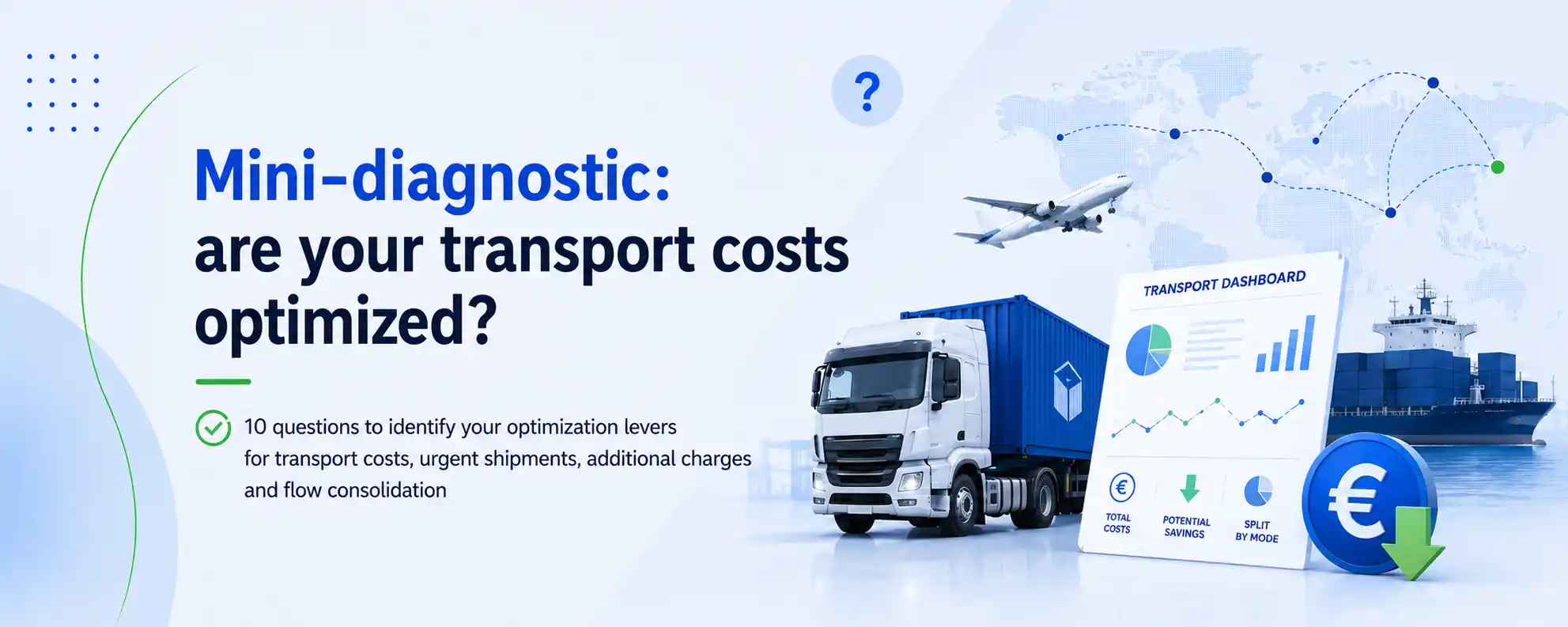
Mini-assessment: are your transport costs optimised?
Your company probably has optimisation potential if you answer “yes” to several of these questions:
- Are your transport costs increasing without a clear explanation?
- Do you frequently rely on urgent shipments?
- Do you have a large number of small shipments?
- Do you rarely compare modes of transport?
- Do your invoices include many additional charges?
- Do your teams lack visibility over costs by route?
- Do your delays create penalties or customer tensions?
- Are your carriers selected mainly out of habit?
- Could your volumes be better consolidated?
- Are your transport indicators incomplete?
If seeral answers are positive, an audit may reveal savings without affecting service quality.
Transport cost analysis with truck, aircraft, cargo ship and logistics indicators to optimise expenditure without affecting service quality.

Nexline’s analysis
Transport cost optimisation should not be viewed as a simple rate reduction.
A company can reduce its expenditure without affecting service quality if it acts on the right levers: data, consolidation, mode selection, planning, negotiation and monitoring of additional charges.
The central point is the total cost.
At Nexline, the objective is to help companies identify where the real additional transport costs are hidden. This requires a practical analysis of routes, volumes, lead times, carriers and operational constraints.
The challenge is simple: reduce unnecessary costs without putting lead times, customers or the continuity of flows at risk.
FAQ
What is transport cost optimisation?
Transport cost optimisation consists of reducing transport-related expenditure without affecting the level of service. It is based on the analysis of actual costs, routes, volumes, modes of transport, additional charges and delivery quality.
How can transport costs be reduced without losing quality?
It is important to avoid focusing solely on the lowest rate. The most effective levers are cost auditing, volume consolidation, flow segmentation, choosing the right mode of transport and monitoring service indicators.
Why can cheaper transport ultimately cost more?
Cheaper transport can generate delays, waiting charges, repeat deliveries, disputes, penalties or additional internal workload. This is why the total cost must be analysed, not only the initial price.
Which indicators should be monitored to optimise transport?
The main indicators are cost per shipment, cost per route, delay rate, capacity utilisation rate, additional charges, cost of urgent shipments, cost of disputes and compliant delivery rate.
In summary