
Air Freight: When Urgency Justifies a Higher Cost
In international transport, air freight is rarely chosen for its price. It is chosen for its speed. When goods need to move fast, when a production shutdown must be avoided, or when a customer commitment needs to be met, transport cost can sometimes become a secondary issue. The question companies often ask is: Is air freight really too expensive? But the better question is: In the end, what costs less: waiting, or bringing the goods by air? As a point of comparison, a World Bank study estimates that air freight generally costs 4 to 5 times more than road transport and 12 to 16 times more than sea freight. This price difference explains why air freight must be used carefully. Yet its role remains strategic. According to IATA, air cargo represents less than 1% of global trade by volume, but more than 33% by value. Airlines also transport more than 62 million tonnes of goods every year. This shows that air freight is mainly used for high-value, time-sensitive or supply-chain-critical goods. Why does air freight cost more? Air freight relies on limited capacity, strict security requirements and short handling times. Unlike sea freight, which can move large volumes over longer transit times, air freight prioritizes speed. Its cost can depend on several factors: actual weight, volumetric weight, origin, destination, flight availability, urgency level, type of goods, handling constraints, documentation requirements and service level. Additional costs may also apply, including fuel surcharges, security fees, handling charges, pre-carriage and final delivery costs. In practice, a light but bulky shipment can be expensive because it takes up a lot of aircraft space. A heavier but more compact shipment may be charged differently. Air freight pricing does not only depend on weight. It also depends on the space used, the expected deadline, available capacity and the level of priority required. What is volumetric weight in air freight? In air freight, the actual weight of the goods is not the only factor considered. The space occupied inside the aircraft also affects the price. This is used to determine the chargeable weight. In general, the airline compares the actual weight with the volumetric weight and applies the higher of the two for billing. Volumetric weight is usually calculated as follows: Length × width × height in cm ÷ 6,000 This means that in air freight, 1 m³ equals around 167 kg of volumetric weight. For example, a package measuring 120 × 100 × 100 cm represents 1.2 m³. Its volumetric weight is therefore 200 kg. If it only weighs 80 kg in reality, the 200 kg figure may be used as the basis for billing. Packaging therefore has a direct impact on air freight cost. An unnecessarily bulky package can increase the chargeable weight, even if the goods themselves are light. When does air freight become relevant? Air freight becomes relevant when the value of time is higher than the savings generated by a slower mode of transport. It is often used for critical spare parts, urgent industrial components, pharmaceutical products, perishable goods, production samples and high-value goods. It may also be relevant for electronic equipment, priority customer orders, urgent replenishment, time-sensitive goods, documents or strategic prototypes. IATA highlights the specific role of air freight for high-value and time-sensitive goods, thanks to speed, reliability, security and specialized handling capabilities. Does urgency always justify air freight? No. Urgency does not automatically mean that goods should be shipped by air. The decision mainly depends on the real cost of delay. A low-value component, for example, may justify air freight if its absence blocks a production line or immobilizes critical equipment. In that situation, a few hours or days of downtime can cost far more than the air freight premium. The same logic applies when a delay creates penalties, stockouts, lost sales or compromises an important customer delivery. On the other hand, if the goods can wait a few more days without major consequences for the business, a more economical transport mode will usually be more relevant. The question is not only how much air freight costs, but how much waiting would cost. How can companies compare air freight cost and delay cost? To make the right decision, companies need to look at the total cost. Question to ask Why it matters What is the value of the goods? High-value goods can absorb a higher transport cost more easily What is the cost of one day of delay? It may be much higher than the price of air freight Is the end customer expecting a specific delivery date? A delay can damage the commercial relationship Does production depend on this part? One missing component can block an entire line Is there a sea or road alternative? It may be enough if the deadline remains acceptable Is the need truly urgent? Some emergencies can be anticipated or consolidated Are the documents ready? An incomplete file can cancel the time gained Is final delivery organized? The aircraft arrival does not guarantee delivery to the recipient This analysis helps avoid two common mistakes. The first is rejecting air freight only because it is more expensive. The second is choosing air freight by reflex, without checking whether the urgency is real. What types of goods often justify air freight? Some goods are better suited to air freight than others. 1. Critical spare parts A spare part may have a low unit value but a very high operational impact. If it blocks a machine, a production line or a technical intervention, the cost of delay can quickly exceed the cost of air freight. In this case, air freight helps reduce downtime. 2. High-value goods High-value goods can often absorb a higher transport cost. This may apply to electronic components, technology products, sensitive equipment or premium goods. Air freight can also provide a level of security and tracking suited to sensitive shipments. 3. Perishable goods Some products lose value quickly when transit times are too long. IATA describes perishable goods as products that are
Transport Cost Optimisation: Key Levers to Reduce Your Expenses
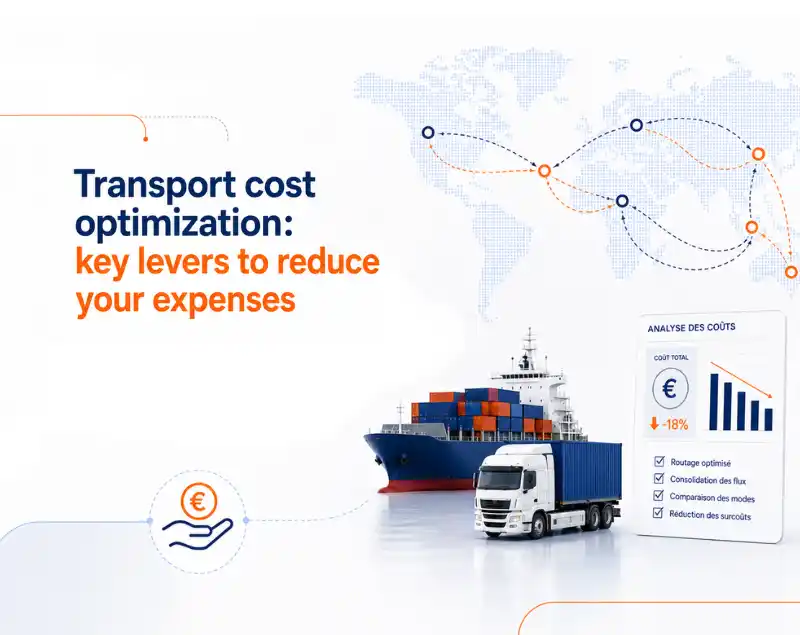
Reducing transport costs does not mean reducing service quality. For a company, the objective is to better control its expenditure while maintaining reliable lead times, monitored flows and compliant deliveries. Transport cost optimisation is based on a simple analysis: which flows cost too much, which charges can be avoided and which modes of transport are truly appropriate? The right approach is to act on the right levers: consolidation, route selection, anticipation of urgent shipments, comparison of transport modes and monitoring of additional charges. Choosing the cheapest transport option can prove counterproductive when delays, shortages, unexpected costs or a poorer customer experience increase its actual cost. The right question is therefore not: How can we pay less? The real question is: Which transport costs can be reduced without weakening my operations? Why do transport costs have such a strong impact on the profitability of French companies? Transport is a strategic item in the supply chain. It depends on many factors: distance, weight, volume, mode of transport, urgency, fuel, capacity availability, tolls, customs, insurance, storage, delays and the expected level of service. In Europe, transport remains a key sector for companies and supply chains. The European Commission notes that it represents approximately 5% of the European Union’s GDP and employs more than 10 million people. Volumes also remain significant. Eurostat indicates that, in 2024, road freight transport in the European Union reached approximately 1,869 billion tonne-kilometres, a slight increase compared with 2023. In other words, transport costs are not a minor issue. They directly affect margins, competitiveness and service quality. Why can reducing transport costs affect service quality? Reducing costs too quickly can have the opposite effect. A company may save money on the transport price but lose more elsewhere: delays, repeat deliveries, storage costs, penalties, dissatisfied customers or immobilised inventory. This is often the trap. A transport cost should never be analysed on its own. It must be compared with the total cost of the operation. For example: Transport cost optimisation must therefore seek a balance between cost, lead time, reliability and service level. Which hidden costs are increasing your transport budget? Additional costs are not always visible in the initial rate. They often appear after the shipment. 1. Urgent shipments Insufficient anticipation can, in some situations, lead to higher transport costs. Using express, air or priority transport is sometimes essential to respond to an emergency or a last-minute shipment. However, when it becomes recurrent, it may reveal room for improvement in planning. A first optimisation lever therefore consists of distinguishing genuinely urgent flows from those that could be anticipated more effectively. 2. Poorly consolidated volumes Shipping small volumes too frequently can cause costs to soar. Consolidation makes it possible to combine several orders, suppliers or deliveries into a single shipment. It can be carried out through groupage, LCL, multi-supplier FCL or a more structured organisation of departures. The objective is simple: fill better, plan better and control better. 3. The wrong mode of transport Not all flows should use the same mode. Sea freight is often relevant for large, non-urgent volumes. Air freight is useful for critical or high-value goods. Road transport provides flexibility. Rail or multimodal transport may be relevant on certain routes. Eurostat notes that, in 2024, approximately 67% of freight transported in the EU, measured in tonne-kilometres, was transported by sea. Road transport represented approximately 25% of the total. The right choice is therefore not always the fastest. It is the one that matches the level of urgency, volume, value and acceptable risk. 4. Hidden charges The advertised price is not enough. A company must also monitor: fuel surcharges;storage charges;waiting charges;repeat delivery charges;customs charges;demurrage and detention charges;insurance;penalties related to delays;internal coordination costs. Transport may initially appear competitive but cost more once all charges are included. 5. Lack of visibility When data is scattered, the company operates blindly. It does not always know how much each route, carrier, customer or product category costs. Without reliable indicators, it becomes difficult to negotiate, compare or improve. Transport cost optimisation therefore often begins with a simple step: clearly setting out all costs. DISCOVER OUR TRANSPORT SERVICES How can transport costs be reduced without affecting service quality? 1. Audit actual costs The first step is to understand what you are really paying. Invoices, routes, volumes, lead times, carriers, additional charges and incidents must be analysed. The objective is to identify differences between the expected rate and the actual cost. A transport audit must answer several questions: which routes cost the most?which charges occur frequently?which carriers are the most reliable?which flows are too urgent?which volumes could be consolidated?which delays cost the company the most? Without this analysis, decisions are often based on impressions. 2. Segment shipments Not all goods require the same level of service. Flows must be divided into three categories. Critical flows These are shipments that can stop production, delay an important customer order or cause an immediate shortage. Examples: essential spare parts;high-value products;perishable goods;priority customer orders;components required for a production line. For these flows, cost is not the only criterion. The priority is reliability, speed and visibility. More expensive transport may be justified if the cost of the delay is higher than the cost of transport. Sensitive flows These are goods that are important to the business but have a flexibility margin of a few days. Examples: regular replenishments;non-blocking components;goods expected for a sales period;scheduled orders;products with limited buffer stock. For these flows, the objective is to find the right balance between cost and lead time. Standard transport may be sufficient, but ETAs must be monitored, peaks in activity anticipated and urgent departures avoided. Flexible flows These are shipments that can withstand a longer lead time without an immediate impact on the business or the end customer. Examples: For these flows, the company can prioritise the most economical solutions: consolidation, groupage, sea freight, scheduled departures or multimodal transport. The benefit of this segmentation is simple: avoiding paying for a premium service for goods that do not need it, while
International transport for SMEs and mid-sized companies: how to structure your flows without making management more complex
International transport for SMEs and mid-sized companies can quickly become complex. Businesses need to coordinate suppliers, documents, customs procedures, deadlines and different modes of transport. However, a company does not need to introduce more tools or procedures to organize its flows more effectively. Above all, it needs clear rules, reliable information and a single point of contact capable of coordinating operations. SMEs and mid-sized companies: which businesses are concerned? An SME is a small or medium-sized enterprise with fewer than 250 employees. A mid-sized company generally employs between 250 and 4,999 people. This article is mainly intended for SMEs and mid-sized companies that: Why does international transport become complex for these companies? International transport becomes complex when flows develop without a shared organization. At first, each shipment may be managed on a case-by-case basis. A supplier provides information, the purchasing department requests a quote and the administrative team prepares the documents. Over time, however, several difficulties begin to appear: The complexity does not come only from the number of shipments. It mainly comes from the fact that each shipment is organized differently, without a common framework or an overall view of operations. How should SMEs and mid-sized companies structure their international flows? SMEs and mid-sized companies should begin by identifying their main international flows. There is no need to introduce a complex system immediately. A shared spreadsheet may be enough to centralize the essential information: This mapping exercise should help the company answer four essential questions: The company can then focus its efforts on flows that represent the greatest volume, value or level of risk. What information should be provided to a freight forwarder? A complete request makes it possible to obtain a faster and more reliable quotation. The following information is generally required: Missing information can affect the price or make the proposed solution unsuitable. For example, an inaccurate address, incorrect weight or an unreported constraint may result in additional charges. Creating a standard transport request template can therefore reduce unnecessary exchanges, errors and response times. Which mode of transport should an SME or mid-sized company choose? The mode of transport depends on the volume, deadline, budget and type of goods. Sea freight Sea freight is suitable for large volumes and non-urgent goods. Companies can choose between: Sea freight consolidation allows several companies to share the same container. Each shipper only pays for the space used. This solution is particularly suitable for SMEs and mid-sized companies that want to ship smaller volumes, limit inventory or test a new market. Air freight Air freight is suitable for urgent, sensitive or high-value goods. Its cost is higher, but it can prevent a stock shortage, production stoppage or delay for a customer. Road freight Road freight is suitable for transport within Europe. It can be organized as a full truckload, consolidated road freight or express transport. Road freight consolidation is useful for shipments of a few pallets that do not require an entire truck. Multimodal transport Multimodal transport combines several modes of transport, such as sea and road freight. It helps companies find the right balance between cost, transit time and reliability. Is freight consolidation suitable for SMEs and mid-sized companies? Yes. Freight consolidation is suitable for these types of companies whose goods do not fill an entire container or truck. It allows them to: Consolidation can be used for sea, air or road freight. However, it may be less suitable for goods that are highly urgent, fragile, dangerous or subject to specific transport requirements. Why are Incoterms important for SMEs and mid-sized companies? Incoterms define how responsibilities are divided between the seller and the buyer. They specify: A misunderstood Incoterm can result in unexpected charges. For example, a supplier may offer a price that includes the main transport but excludes destination charges, customs clearance or final delivery. The company must therefore check: SMEs and mid-sized companies should not accept an Incoterm simply because it is proposed by the supplier or has been used for several years. It must match the level of control required and the expertise available within the company. Which documents should be checked before departure? Documents must be complete and consistent before the goods leave their point of origin. Depending on the country, product and mode of transport, it may be necessary to check: The description, quantity, weight, value and origin must be consistent across all documents. An error may result in: The best practice is to carry out these checks before departure, rather than once the goods have already arrived at their destination. How does Nexline support SMEs and mid-sized companies? Nexline supports SMEs and mid-sized companies in organizing and monitoring their international flows. Depending on the company’s needs, this support may include: The aim is not to introduce unnecessary procedures. It is to simplify management, improve visibility and secure international operations. Internal teams remain in control of their decisions while benefiting from a single point of contact capable of coordinating the different stages of transport. FAQ: international transport for SMEs and mid-sized companies How should SMEs and mid-sized companies organize international transport? They should identify their main flows, define responsibilities, standardize requests and centralize the monitoring of costs, deadlines and documents. Which mode of transport should SMEs and mid-sized companies choose? The choice depends on the volume, deadline and type of goods. Sea freight is suitable for large volumes, air freight for urgent shipments and road freight for transport within Europe. Is freight consolidation useful for SMEs and mid-sized companies? Yes. Consolidation allows several companies to share a container, truck or air shipment. Each company only pays for the space used, which reduces the cost of smaller shipments. What is the difference between consolidated and full-load transport? With consolidated transport, several shippers share the same transport capacity. With full-load transport, one company reserves the entire container or truck. How can international transport costs be reduced? Companies should anticipate departures, limit urgent shipments, compare total costs, avoid unexpected charges and choose consolidation when the volume does