International transport for SMEs and mid-sized companies can quickly become complex. Businesses need to coordinate suppliers, documents, customs procedures, deadlines and different modes of transport.
However, a company does not need to introduce more tools or procedures to organize its flows more effectively.
Above all, it needs clear rules, reliable information and a single point of contact capable of coordinating operations.
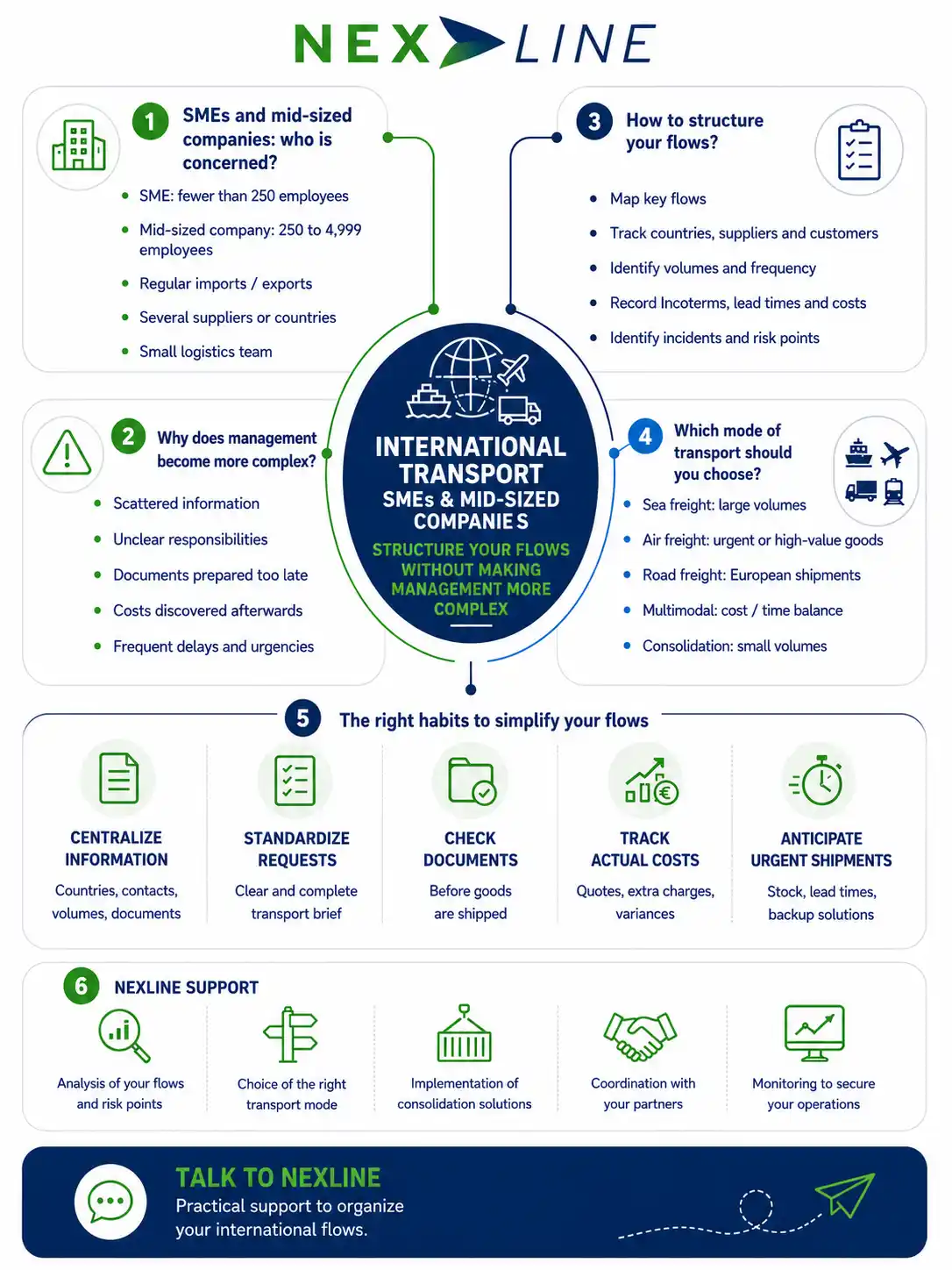
SMEs and mid-sized companies: which businesses are concerned?
An SME is a small or medium-sized enterprise with fewer than 250 employees. A mid-sized company generally employs between 250 and 4,999 people.
This article is mainly intended for SMEs and mid-sized companies that:
- import or export regularly;
- work with several suppliers or countries;
- have a small internal logistics team;
- experience delays or unexpected costs;
- want to develop their international flows without making their organization more complex.
Why does international transport become complex for these companies?
International transport becomes complex when flows develop without a shared organization.
At first, each shipment may be managed on a case-by-case basis. A supplier provides information, the purchasing department requests a quote and the administrative team prepares the documents.
Over time, however, several difficulties begin to appear:
- information remains scattered across email inboxes;
- responsibilities are not clearly defined;
- documents are prepared too late;
- actual costs are only known after delivery;
- delays are identified at the last minute;
- urgent shipments become increasingly frequent;
- management depends on a single person.
The complexity does not come only from the number of shipments.
It mainly comes from the fact that each shipment is organized differently, without a common framework or an overall view of operations.
How should SMEs and mid-sized companies structure their international flows?
SMEs and mid-sized companies should begin by identifying their main international flows.
There is no need to introduce a complex system immediately. A shared spreadsheet may be enough to centralize the essential information:
- country of origin;
- country of destination;
- supplier or customer;
- type of goods;
- average volume;
- shipment frequency;
- mode of transport used;
- Incoterm;
- usual transit time;
- average cost;
- previous incidents.
This mapping exercise should help the company answer four essential questions:
- Which flows are the most important?
- Which flows are the most expensive?
- Which flows are most exposed to delays?
- Which operations require the most time from internal teams?
The company can then focus its efforts on flows that represent the greatest volume, value or level of risk.
What information should be provided to a freight forwarder?
A complete request makes it possible to obtain a faster and more reliable quotation.
The following information is generally required:
- collection address;
- delivery address;
- type of goods;
- number of packages or pallets;
- weight;
- dimensions;
- commercial value;
- availability date;
- Incoterm;
- required delivery time;
- loading or delivery constraints;
- whether the goods are dangerous, fragile or regulated.
Missing information can affect the price or make the proposed solution unsuitable.
For example, an inaccurate address, incorrect weight or an unreported constraint may result in additional charges.
Creating a standard transport request template can therefore reduce unnecessary exchanges, errors and response times.
Which mode of transport should an SME or mid-sized company choose?
The mode of transport depends on the volume, deadline, budget and type of goods.
Sea freight
Sea freight is suitable for large volumes and non-urgent goods.
Companies can choose between:
- a full container for larger volumes;
- sea freight consolidation for smaller volumes.
Sea freight consolidation allows several companies to share the same container. Each shipper only pays for the space used.
This solution is particularly suitable for SMEs and mid-sized companies that want to ship smaller volumes, limit inventory or test a new market.
Air freight
Air freight is suitable for urgent, sensitive or high-value goods.
Its cost is higher, but it can prevent a stock shortage, production stoppage or delay for a customer.
Road freight
Road freight is suitable for transport within Europe.
It can be organized as a full truckload, consolidated road freight or express transport.
Road freight consolidation is useful for shipments of a few pallets that do not require an entire truck.
Multimodal transport
Multimodal transport combines several modes of transport, such as sea and road freight.
It helps companies find the right balance between cost, transit time and reliability.
Is freight consolidation suitable for SMEs and mid-sized companies?
Yes. Freight consolidation is suitable for these types of companies whose goods do not fill an entire container or truck.
It allows them to:
- pay only for the space used;
- ship more regularly;
- limit inventory levels;
- test a supplier or market;
- reduce the cost of smaller shipments.
Consolidation can be used for sea, air or road freight.
However, it may be less suitable for goods that are highly urgent, fragile, dangerous or subject to specific transport requirements.
Why are Incoterms important for SMEs and mid-sized companies?
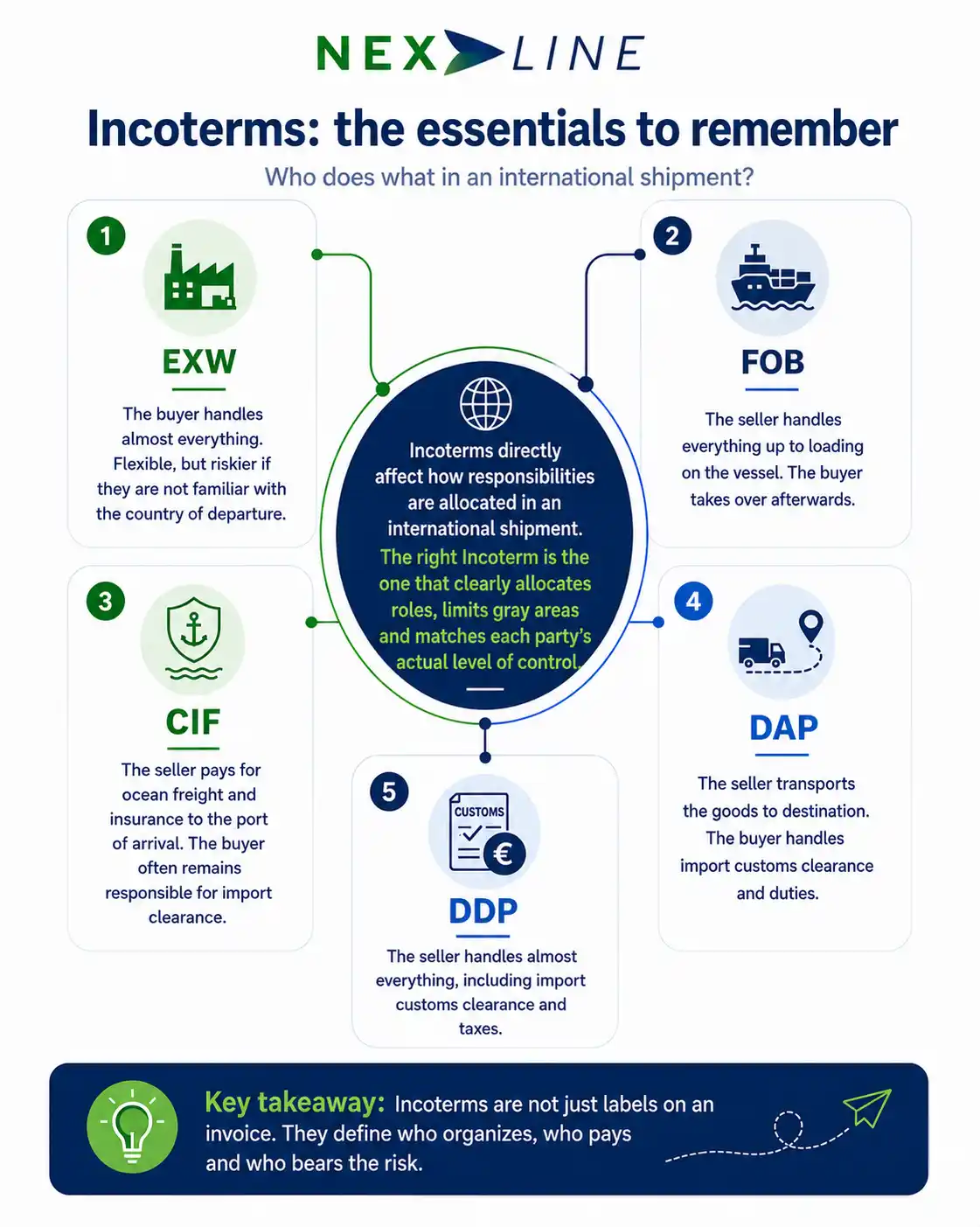
Incoterms define how responsibilities are divided between the seller and the buyer.
They specify:
- who organizes the transport;
- who pays the different costs;
- when the risk is transferred;
- who handles the formalities;
- how far each party remains responsible.
A misunderstood Incoterm can result in unexpected charges.
For example, a supplier may offer a price that includes the main transport but excludes destination charges, customs clearance or final delivery.
The company must therefore check:
- what is actually included in the price;
- the exact point at which risk is transferred;
- which formalities remain its responsibility;
- which charges may arise on arrival.
SMEs and mid-sized companies should not accept an Incoterm simply because it is proposed by the supplier or has been used for several years.
It must match the level of control required and the expertise available within the company.
Which documents should be checked before departure?
Documents must be complete and consistent before the goods leave their point of origin.
Depending on the country, product and mode of transport, it may be necessary to check:
- the commercial invoice;
- the packing list;
- the bill of lading;
- the air waybill;
- the CMR consignment note;
- the certificate of origin;
- customs documents;
- specific licences or certificates.
The description, quantity, weight, value and origin must be consistent across all documents.
An error may result in:
- a request for additional information;
- a customs inspection;
- a delay;
- storage charges;
- the goods being held by customs.
The best practice is to carry out these checks before departure, rather than once the goods have already arrived at their destination.
How does Nexline support SMEs and mid-sized companies?
Nexline supports SMEs and mid-sized companies in organizing and monitoring their international flows.
Depending on the company’s needs, this support may include:
- analysis of existing flows;
- comparison of transport modes;
- implementation of freight consolidation solutions;
- organization of sea, air and road transport;
- coordination of the different parties involved;
- customs support;
- verification of the required information;
- shipment tracking;
- risk anticipation;
- identification of alternative solutions.
The aim is not to introduce unnecessary procedures.
It is to simplify management, improve visibility and secure international operations.
Internal teams remain in control of their decisions while benefiting from a single point of contact capable of coordinating the different stages of transport.
FAQ: international transport for SMEs and mid-sized companies
How should SMEs and mid-sized companies organize international transport?
They should identify their main flows, define responsibilities, standardize requests and centralize the monitoring of costs, deadlines and documents.
Which mode of transport should SMEs and mid-sized companies choose?
The choice depends on the volume, deadline and type of goods. Sea freight is suitable for large volumes, air freight for urgent shipments and road freight for transport within Europe.
Is freight consolidation useful for SMEs and mid-sized companies?
Yes. Consolidation allows several companies to share a container, truck or air shipment. Each company only pays for the space used, which reduces the cost of smaller shipments.
What is the difference between consolidated and full-load transport?
With consolidated transport, several shippers share the same transport capacity. With full-load transport, one company reserves the entire container or truck.
How can international transport costs be reduced?
Companies should anticipate departures, limit urgent shipments, compare total costs, avoid unexpected charges and choose consolidation when the volume does not justify a full load.
Why work with a freight forwarder?
A freight forwarder compares solutions, organizes transport, coordinates the parties involved and supports SMEs and mid-sized companies when unexpected issues arise.
How can customs delays be avoided?
Documents must be complete and consistent before departure. The description, value, weight and origin of the goods must be correctly stated.
Which indicators should be monitored?
SMEs and mid-sized companies can monitor the cost per shipment, actual transit time, number of incidents, difference between the quotation and final invoice, and the percentage of urgent shipments.
Summary