Sea freight is at the heart of international trade. Every day, thousands of containers carry goods across continents, connecting suppliers, manufacturers, distributors and importing companies.
According to the United Nations Conference on Trade and Development (UNCTAD), approximately 80% of global merchandise trade by volume is transported by sea.
This figure highlights an important reality: for many companies, supply chain performance depends directly on the efficiency of their ocean freight operations.
But how do you organise a shipment efficiently? Which container should you choose? What transit times and costs should you anticipate? And how can you avoid unexpected charges upon arrival?
This guide provides practical answers to help you organise, secure and manage your international sea freight shipments, from collection at your supplier’s premises to final delivery.
1. What Is Sea Freight and How Does It Work?
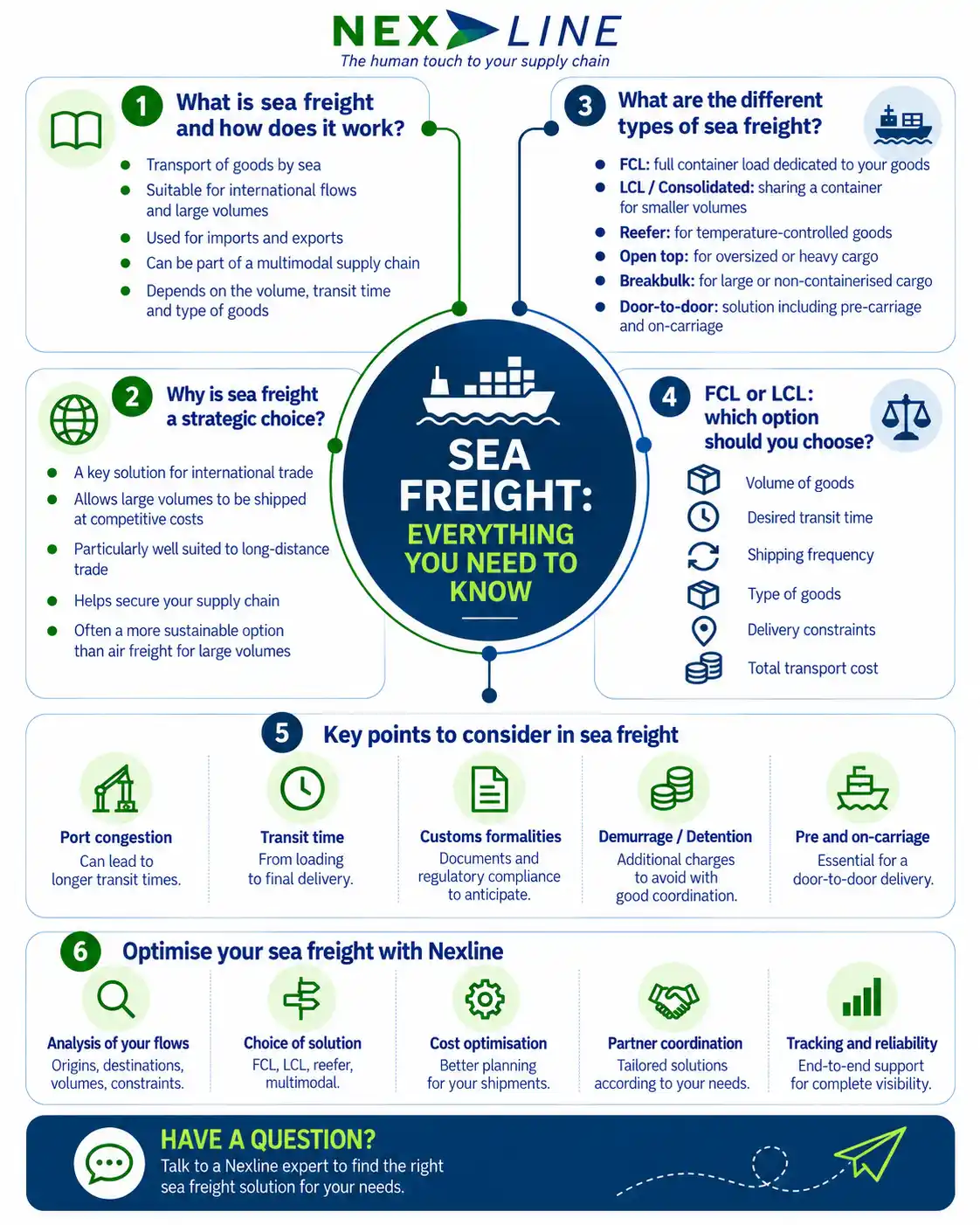
Sea freight refers to the transportation of goods by sea between ports, as part of domestic or international shipping operations. It is particularly suitable for transporting large volumes of goods, industrial supplies and regular import-export shipments.
Sea freight relies on coordination between several stakeholders: suppliers, inland transport providers, shipping lines, port terminals, customs authorities and warehouses.
Ocean freight therefore involves much more than moving goods across the sea.
For businesses, the challenge is to establish an efficient logistics operation that ensures continuity throughout the supply chain.
Why Choose Sea Freight?
Sea freight offers several advantages for businesses:
- High cargo capacity, making it suitable for industrial and commercial shipments.
- Competitive shipping costs on many international routes, particularly for larger volumes.
- Global coverage, connecting major production and consumption markets.
- Flexible shipping solutions, ranging from full container loads to consolidated shipments.
- A generally lower carbon footprint per tonne-kilometre than air freight, depending on operating conditions.
However, sea freight requires careful planning. Transit times are generally longer than air freight and may vary depending on port conditions and geopolitical developments.
In its Review of Maritime Transport 2025, UNCTAD highlights how geopolitical tensions, changes to shipping routes and freight rate volatility are making global supply chains less predictable.
To explore the different solutions available for your cargo, discover Nexline’s international sea freight services.
2. How Does an International Sea Freight Shipment Work?
An international sea freight shipment generally involves seven main stages. However, contrary to what you might expect, moving goods by sea involves much more than the ocean voyage itself.
To transport goods from their place of production to their final destination, several transport modes often need to be combined, including sea, road and rail.
This is known as multimodal transport, which makes it possible to organise an end-to-end shipment.
Step 1: Preparing the Goods
Goods are packaged, packed and labelled according to their nature, dimensions and transport requirements.
Packaging must protect products from impacts, handling operations and the conditions encountered during transportation.
Step 2: Organising Pre-Carriage
Before goods can be loaded onto a vessel, they often need to be transported from the supplier’s factory or warehouse to the port of departure.
This stage, known as pre-carriage, is usually carried out by truck. However, rail or inland waterway transport may also be used, depending on the available infrastructure.
Step 3: Booking Ocean Freight
The freight forwarder identifies and organises a shipping solution based on cargo volumes, destination, transit times and operational requirements.
Step 4: Preparing Shipping Documents and Customs Formalities
Commercial and transport documents are checked. Applicable customs declarations and procedures are prepared in coordination with the relevant parties.
Step 5: Loading and Shipping the Goods
Goods are loaded onto the vessel, generally in a suitable shipping container, and transported to the destination port.
Step 6: Tracking the Shipment
Shipment tracking makes it possible to monitor key transport milestones, identify changes to schedules and anticipate estimated arrival dates.
Step 7: Customs Clearance and Final Delivery
Once goods arrive at the destination port, they undergo the necessary port operations and customs formalities.
They are then transported to the consignee’s warehouse or final delivery location, usually by truck or train.
This final stage is known as on-carriage.
What Is Multimodal Transport?
Multimodal transport involves combining at least two different modes of transport within a single logistics operation.
Let’s take the example of a French company importing goods from China:
Factory in China → Road transport → Port of Shanghai → Sea freight → Port of Le Havre → Road transport → Warehouse in France.
Sea freight handles the main international journey, while road transport connects the ports to the original shipping location and final destination.
This combination makes it possible to organise door-to-door transport, without requiring the company to coordinate every service provider individually.
For more information about multimodal transport, consult the United Nations Economic Commission for Europe’s terminology on combined transport.
Nexline’s Expert Advice
A successful sea freight shipment depends on more than the ocean crossing. It requires effective coordination across every link in the supply chain, from the supplier to the final recipient.
At Nexline, we organise these different stages by selecting and coordinating the right partners for each operation.
Our integrated logistics approach enables us to design consistent, tailored solutions that meet the specific needs of each business.
One clear objective: keeping your goods moving smoothly, from start to finish.
3. FCL or LCL: Which Sea Freight Solution Should You Choose?
Choosing between a full container load and consolidated shipping is one of the most important decisions when planning a sea freight shipment.
FCL: Full Container Load
FCL refers to a shipping container dedicated to a single shipper’s goods.
This solution is particularly suitable for companies shipping large volumes or looking for an arrangement involving fewer handling operations associated with cargo consolidation.
LCL: Less than Container Load
LCL, also known as consolidated sea freight, allows goods from several shippers to be transported in the same container.
It is particularly suitable for smaller shipments when booking an entire container would not be economically justified.
FCL vs LCL: Comparison
| Criteria | FCL | LCL |
|---|---|---|
| Container | Dedicated | Shared |
| Cargo volume | Medium to large | Small to medium |
| Pricing | Mainly per container | Mainly by chargeable weight or volume |
| Handling | Generally fewer consolidation-related handling operations | Consolidation and deconsolidation |
| Transit times | Potentially more direct | Additional consolidation time |
| Typical use | Large volumes, regular shipments | Smaller shipments, variable volumes |
At What Volume Should You Choose FCL?
There is no universal threshold.
The choice depends on cargo volume, weight, freight rates, handling charges and the specific characteristics of the goods.
This is why it is important to compare the total costs of both solutions.
For companies regularly importing goods from Asia, consolidated sea freight can also become an effective way to organise their supply chain.
4. Which Type of Shipping Container Should You Choose?
Not all shipping containers have the same dimensions or characteristics.
The right choice depends on the type of goods, their volume, weight and loading requirements.
| Container type | Main application |
|---|---|
| 20ft Dry Container | General cargo and relatively heavy loads |
| 40ft Dry Container | Large volumes of general cargo |
| 40ft High Cube | Cargo requiring additional height |
| Reefer Container | Temperature-controlled goods |
| Open Top Container | Cargo requiring top loading |
| Flat Rack Container | Industrial equipment and oversized cargo |
A 40ft container provides more volume than a 20ft container, but it does not necessarily offer twice the payload capacity.
For heavy cargo, weight distribution and regulatory requirements must be carefully assessed.
Choosing the right container should always be based on the actual characteristics of the shipment.
5. How Much Does International Sea Freight Cost?
Sea freight rates depend on several factors.
There is no fixed price for shipping a container, even when the ports of departure and arrival remain the same.
What Factors Influence Sea Freight Rates?
The main factors include:
- Shipping route: origin, destination, ports of call and possible transshipments.
- Volume and weight: type and number of containers, or chargeable volume for LCL shipments.
- Seasonality: demand, available capacity and peak shipping periods.
- Type of cargo: general, hazardous, refrigerated or oversized goods.
- Additional services: inland transportation, customs, insurance, storage and handling.
- Market conditions: vessel availability, port congestion and geopolitical disruptions.
Beyond the ocean freight rate itself, additional charges can also affect the final cost of a shipment.
These include demurrage and detention charges, which may apply when the permitted container usage periods are exceeded.
To better anticipate these costs, discover the difference between demurrage and detention and how to avoid additional container charges.
How Can You Actually Reduce Sea Freight Costs?
The first step is to identify which parts of your logistics operation offer opportunities for improvement.
Shipment consolidation, route selection and better operational planning are just some of the options worth exploring.
We explain these strategies in greater detail in our article: Transport Cost Optimisation: How to Reduce Logistics Expenses Without Compromising Operations.
Would you like to know how much your next ocean freight shipment will cost?
DISCOVER OUR TRANSPORT SERVICES
6. How Long Does International Sea Freight Take?
Sea freight transit times depend on the shipping route, ports, number of stops, transshipments and operational conditions.
It is important to distinguish between two concepts.
Port-to-port transit time refers to the time required to transport cargo between the port of departure and the destination port.
Door-to-door transit time includes collection, port operations, ocean transportation, customs formalities and final delivery.
For importing companies, door-to-door transit time is usually the most relevant indicator.
Why Can Sea Freight Transit Times Vary?
The main causes include:
- Port terminal congestion.
- Adverse weather conditions.
- Changes to vessel schedules.
- Geopolitical tensions affecting certain routes.
- Transshipment operations.
- Customs inspections.
- Inland transportation disruptions.
Disruptions to international shipping routes can significantly affect transit times.
In its 2025 report, UNCTAD explains that vessel diversions associated with geopolitical tensions contributed to an increase of nearly 6% in tonne-miles in 2024.
Tonne-miles measure the amount of cargo transported in relation to the distance travelled.
In practical terms, goods may need to travel longer distances, requiring additional shipping capacity.
7. What Documents Are Required for Sea Freight?
An international shipment involves several commercial, logistics and customs documents.
The documents required depend on the countries involved, the type of goods and the contractual arrangements.
Main Shipping Documents
Commercial Invoice
The commercial invoice provides information about the goods, their value, the parties involved and the terms of sale.
Packing List
The packing list details the contents of each package, including quantities, dimensions and weights.
Bill of Lading (B/L)
The Bill of Lading is an essential maritime transport document. Depending on its form, it can serve several contractual and documentary purposes.
Customs Documents
Customs documentation is required to complete applicable import or export procedures.
Specific Certificates and Authorisations
Certain categories of goods may require additional documents to comply with regulatory requirements.
For more information about customs procedures, discover Nexline’s customs declaration services.
8. How Can You Improve Your Sea Freight and Supply Chain Performance?
An effective sea freight strategy involves more than negotiating the lowest shipping rate.
It should help your company strike the right balance between costs, transit times, reliability and service quality.
Consolidate Shipments
Combining orders from several suppliers can improve container utilisation.
It can also make it easier to organise shipments around more predictable departure schedules.
Choose the Right Transport Modes
Sea freight is not necessarily the best option for every shipment.
Depending on your requirements, combining maritime, road, rail or air transport may provide a more suitable solution.
Improve Shipment Visibility
Regular tracking helps businesses anticipate arrivals and prepare operations at destination.
Analyse Actual Logistics Costs
The total cost should include transportation, port charges, customs procedures, storage and potential container-related fees.
Coordinate All Logistics Operations
An efficient supply chain operates as a connected system.
Integrated logistics helps coordinate shipments, service providers and the different stages of cargo transportation.
Would you like to identify potential savings in your logistics operations?
Discover our analysis of transport cost optimisation and explore opportunities to improve your supply chain.
9. Why Work With a Sea Freight Forwarder?
A freight forwarder plays a central role in organising international trade operations.
Unlike a shipping line, which operates vessels and transports cargo by sea, a freight forwarder organises and coordinates the services needed to complete an international shipment.
Depending on the services agreed upon, a freight forwarder may handle transport bookings, shipment tracking, documentation coordination and additional logistics operations.
How Do You Choose the Right Sea Freight Forwarder?
For B2B companies, several criteria should be considered.
- International expertise: knowledge of shipping routes, markets and regulatory requirements.
Operational coordination: effective collaboration between carriers, terminals, warehouses and customs professionals.
- Transparency: clear information about services, schedules and costs.
- Responsiveness: the ability to identify problems and propose suitable alternatives.
- Tailored solutions: logistics services designed around each company’s operational requirements.
The role of a freight forwarder therefore goes far beyond simply booking transportation.
Frequently Asked Questions About Sea Freight
What Is the Difference Between FCL and LCL?
FCL refers to a container dedicated to one shipper, while LCL allows goods from several businesses to be consolidated in a shared container.
The best option depends on cargo volume, costs, transit times and shipping requirements.
How Much Does It Cost to Ship a 20ft or 40ft Container?
Shipping costs vary depending on the route, container type, shipping period, available capacity and additional charges.
A personalised freight quote provides a more accurate estimate of the total shipping cost.
Why Should You Work With a Sea Freight Forwarder?
A freight forwarder coordinates the different stakeholders involved in international transportation.
They help businesses organise shipments more efficiently and manage costs, transit times and operational risks.
How Long Does Sea Freight Take From China to France?
Sea freight from China to France generally takes approximately 30 to 40 days, depending on the departure and arrival ports, shipping route and potential stops.
These are indicative port-to-port estimates. Door-to-door delivery can take longer once pre-carriage, port operations, customs clearance and final delivery are included.
In Brief