
Nexline Lyon: A Strategic Hub for International Logistics
Nexline Lyon strengthens our presence in France and brings us closer to businesses managing international logistics operations. In 2026, Nexline Group has four locations in France: Paris-Charles de Gaulle, Villeneuve-d’Ascq, Le Havre and Lyon. In Lyon, our team combines experience, energy and international logistics expertise. This location plays an important role in our network, particularly through our collaboration with Crosslog Rhône-Alpes Lyon. Nexline Lyon: A Dedicated and Experienced Team The strength of Nexline Lyon lies in the people who support our customers every day. Our team brings together experienced professionals and enthusiastic young talents. Together, they share the same ambition: designing logistics solutions that meet the specific needs of each business. The team includes: Our sales team also contributes to Nexline’s development and maintains close relationships with our customers: This combination of skills and personalities reflects Nexline Group’s values: proximity, expertise and a strong commitment to human relationships. Crosslog Rhône-Alpes Lyon: Supporting Our Logistics Operations In Lyon, the Crosslog Rhône-Alpes warehouse plays an essential role in our logistics organisation. It supports both B2B and B2C operations, as well as the management of Nexbox shipments from Asia. This collaboration helps coordinate warehousing activities with our customers’ transportation and distribution requirements. By combining local operational expertise with our international network, Nexline provides flexible solutions adapted to different supply chain needs. Discover our warehousing and inventory management solutions. Why Lyon Is a Strategic Hub for International Logistics Our decision to establish a presence in Lyon was no coincidence. Located at the crossroads of major road, rail and inland waterway networks, Lyon offers a strategic position for the movement of goods across France and Europe. A Key Location Along the Rhône-Saône Corridor Lyon occupies a central position along the Rhône-Saône corridor, connecting major industrial areas to the Port of Marseille-Fos. This transport corridor offers important opportunities for businesses managing import and export operations. The role of this connection is also highlighted by Voies Navigables de France (VNF), which outlines initiatives supporting container transport between Fos and Lyon. For international businesses, Lyon’s location provides access to several transport networks and major European markets. Strong Connections to Our International Network Lyon is also an important gateway for Nexline’s overseas operations. Through our own offices in China, Vietnam, Tunisia and Bangladesh, we help businesses coordinate international shipments between Asia, Europe and other global markets. Our international presence allows us to connect the different players involved in the supply chain, from the point of origin to the final destination. This combination of local knowledge and international coordination helps us respond to the needs of importers and exporters. Multimodal Transport and Customs Expertise The technical expertise of our teams is another key strength of Nexline Lyon. Our capabilities include customs clearance, sea freight, air freight, rail freight and end-to-end shipment tracking. By combining these services with our international network, we help customers manage their import and export flows with greater flexibility and visibility. Explore our multimodal transport solutions to discover how we coordinate different transport modes. Nexline Lyon: Local Expertise, Global Connections With offices at Paris-Charles de Gaulle, Villeneuve-d’Ascq, Le Havre and Lyon, Nexline continues to strengthen its presence across France. This network allows us to remain close to our customers while connecting them to international logistics markets. In Lyon, our ambition is simple: combine local expertise, experienced teams and flexible solutions to support businesses with their logistics challenges. Because at Nexline, we believe efficient logistics starts with understanding what happens on the ground, working with the right people and building strong partnerships. Local presence, international expertise and logistics designed around your needs. Looking for a logistics partner to support your international shipments or supply chain operations? DISCOVER OUR TRANSPORT SERVICES
Bonded Warehousing: 3 Questions to See If It’s Right for You
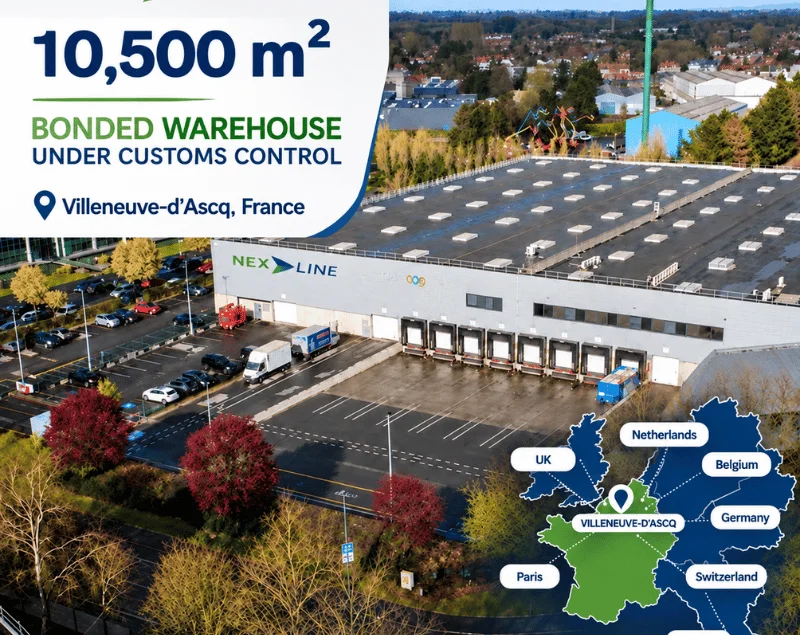
Bonded warehousing can be a valuable solution for companies importing goods into the European Union. It allows businesses to defer customs duties and import taxes while managing inventory according to their operational needs. But how do you know whether bonded warehousing makes sense for your business? At Nexline, we suggest starting with three simple questions. And to support your operations, our 10,500 m² warehouse in Villeneuve-d’Ascq, France, now operates under customs control, with a dedicated IM7 area. 1. Do Your Imported Goods Remain in Storage for More Than 4 to 6 Weeks? When imported goods remain in storage for several weeks before being sold, paying customs duties immediately can put pressure on your cash flow. Bonded warehousing allows non-EU goods to be stored under customs control without immediately paying import duties and applicable taxes. As a result, you can defer these payments until the goods are released for free circulation in the EU, subject to the applicable customs and tax rules. This can be particularly useful for businesses managing a gap between the arrival of their products and their sale. 2. Do You Re-Export Some of Your Goods Outside the European Union? Some businesses import goods into the EU before distributing them to different markets, including destinations outside the European Union. In this situation, bonded warehousing can offer an important advantage. Goods stored under the customs warehousing procedure can be re-exported without incurring EU import duties and VAT, provided the relevant customs conditions are met. The European Commission explains how customs warehousing works, including the options available when goods leave the warehouse. For companies managing international distribution flows, this flexibility can make a significant difference. 3. Do You Pay Customs Duties and VAT When the Entire Container Arrives? You import a full container, but you do not sell all the goods immediately. Depending on your current customs arrangements, you may have to pay duties and taxes before the products generate revenue. Bonded warehousing allows you to defer these payments while the goods remain under the customs warehousing procedure. This means you can better align inventory releases with your commercial requirements. The European Commission also provides guidance on import VAT and customs suspensive arrangements. Nexline: 10,500 m² of Bonded Warehousing in Villeneuve-d’Ascq, France Did you answer yes to any of these three questions? Our bonded warehousing solution could be a good fit for your business. Located in Villeneuve-d’Ascq, northern France, our 10,500 m² logistics facility now offers bonded warehousing, including a dedicated IM7 area. This capacity allows us to support our customers with the storage and management of imported goods, taking into account their logistics flows and operational requirements. At Nexline, we believe that every supply chain has its own challenges. That’s why we take the time to understand your business before designing a solution that fits. Discover more about our warehousing and inventory management solutions. Could Bonded Warehousing Improve Your Logistics Operations? Every business faces different challenges when it comes to storage, cash flow and international distribution. Bonded warehousing is not necessarily the right solution for every shipment. However, it is worth considering if your goods remain in storage for extended periods, if you re-export part of your inventory or if you want greater flexibility in managing customs duties and taxes. The next step? Let’s review your logistics flows and explore how our bonded warehousing solution in Villeneuve-d’Ascq could meet your needs. Talk to our logistics experts DISCOVER OUR TRANSPORT SERVICES
Nexline Bangladesh Supports an Athlete at Powerman Malaysia 2026

Nexline Bangladesh proudly supported a Bangladeshi athlete competing in Powerman Malaysia 2026. Led by Mohammad Osman Ghani, our Bangladesh Manager, this sponsorship reflects the values we strongly believe in: commitment, perseverance, ambition and mutual support. For Nexline Group, supporting this athlete was about much more than putting our name on a jersey. It was about standing behind someone determined to push beyond their limits and achieve a personal goal. Powerman Malaysia 2026: A Challenge of Determination and Perseverance Competing in Powerman Malaysia 2026 was a demanding challenge for the Bangladeshi athlete. After an experience that pushed him beyond his limits, he successfully crossed the finish line. His achievement reflects the determination and resilience needed to overcome a major sporting challenge. Throughout this journey, Nexline Bangladesh was proud to support him. Beyond the sporting achievement, this experience highlights a belief we share: personal commitment matters, but the support of others can make all the difference. Shared Values Between Sport and Logistics At Nexline Group, we believe sport and logistics share essential values. Commitment, perseverance and ambition are important when facing challenges. However, success also depends on trust, preparation and teamwork. These principles guide our teams every day. As we highlighted in our article on the shared values between business and sport, strong results are built through collective effort. By supporting an athlete at Powerman Malaysia 2026, Nexline Bangladesh brought these values to life beyond our daily logistics operations. Nexline Bangladesh: Supporting Local Communities Being an international company also means staying connected to the countries and communities where our teams operate. At Nexline, we value local initiatives that allow our colleagues to make a difference beyond their professional responsibilities. This sponsorship is a meaningful example of that commitment. We would like to thank Mohammad Osman Ghani, our Bangladesh Manager, for making this initiative possible. His involvement reflects Nexline Group’s people-first approach: an international company built around committed teams, strong relationships and local engagement. Crossing the Finish Line Together Congratulations to the athlete for successfully completing Powerman Malaysia 2026 and proudly representing Bangladesh. We are delighted to have played a small part in this journey. His achievement reminds us that determination helps us move forward, while encouragement and mutual support make the journey even more meaningful. Some distances are easier to cover when someone believes in you. DISCOVER OUR TRANSPORT SERVICES
Sea Freight: Everything You Need to Know
Sea freight is at the heart of international trade. Every day, thousands of containers carry goods across continents, connecting suppliers, manufacturers, distributors and importing companies. According to the United Nations Conference on Trade and Development (UNCTAD), approximately 80% of global merchandise trade by volume is transported by sea. This figure highlights an important reality: for many companies, supply chain performance depends directly on the efficiency of their ocean freight operations. But how do you organise a shipment efficiently? Which container should you choose? What transit times and costs should you anticipate? And how can you avoid unexpected charges upon arrival? This guide provides practical answers to help you organise, secure and manage your international sea freight shipments, from collection at your supplier’s premises to final delivery. 1. What Is Sea Freight and How Does It Work? Sea freight refers to the transportation of goods by sea between ports, as part of domestic or international shipping operations. It is particularly suitable for transporting large volumes of goods, industrial supplies and regular import-export shipments. Sea freight relies on coordination between several stakeholders: suppliers, inland transport providers, shipping lines, port terminals, customs authorities and warehouses. Ocean freight therefore involves much more than moving goods across the sea. For businesses, the challenge is to establish an efficient logistics operation that ensures continuity throughout the supply chain. Why Choose Sea Freight? Sea freight offers several advantages for businesses: However, sea freight requires careful planning. Transit times are generally longer than air freight and may vary depending on port conditions and geopolitical developments. In its Review of Maritime Transport 2025, UNCTAD highlights how geopolitical tensions, changes to shipping routes and freight rate volatility are making global supply chains less predictable. To explore the different solutions available for your cargo, discover Nexline’s international sea freight services. 2. How Does an International Sea Freight Shipment Work? An international sea freight shipment generally involves seven main stages. However, contrary to what you might expect, moving goods by sea involves much more than the ocean voyage itself. To transport goods from their place of production to their final destination, several transport modes often need to be combined, including sea, road and rail. This is known as multimodal transport, which makes it possible to organise an end-to-end shipment. Step 1: Preparing the Goods Goods are packaged, packed and labelled according to their nature, dimensions and transport requirements. Packaging must protect products from impacts, handling operations and the conditions encountered during transportation. Step 2: Organising Pre-Carriage Before goods can be loaded onto a vessel, they often need to be transported from the supplier’s factory or warehouse to the port of departure. This stage, known as pre-carriage, is usually carried out by truck. However, rail or inland waterway transport may also be used, depending on the available infrastructure. Step 3: Booking Ocean Freight The freight forwarder identifies and organises a shipping solution based on cargo volumes, destination, transit times and operational requirements. Step 4: Preparing Shipping Documents and Customs Formalities Commercial and transport documents are checked. Applicable customs declarations and procedures are prepared in coordination with the relevant parties. Step 5: Loading and Shipping the Goods Goods are loaded onto the vessel, generally in a suitable shipping container, and transported to the destination port. Step 6: Tracking the Shipment Shipment tracking makes it possible to monitor key transport milestones, identify changes to schedules and anticipate estimated arrival dates. Step 7: Customs Clearance and Final Delivery Once goods arrive at the destination port, they undergo the necessary port operations and customs formalities. They are then transported to the consignee’s warehouse or final delivery location, usually by truck or train. This final stage is known as on-carriage. What Is Multimodal Transport? Multimodal transport involves combining at least two different modes of transport within a single logistics operation. Let’s take the example of a French company importing goods from China: Factory in China → Road transport → Port of Shanghai → Sea freight → Port of Le Havre → Road transport → Warehouse in France. Sea freight handles the main international journey, while road transport connects the ports to the original shipping location and final destination. This combination makes it possible to organise door-to-door transport, without requiring the company to coordinate every service provider individually. For more information about multimodal transport, consult the United Nations Economic Commission for Europe’s terminology on combined transport. Nexline’s Expert Advice A successful sea freight shipment depends on more than the ocean crossing. It requires effective coordination across every link in the supply chain, from the supplier to the final recipient. At Nexline, we organise these different stages by selecting and coordinating the right partners for each operation. Our integrated logistics approach enables us to design consistent, tailored solutions that meet the specific needs of each business. One clear objective: keeping your goods moving smoothly, from start to finish. 3. FCL or LCL: Which Sea Freight Solution Should You Choose? Choosing between a full container load and consolidated shipping is one of the most important decisions when planning a sea freight shipment. FCL: Full Container Load FCL refers to a shipping container dedicated to a single shipper’s goods. This solution is particularly suitable for companies shipping large volumes or looking for an arrangement involving fewer handling operations associated with cargo consolidation. LCL: Less than Container Load LCL, also known as consolidated sea freight, allows goods from several shippers to be transported in the same container. It is particularly suitable for smaller shipments when booking an entire container would not be economically justified. FCL vs LCL: Comparison Criteria FCL LCL Container Dedicated Shared Cargo volume Medium to large Small to medium Pricing Mainly per container Mainly by chargeable weight or volume Handling Generally fewer consolidation-related handling operations Consolidation and deconsolidation Transit times Potentially more direct Additional consolidation time Typical use Large volumes, regular shipments Smaller shipments, variable volumes At What Volume Should You Choose FCL? There is no universal threshold. The choice depends on cargo volume, weight, freight rates, handling charges