In international transport, air freight is rarely chosen for its price.
It is chosen for its speed.
When goods need to move fast, when a production shutdown must be avoided, or when a customer commitment needs to be met, transport cost can sometimes become a secondary issue.
The question companies often ask is:
Is air freight really too expensive?
But the better question is:
In the end, what costs less: waiting, or bringing the goods by air?
As a point of comparison, a World Bank study estimates that air freight generally costs 4 to 5 times more than road transport and 12 to 16 times more than sea freight. This price difference explains why air freight must be used carefully.
Yet its role remains strategic. According to IATA, air cargo represents less than 1% of global trade by volume, but more than 33% by value. Airlines also transport more than 62 million tonnes of goods every year. This shows that air freight is mainly used for high-value, time-sensitive or supply-chain-critical goods.
Why does air freight cost more?
Air freight relies on limited capacity, strict security requirements and short handling times.
Unlike sea freight, which can move large volumes over longer transit times, air freight prioritizes speed.
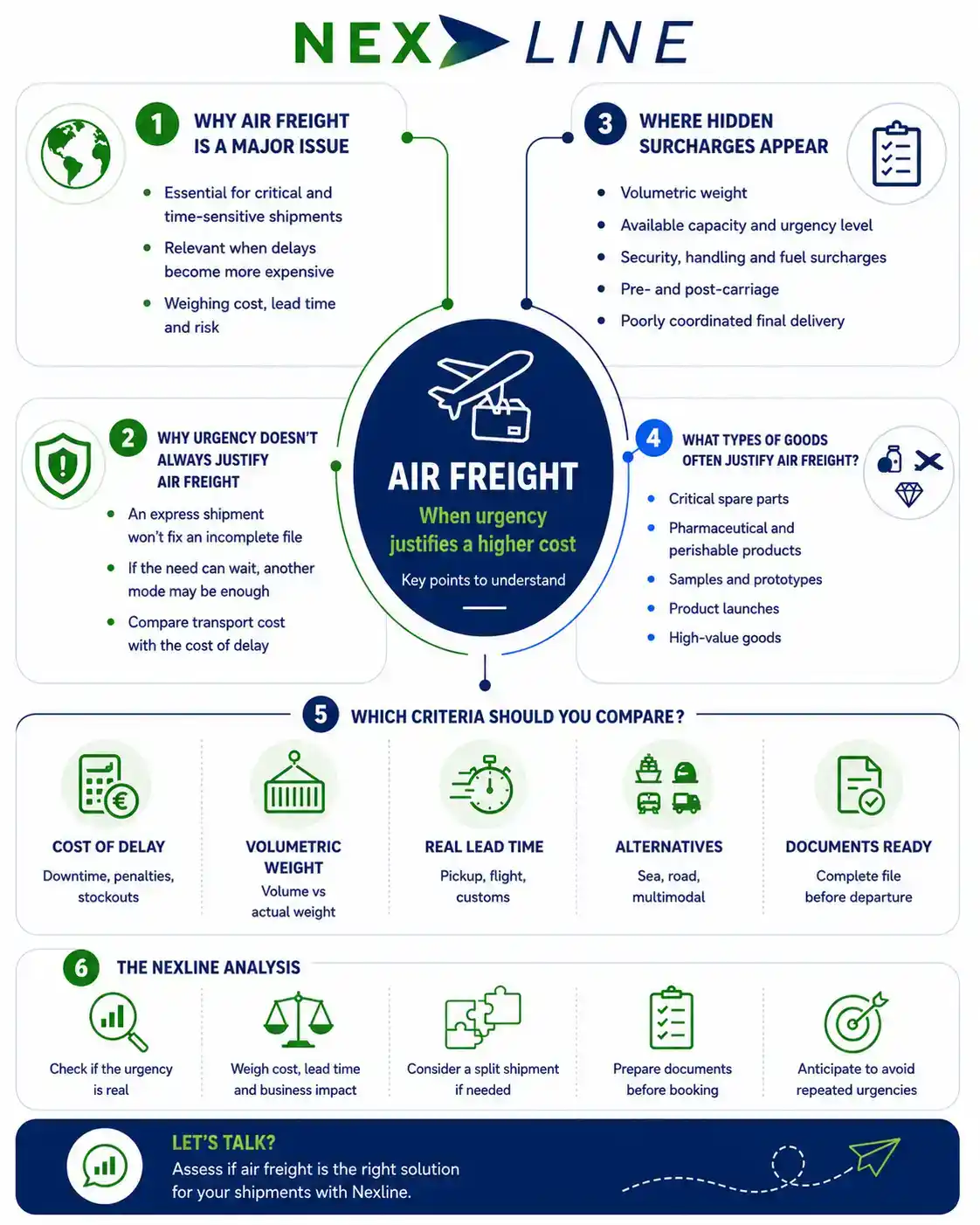
Its cost can depend on several factors: actual weight, volumetric weight, origin, destination, flight availability, urgency level, type of goods, handling constraints, documentation requirements and service level.
Additional costs may also apply, including fuel surcharges, security fees, handling charges, pre-carriage and final delivery costs.
In practice, a light but bulky shipment can be expensive because it takes up a lot of aircraft space.
A heavier but more compact shipment may be charged differently.
Air freight pricing does not only depend on weight.
It also depends on the space used, the expected deadline, available capacity and the level of priority required.
What is volumetric weight in air freight?
In air freight, the actual weight of the goods is not the only factor considered. The space occupied inside the aircraft also affects the price.
This is used to determine the chargeable weight. In general, the airline compares the actual weight with the volumetric weight and applies the higher of the two for billing.
Volumetric weight is usually calculated as follows:
Length × width × height in cm ÷ 6,000
This means that in air freight, 1 m³ equals around 167 kg of volumetric weight.
For example, a package measuring 120 × 100 × 100 cm represents 1.2 m³. Its volumetric weight is therefore 200 kg. If it only weighs 80 kg in reality, the 200 kg figure may be used as the basis for billing.
Packaging therefore has a direct impact on air freight cost. An unnecessarily bulky package can increase the chargeable weight, even if the goods themselves are light.
When does air freight become relevant?
Air freight becomes relevant when the value of time is higher than the savings generated by a slower mode of transport.
It is often used for critical spare parts, urgent industrial components, pharmaceutical products, perishable goods, production samples and high-value goods.
It may also be relevant for electronic equipment, priority customer orders, urgent replenishment, time-sensitive goods, documents or strategic prototypes.
IATA highlights the specific role of air freight for high-value and time-sensitive goods, thanks to speed, reliability, security and specialized handling capabilities.
Does urgency always justify air freight?
No. Urgency does not automatically mean that goods should be shipped by air.
The decision mainly depends on the real cost of delay. A low-value component, for example, may justify air freight if its absence blocks a production line or immobilizes critical equipment. In that situation, a few hours or days of downtime can cost far more than the air freight premium.
The same logic applies when a delay creates penalties, stockouts, lost sales or compromises an important customer delivery.
On the other hand, if the goods can wait a few more days without major consequences for the business, a more economical transport mode will usually be more relevant.
The question is not only how much air freight costs, but how much waiting would cost.
How can companies compare air freight cost and delay cost?
To make the right decision, companies need to look at the total cost.
| Question to ask | Why it matters |
|---|---|
| What is the value of the goods? | High-value goods can absorb a higher transport cost more easily |
| What is the cost of one day of delay? | It may be much higher than the price of air freight |
| Is the end customer expecting a specific delivery date? | A delay can damage the commercial relationship |
| Does production depend on this part? | One missing component can block an entire line |
| Is there a sea or road alternative? | It may be enough if the deadline remains acceptable |
| Is the need truly urgent? | Some emergencies can be anticipated or consolidated |
| Are the documents ready? | An incomplete file can cancel the time gained |
| Is final delivery organized? | The aircraft arrival does not guarantee delivery to the recipient |
This analysis helps avoid two common mistakes.
The first is rejecting air freight only because it is more expensive.
The second is choosing air freight by reflex, without checking whether the urgency is real.
What types of goods often justify air freight?
Some goods are better suited to air freight than others.
1. Critical spare parts
A spare part may have a low unit value but a very high operational impact.
If it blocks a machine, a production line or a technical intervention, the cost of delay can quickly exceed the cost of air freight.
In this case, air freight helps reduce downtime.
2. High-value goods
High-value goods can often absorb a higher transport cost.
This may apply to electronic components, technology products, sensitive equipment or premium goods.
Air freight can also provide a level of security and tracking suited to sensitive shipments.
3. Perishable goods
Some products lose value quickly when transit times are too long.
IATA describes perishable goods as products that are time-sensitive and/or temperature-sensitive. Air freight can therefore help preserve their quality, safety and value within an international supply chain.
4. Pharmaceutical and healthcare products
Pharmaceutical, biological or medical products may require short transit times, controlled temperature and reinforced traceability.
The WHO states that almost all vaccines used in immunization programmes are licensed for storage and distribution in a traditional cold chain between 2°C and 8°C.
In this context, air freight can reduce transit times, provided that packaging, temperature control, documents and handling are properly managed.
5. Product launches
A commercial launch can depend on a specific date.
In this case, a delay can affect communication, sales, commercial teams and customer relationships.
Air freight can help secure product availability on time.
6. Samples and prototypes
Some samples need to arrive quickly to validate production, unlock an order or support a commercial decision.
Even if their market value is limited, their operational value can be important.
In this case, air freight can accelerate decision-making.

Air freight or sea freight: how should companies decide?
Sea freight is often more economical for large volumes and less urgent goods.
Air freight becomes more relevant when time becomes the main factor.
| Situation | Often suitable mode |
|---|---|
| Large volume, flexible deadline | Sea freight |
| Urgent goods, low volume | Air freight |
| Planned replenishment | Sea freight or multimodal |
| Critical spare part blocking operations | Air freight |
| Perishable product with strong time constraint | Air freight |
| Heavy goods with no urgency | Sea freight |
| Intermediate cost/time need | Multimodal solution |
| Only one part is urgent | Split shipment: air for the urgent part, sea for the rest |
The decision should not simply oppose air freight and sea freight.
In some cases, a combined solution can be more relevant.
For example, the critical part of an order can be shipped by air, while the rest travels by sea.
This helps secure the urgent need without increasing the total cost unnecessarily.
What alternatives exist to urgent air freight?
Before booking air freight, it can be useful to review several alternatives.
1. Accelerated sea freight
On some routes, sea freight remains relevant if the deadline is still acceptable.
It can be more economical for large volumes.
2. Express road transport
For European or regional flows, express road transport can sometimes respond to urgency at a lower cost than air freight.
3. Multimodal transport
A solution combining several transport modes can offer a better balance between cost and lead time.
4. Split shipment
This solution consists of separating the shipment into two parts.
The urgent part is shipped by air.
The rest is shipped using a more economical mode.
This is often a good option when only part of the shipment is truly critical.
5. Air charter
An air charter can be considered in extreme situations.
It can respond to a very high level of urgency, but its cost is usually significant.
It should therefore be reserved for cases where the impact of delay is very high.
What are the risks of poorly prepared air freight?
Air freight is fast, but it does not forgive inaccuracies.
An incomplete file can create a blockage, even when flight capacity is available.
The most common risks include incorrect dimensions, underestimated volumetric weight, missing documents, unsuitable packaging, underestimated customs constraints, regulated goods, missing temperature information, poor coordination between pickup, flight and final delivery, premature ETA communication and extra costs caused by poor preparation.
In air freight, speed does not only depend on the aircraft.
It also depends on the quality of the information provided before shipment.
IATA reminds that air cargo acceptance and handling require checking that shipments are ready for transport, in compliance with operator rules, IATA regulations and the export/import requirements of the countries involved.
What documents should be prepared for urgent air freight?
Urgent air freight can lose its value if the documents are not ready.
Depending on the goods and the countries involved, companies may need to prepare a commercial invoice, packing list, customs code, origin information, Incoterm, shipper and consignee details, regulatory documents, health or phytosanitary certificates where required, product data sheet, safety data sheet for certain goods, temperature instructions, handling instructions and insurance information where necessary.
A missing document can create a delay greater than the time saved by using air transport.
This is why documentation work should begin before booking.
How can companies prevent urgency from becoming systematic?
Air freight is sometimes essential.
However, it should not become the default solution because shipments were poorly anticipated.
To limit urgent shipments, companies first need to identify their critical goods more clearly and monitor sensitive stock levels. They should also anticipate supplier lead times, prepare documents before shipment and compare transport options early.
This approach makes it possible to plan alternatives for strategic flows, analyze recurring delays and clearly define when air freight is truly authorized.
The goal is to formalize decision criteria between cost, time and risk, so that air freight is reserved for situations where it truly creates value.
This anticipation also helps avoid paying more simply because a decision was made too late.
The human touch to your supply chain
The Nexline analysis
Air freight is not a solution to use automatically.
It is a solution to activate when lead time, risk or the value of the goods justifies a higher cost.
But the challenge is not only to choose between air freight, sea freight or road transport.
Companies also need to understand why the urgency appears.
An urgent shipment may come from a real unexpected event: a breakdown, a stockout, a priority customer request, sensitive goods or a supplier delay.
In this case, air freight can be the best option to protect the business.
But urgency can also reveal a lack of anticipation: documents prepared too late, insufficient stock, underestimated supplier lead times or no alternative transport solution.
At Nexline, the objective is therefore twofold.
First, help companies decide quickly when air freight is truly necessary.
Then, analyze the causes of urgency to prevent this type of situation from becoming systematic.
This means looking at the real urgency, the value of the goods, the impact of delay, available transport alternatives, customs feasibility, available documents, final delivery constraints, volumetric weight, available transport solutions and possible root causes.
Well-prepared air freight can secure a critical operation.
By contrast, air freight decided too quickly, without a complete analysis, can be expensive without solving the real issue.
The objective is simple: use speed when it truly creates value, while strengthening anticipation to reduce avoidable emergencies.
FAQ
When should companies choose air freight?
Air freight is relevant when the deadline is critical, when the goods have high value, or when a delay can significantly affect production, sales or the customer relationship.
Why does air freight cost more?
Air freight costs more because it relies on limited capacity, short deadlines, strict security requirements and specialized handling resources. The price also depends on actual weight, volumetric weight, destination and the level of service required.
What is volumetric weight in air freight?
Volumetric weight reflects the space occupied by the goods inside the aircraft. A light but bulky shipment can therefore cost more than a compact shipment because it takes up more space.
Is air freight always faster?
Yes, air transport is generally faster than sea freight over long distances. However, the real lead time also depends on pickup, cargo handling, customs clearance and final delivery.
What goods are often shipped by air freight?
Urgent goods, critical spare parts, high-value products, pharmaceutical goods, perishables, electronic components and some production samples are often shipped by air freight.
How can companies reduce air freight costs?
Companies can reduce costs by checking the real urgency, optimizing packaging, reducing unnecessary volume, comparing service levels and preparing documents before booking.
Should companies choose air freight or sea freight?
Sea freight is often suitable for large volumes and flexible deadlines. Air freight is preferable when time, value or operational risk justifies a higher cost.
Can air freight be combined with sea freight?
Yes. In some cases, only the urgent part can be shipped by air, while the rest is shipped by sea. This helps secure the urgent need while controlling the overall cost.
How can companies avoid repeated emergencies?
They need to identify critical flows, monitor sensitive stocks, anticipate supplier lead times, prepare documents early and plan alternatives for strategic shipments.
In summary
Air freight is more expensive than other transport modes.
But in some cases, this cost can be justified.
When goods are urgent, critical, sensitive or high-value, the real risk is not always the transport price.
The real risk may be delay.
Before choosing air freight, companies should compare transport cost with the real cost of late delivery.
They should also check volumetric weight, documents, packaging, service level and final delivery feasibility.
A good decision helps secure deadlines, limit risks and protect operational continuity.
Above all, good anticipation allows air freight to be reserved for real emergencies, instead of being used as a costly last-minute solution.
En brief