Choosing a mode of freight transport is not simply a matter of comparing prices. An economical sea freight solution can become costly if delivery delays lead to stock shortages. Conversely, more expensive air freight may be justified when it helps prevent a production shutdown.
Sea, air, road or rail freight: the right choice depends on your goods, your budget, your delivery deadlines and your logistical requirements.
Each transport solution has its advantages and limitations. In some cases, combining several modes of transport can provide a better balance.
According to the European Court of Auditors, intermodal transport makes it possible to leverage the strengths of each mode in terms of flexibility, speed, cost and environmental performance.
So, how do you make the right decision? Which factors should you consider? And how can you optimize your costs without compromising the reliability of your supply chain?
Here are the key factors to consider when choosing a transport solution that meets your business needs.
1. Comparison: Sea, Air, Road or Rail Freight?
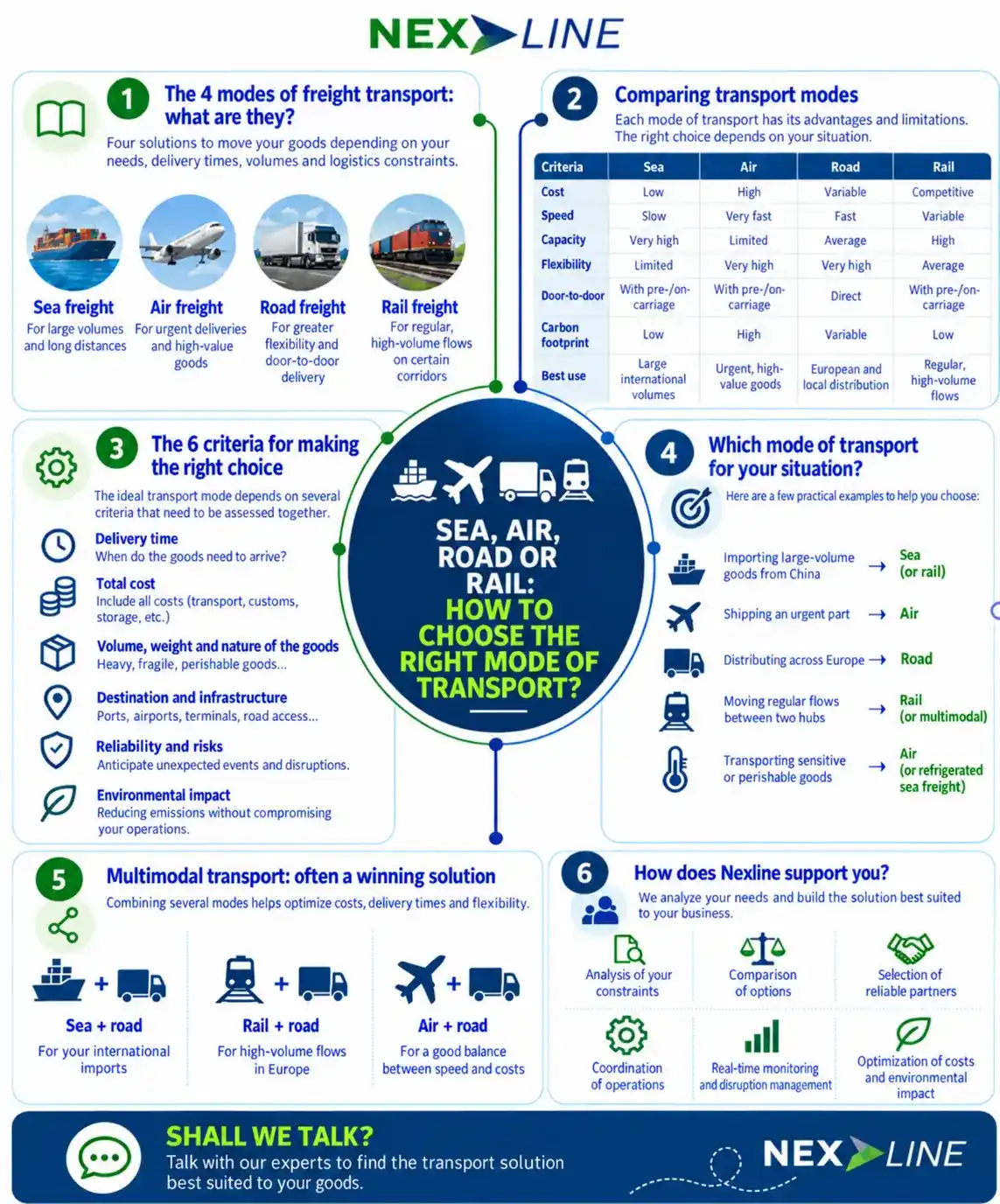
There is no single best mode of transport for every situation. Sea freight is often a cost-effective option for large international shipments, air freight for urgent deliveries, road freight for its flexibility, and rail freight for certain high-volume shipments.
The following table compares their main characteristics.
Comparison of Sea, Air, Road and Rail Freight
| Criteria | Sea Freight | Air Freight | Road Freight | Rail Freight |
|---|---|---|---|---|
| Relative cost | Often low for large volumes | High | Varies depending on distance | Competitive on certain routes |
| Speed | Low | Very high | High over short and medium distances | Variable |
| Capacity | Very high | Limited | Moderate per vehicle | High |
| Flexibility | Depends on ports | Depends on airports | Very high | Depends on the rail network |
| Door-to-door | Requires inland transport | Requires inland transport | Direct | Requires inland transport |
| Best suited for | Large-scale imports and exports | Urgent, high-value shipments | Distribution, European transport | Regular, high-volume shipments |
| Emissions per tonne-km | Generally low | Generally high | Variable | Generally low |
This comparison presents general trends. Actual performance depends on the route, type of goods, load factor, equipment used and operating conditions.
The European Environment Agency confirms that rail and waterborne transport generally produce lower greenhouse gas emissions than road and air transport.
However, a mode of transport that performs well on paper is not necessarily the best solution for a specific shipment.
A train operating below capacity, a route requiring multiple transfers, or a particularly long sea route can change the economic and environmental balance.
This is why comparisons should always consider the entire logistics operation.
EXPLORE OUR TRANSPORT SERVICES
2. The Six Essential Criteria for Choosing the Right Mode of Transport
When selecting a transport solution, six key criteria must be considered together: delivery times, total cost, cargo characteristics, destination, reliability and environmental impact.
1. Delivery Time: Your First Priority
The first question is simple: when do your goods actually need to arrive?
An order intended to replenish stock in three months does not have the same requirements as a component needed for industrial production within the next few days.
Depending on the situation:
- Urgent international shipments: air freight may be the preferred option.
- Fast deliveries within Europe: road freight may be suitable.
- Planned shipments: sea freight or rail freight may be worth considering.
- Intermediate requirements: combining multiple modes of transport may be an effective solution.
It is also important to distinguish between transit time and door-to-door delivery time.
An air freight shipment involving just a few hours of flight time may still require several additional steps: collection, document preparation, cargo handling, customs clearance and final delivery.
The delivery time you should compare is therefore the total time between the actual departure of the goods and their availability to the recipient.
2. Total Cost: Looking Beyond Freight Rates
The price quoted by a transport provider does not necessarily reflect the total cost of a shipment.
To make a meaningful comparison, you need to consider:
- Main freight costs.
- Pre-carriage and on-carriage transport.
- Cargo handling and terminal fees.
- Customs formalities and associated charges.
- Insurance, where applicable.
- Warehousing and potential storage or detention charges.
- Indirect costs associated with transit times.
Let’s take an example.
A company is comparing a cost-effective sea freight option with a faster air freight solution.
Sea freight costs less upfront. However, it may require maintaining higher inventory levels to cover longer lead times.
Air freight, although more expensive, can help reduce certain storage costs or prevent stock shortages.
The key is therefore to compare total logistics costs, not just freight rates.
3. Weight, Volume and Nature of the Goods
Not all goods can be transported under the same conditions.
Several characteristics directly influence the choice of transport:
- Total weight.
- Volume and dimensions.
- Value of the goods.
- Fragility.
- Shelf life.
- Any temperature requirements.
- Regulatory classification.
Bulky, non-urgent goods are often well suited to sea freight.
Lightweight, high-value or urgent goods may justify using air freight.
Heavy industrial goods transported regularly along a suitable route may be more efficiently shipped by rail.
Finally, the transport of dangerous goods or…
The original French text ends mid-sentence. Send me the rest and I’ll complete the translation.
4. Destination: Infrastructure Makes a Difference
The choice of transport also depends on where the goods need to be delivered.
A factory located near a major port, cargo airport or rail terminal has different transport options compared to a warehouse located far from major infrastructure.
When assessing a transport route, several factors need to be considered:
- Accessibility of ports, airports and terminals.
- Frequency of departures.
- Connections and transshipments.
- Availability of transport providers.
- Customs requirements.
- Feasibility of last-mile delivery.
A route that is theoretically faster may ultimately prove less advantageous if it involves complex connections or multiple cargo handling operations.
5. Reliability: Anticipating Disruptions
Fast transport does not necessarily offer the highest level of predictability.
Shipments can be disrupted by a wide range of factors:
- Port or airport congestion.
- Weather conditions.
- Geopolitical disruptions.
- Traffic restrictions.
- Capacity constraints.
- Customs inspections.
- Delays during cargo handling operations.
According to UNCTAD’s Review of Maritime Transport 2025, geopolitical tensions have a significant impact on shipping routes, costs and supply chain predictability.
For a business, the best transport solution is therefore not simply the one that promises the shortest delivery time.
It is the one whose level of reliability meets its operational requirements.
6. Environmental Impact: Factoring Emissions into Your Decision
Businesses are increasingly incorporating emissions from freight transport into their environmental strategies.
On many routes, rail freight and sea freight have a lower carbon intensity than air freight.
However, it is important to avoid jumping to conclusions.
A meaningful environmental comparison should take into account:
- The entire transport route.
- The type of propulsion and fuel used.
- The load factor.
- The distances travelled.
- Transshipment operations.
- Any empty return journeys.
The objective is to identify opportunities to reduce emissions without compromising operational reliability.
To learn more, explore the Smart Freight Centre’s resources on measuring and reducing freight transport emissions
3. Which Mode of Transport Should You Choose for Your Shipment?
The best way to understand the differences between modes of transport is to look at how they apply to real-world situations.
You Import Bulky Goods from China
Recommended option to consider first: sea freight.
For a French company regularly importing furniture, home décor or consumer goods, sea freight is often a cost-effective solution.
Depending on shipment volumes, there are two main options:
- FCL (Full Container Load): a container dedicated to a single shipper.
- LCL (Less than Container Load): consolidated shipments from multiple shippers sharing a container.
The choice depends on shipment volume, delivery times and total shipping costs.
If part of the order becomes urgent, a supplementary air freight shipment may also be considered.
You Need to Ship an Industrial Component Urgently
Recommended option to consider first: air freight.
When a delay threatens to halt production, speed may take priority over cost.
Air freight can reduce international transit times, provided suitable routes and capacity are available.
However, actual collection, customs clearance and final delivery times must be checked before confirming the transport solution.
You Regularly Distribute Goods Across Europe
Recommended option to consider first: road freight.
For deliveries to multiple warehouses or distributors across Europe, road freight offers a high degree of flexibility.
Depending on shipment volume, businesses can choose between:
- Full Truckload (FTL): a dedicated truck for a single shipment.
- Less than Truckload (LTL): consolidated shipments sharing truck capacity.
- Express delivery: for time-sensitive shipments.
For large, recurring shipments, rail freight may also be worth considering on routes where suitable connections are available.
You Regularly Transport Containers Between Two Logistics Hubs
Recommended option to consider: rail freight or a combination of rail and road transport.
When shipment volumes are sufficient and terminals are conveniently located, rail freight can offer economic and environmental benefits.
Road transport is generally still required for collection from the shipper or final delivery to the recipient.
The suitability of this solution depends on several factors, including shipment frequency, rail schedules and transshipment costs.
You Ship Sensitive or Perishable Goods
Recommended option: the transport solution that meets the product’s specific requirements.
The choice depends on acceptable delivery times, shelf life, temperature requirements and handling conditions.
Air freight may be suitable for perishable goods requiring fast delivery.
Sea freight in refrigerated containers may be appropriate for large shipments of goods with a shelf life that allows for longer transit times.
In both cases, appropriate packaging and strict cold chain management are essential to prevent temperature disruptions during transport.
4. What If Multimodal Transport Were the Best Solution?
Multimodal transport involves using at least two different modes of transport for a single shipment.
The objective is to take advantage of the strengths of each mode rather than relying on a single transport solution for the entire journey.
According to the European Commission, developing multimodal transport is a key way to improve the efficiency of transport chains and reduce their environmental impact.
Sea + Road Freight: A Common Combination in International Shipping
Let’s take the example of a container shipped from a Chinese factory to a warehouse in France.
The journey can be organized as follows:
Factory in China → Truck → Port of Shanghai → Cargo Ship → Port of Le Havre → Truck → Warehouse in France.
Sea freight handles the main leg of the journey, while road freight covers pre-carriage and final delivery.
Rail + Road Freight: Consolidating Shipments Without Losing Flexibility
For certain continental freight routes, rail can handle most of the journey, while trucks provide connections between rail terminals and logistics facilities.
This approach makes it possible to take advantage of rail freight’s high capacity while maintaining the flexibility of road transport for the first and last legs of the journey.
Sea + Air Freight: Balancing Costs and Delivery Times
On certain international routes, a solution combining sea and air freight may be considered.
This involves transporting part of the shipment by sea, then using air freight for the remaining journey.
This approach can offer a compromise between shipping entirely by sea and relying exclusively on air freight.
However, it is essential to check the availability of connections, customs requirements and transshipment costs.
Nexline’s Advice
The best route is not always the most direct.
At Nexline, we analyze your entire logistics operation before selecting the most suitable modes of transport and partners.
Our role is to coordinate a seamless supply chain, from collection to final delivery.
Discover our multimodal transport solutions.

5. How Does Nexline Help You Choose the Right Transport Solution?
Comparing different modes of transport is the first step. Managing their day-to-day operations is another challenge altogether.
An international shipment may involve several carriers, warehouses, terminals, customs service providers and local partners.
For businesses, the challenge is to ensure effective coordination between all these parties while minimizing the risk of disruptions throughout the supply chain.
This is precisely the role of a freight forwarder.
At Nexline, our goal is not to systematically sell you sea, air, road or rail freight services.
We build the transport solution that meets your specific needs.
Our approach is based on several key steps:
- Understanding your requirements. We analyze your goods, shipping volumes, delivery deadlines and priorities.
- Comparing the options. We assess available routes, modes of transport and consolidation opportunities.
- Selecting the right partners. We leverage our international network according to the specific requirements of each shipment.
- Coordinating operations. We organize the different stages of transport and manage the parties involved.
- Monitoring shipments. We provide visibility into the progress of your shipments and any unexpected disruptions.
- Identifying improvements. We look for opportunities to optimize costs, delivery times and overall logistics performance.
Our experience in international freight forwarding has taught us one thing: a good logistics solution is not just about competitive pricing.
It also depends on the ability to anticipate problems and respond to them effectively.
That’s the difference between simply booking transportation and building an efficient supply chain.
Would you like to compare different transport solutions for your goods?
Let’s discuss your logistics needs
7. FAQ: Frequently Asked Questions About Choosing the Right Mode of Transport
What is the cheapest mode of freight transport?
Sea freight is often the most cost-effective option for shipping large volumes over long international distances. However, no single mode of transport is always the cheapest. For certain European routes, road or rail freight may be more economical. The decision should take into account cargo handling costs, additional transport legs, customs formalities and any potential storage fees.
What is the fastest mode of freight transport?
Air freight is generally the fastest option for long-distance international shipments. However, over shorter distances, road freight may be more efficient for door-to-door deliveries, as it avoids certain cargo transfers. When comparing delivery times, it is essential to consider the entire journey, not just the main transport leg.
Which mode of transport should you choose when importing from China?
Sea freight is generally suitable for large-volume imports that can be planned in advance. Air freight is better suited to urgent, sensitive or high-value goods. Rail freight may also be considered along certain corridors, depending on service availability and operating conditions. The decision depends on shipment volume, budget, destination and required delivery time.
Is rail freight more environmentally friendly than road freight?
Rail freight generally has a lower greenhouse gas emissions intensity than road freight, particularly for consolidated, high-volume shipments. However, its environmental impact depends on the energy mix, distances travelled, load factors and any additional transport operations. A reliable comparison must consider the entire journey.
How can you reduce international freight costs?
Reducing international freight costs requires a combination of strategies: consolidating shipments, planning orders in advance, choosing transport modes based on actual delivery requirements and minimizing additional charges. Effective coordination between suppliers, carriers and warehouses also plays an important role. The goal is to reduce overall supply chain costs without compromising service quality.
To explore this topic further, read our article: Transport Cost Optimization: How to Reduce Expenses Without Compromising Your Operations.
Can you combine sea, air, road and rail freight?
Yes. This is the principle of multimodal transport. For example, a company may combine sea and road freight to import goods from Asia or use rail and road freight for continental shipments. Some solutions also combine sea and air freight. The choice depends on available infrastructure, delivery times, costs and operational requirements.
In Summary