When a company needs to transport goods, road freight is often the first solution considered.
Full truckload, groupage, express delivery, long-haul transport… Several options are available depending on the type of goods and the requirements of the flow.
But what exactly does road freight mean? How much does road transport cost? When should you choose a full truckload rather than groupage? And is road transport always the best solution?
In this guide, we take a straightforward look at road freight, how it works, and the main criteria to consider before choosing a transport solution.
Road freight: definition
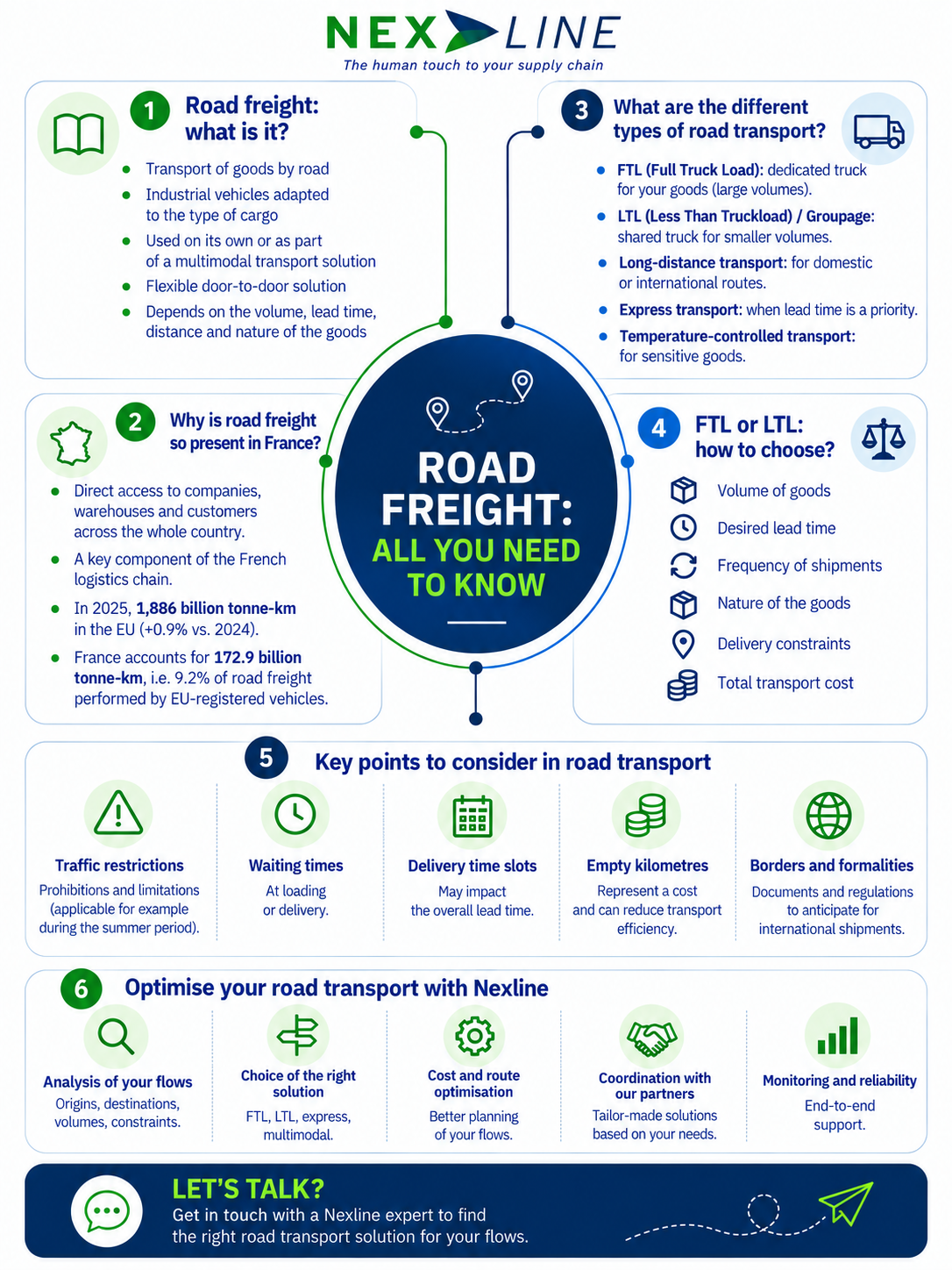
Road freight refers to the transportation of goods by road, generally using commercial vehicles adapted to the type of cargo.
In France, road freight transport is a key part of the logistics chain. The road network provides direct access to businesses, warehouses, and end customers, offering a high degree of flexibility.
In practice, goods can be transported:
- from a warehouse to a customer,
- from a factory to a port,
- from a rail terminal to a warehouse,
- or directly from a supplier to the final customer.
Road freight can therefore be used on its own or as part of multimodal transport.
The choice of transport solution then depends on the volume, lead time, distance, and specific requirements of the goods.
Why is road freight so widely used in France?
Road freight in France plays a central role in the movement of goods. Trucks can serve businesses, warehouses and customers directly, without requiring an intermediate terminal.
This importance is also reflected at European level. In 2025, road freight transport in the European Union reached 1,886 billion tonne-kilometres, an increase of 0.9% compared with 2024. France alone accounted for 172.9 billion tonne-kilometres, representing approximately 9.2% of road freight performed by EU-registered vehicles. European Commission
What are the different types of road transport?
Not every shipment requires the same vehicle or transport organization.
FTL: full truckload
FTL (Full Truck Load) means that the truck is dedicated to your goods.
This solution is particularly suitable for large volumes or goods that require fewer handling operations.
LTL : groupage transport
LTL (Less Than Truckload) means that your shipment does not fill an entire truck.
It can therefore be consolidated with other shipments.
Example:
A company needs to ship 3 pallets to Spain.
Booking an entire truck just for these 3 pallets is not necessarily the most relevant solution.
Road freight consolidation allows the transport capacity to be shared with other shipments.
Long-haul transport
Road transport can also be used for inter-regional or international journeys.
It offers significant flexibility for door-to-door deliveries and can be particularly relevant when the origin and destination are far from rail or port terminals.
Express transport
When delivery time is the priority, an express solution can be arranged.
In this case, the main consideration is no longer simply the transport price: lead time becomes the determining factor.
FTL or LTL: How do you choose?
The difference is ultimately quite simple:
| FTL | LTL / Groupage | |
|---|---|---|
| Truck | Dedicated | Shared |
| Volume | Large | Small or medium |
| Handling | Limited | Potentially more frequent |
| Cost | Dedicated truck | Shared transport cost |
| Best suited for | Large flows | Smaller shipments |
But volume is not the only factor.
You should also consider shipment frequency, required lead time, type of goods and delivery constraints.
How much does road freight cost?
There is no single standard price for road freight transport.
The price depends on factors including:
- distance;
- weight and volume;
- vehicle type;
- type of goods;
- destination;
- tolls and other route-related costs;
- loading and delivery requirements;
- whether FTL or groupage is used.
And there is an important point to keep in mind: the transport price does not necessarily represent the total cost of the logistics flow.
You may also need to consider handling, waiting time, pre-carriage or on-carriage costs.
This is why two transport solutions with different quoted prices can ultimately have a similar total logistics cost.
Would you like to know the cost of your flow? Request a tailored quote and speak with a Nexline expert.
DISCOVER OUR TRANSPORT SERVICES
What should you watch out for when using road transport?
Road transport offers a high degree of flexibility, but several factors need to be anticipated.
– Traffic restrictions
Heavy goods vehicles are subject to traffic restrictions that can affect transport schedules. In France, general and additional restrictions apply during certain periods, particularly in summer.
– Waiting times
A truck may be available but still spend several hours waiting at loading or delivery.
– Delivery time slots
A delay of just a few hours can have significant consequences when a warehouse or customer operates with scheduled delivery appointments.
– Empty kilometres
Empty runs generate costs and can reduce the economic efficiency of transport.
– Borders and customs formalities
For international transport, the necessary formalities and documentation must be anticipated.
The performance of road transport therefore depends just as much on how the flow is planned as on the journey itself.
Nexline’s analysis
The question is ultimately not simply:
“Which truck should I book?”
It is rather:
“What organization will allow this shipment to be transported at the right cost, within the required timeframe and with the expected level of service?”
The same shipper may need FTL for some flows, LTL for others, and a multimodal solution for long-distance shipments.
This is why road transport should be considered as an integral part of the supply chain, rather than simply as a transport service.
At Nexline, flow analysis takes into account origin, destination, volumes, frequency, lead times, goods, delivery constraints, and any customs requirements.
The objective: to build the most coherent solution for your flow rather than applying a standard formula.
FAQ — Road transport
Can road transport and rail freight be combined?
Yes. Trucks can handle pre-carriage and on-carriage, while rail takes care of part of the journey. This is the principle behind rail-road multimodal transport.
Is road transport suitable for long distances?
Yes, particularly for certain European or inter-regional flows. However, for long-distance shipments, it is worth comparing road freight with rail, sea freight or a multimodal solution based on volume, lead time and total cost.
What is the difference between FTL and LTL?
With FTL, the truck is dedicated to your goods. With LTL, your shipment shares available truck capacity with other goods. The choice depends mainly on volume, frequency and the level of service required.
How can you reduce the cost of road transport?
The main levers include consolidating shipments, optimizing routes, choosing between FTL and LTL, reducing waiting times, and improving flow planning.
In summary