You have goods to transport over a long distance.
Sea freight may be too slow. Air freight may be disproportionate to the value or urgency of the shipment. And road transport is not always the only option.
Rail freight can be an interesting alternative.
But choosing rail is not simply a matter of comparing the price of a train with that of a truck.
The better question is:
- Is rail freight suited to my flow, volumes, lead times and logistics organisation?
Distance, volume, shipment frequency, terminal locations, pre-carriage, final delivery, door-to-door transit time, total cost…
The choice of transport mode should be based on the entire journey.
In this guide, Nexline explains when rail freight can be relevant, how it works in practice and which criteria to consider before making a decision.
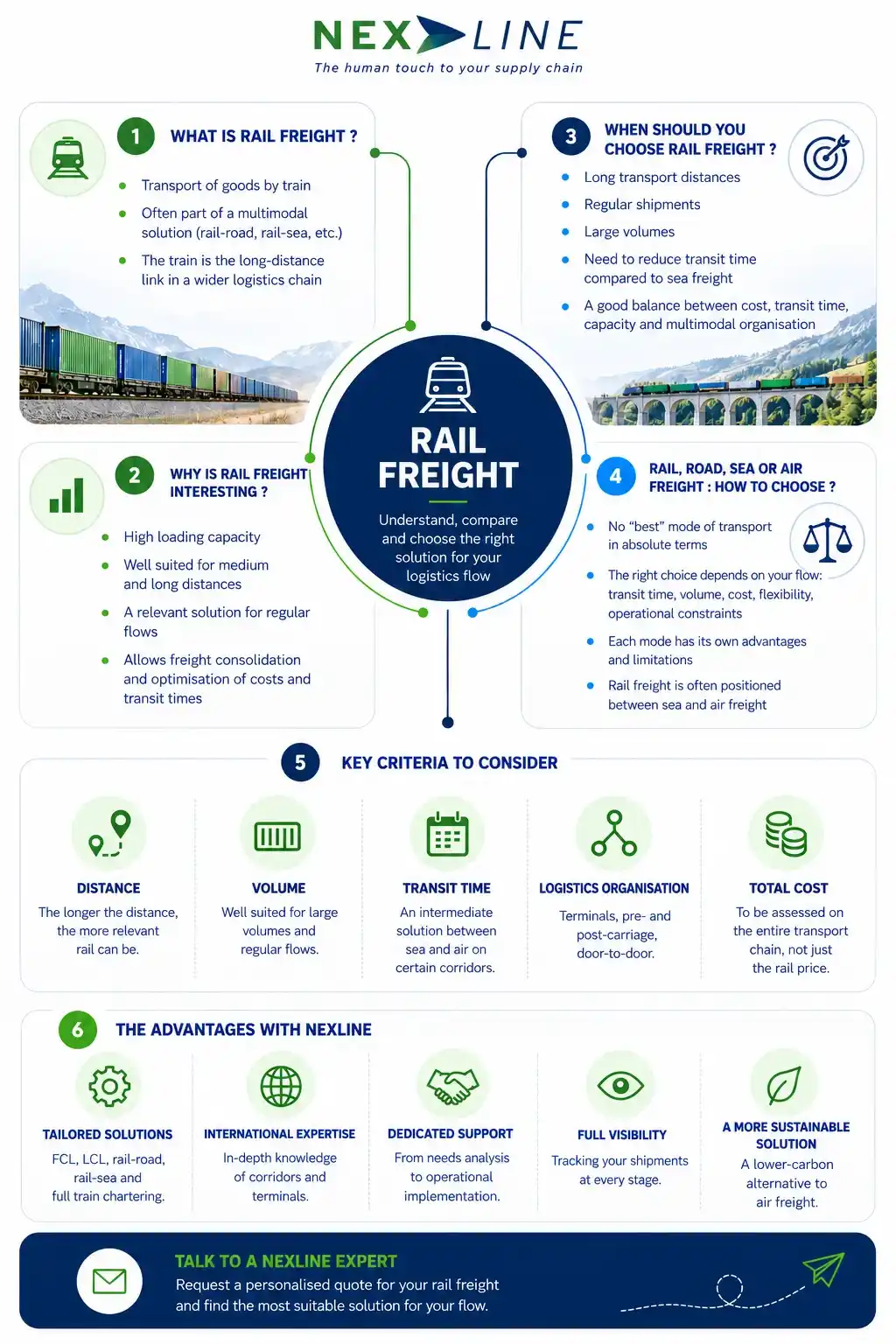
What is rail freight?
Rail freight is the transportation of goods by train.
But within a supply chain, the train does not necessarily cover the entire journey.
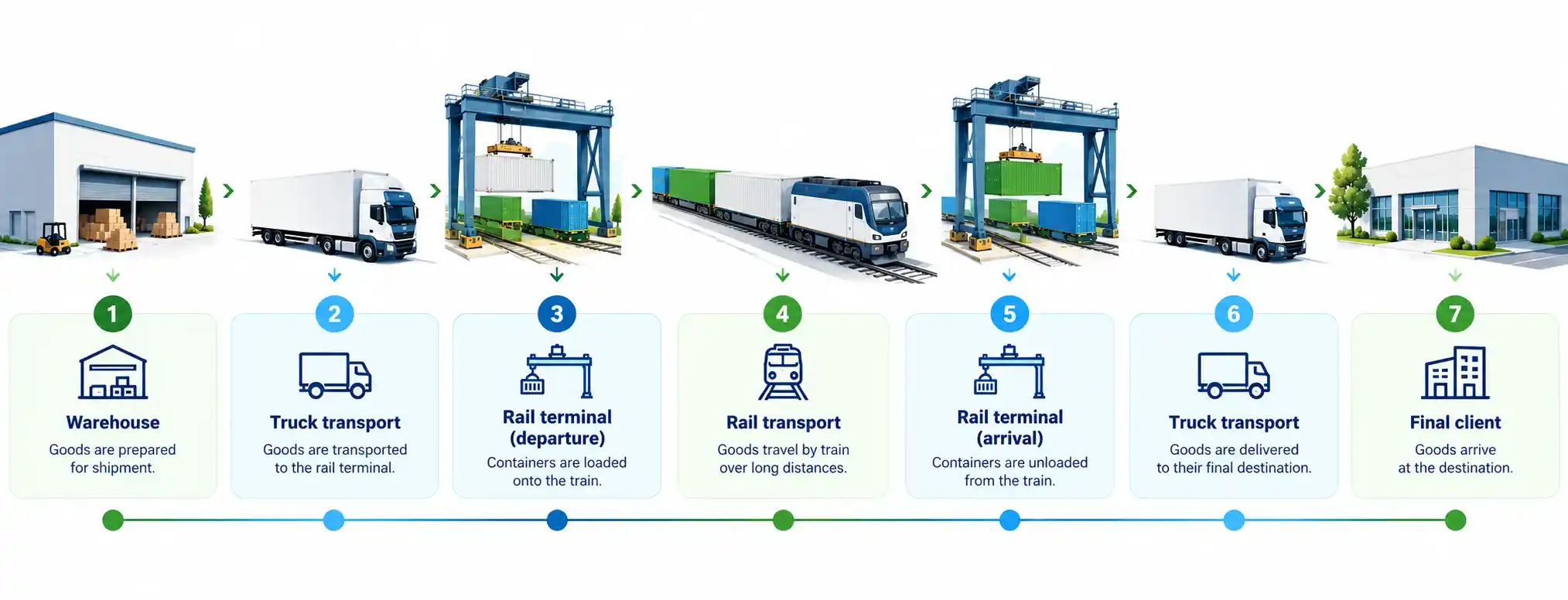
For example, goods may follow this route:
This is known as multimodal transport, where several modes of transport are combined to complete the same shipment.
This is an important distinction: choosing rail freight does not necessarily mean replacing trucks with trains from end to end.
Rail can be the long-distance link within a wider logistics chain.
Nexline offers solutions including FCL, LCL, rail-road, rail-sea and full train chartering.
When is rail freight a good option?
There is no magic distance at which a company should automatically switch to rail.
However, certain factors can make rail freight particularly relevant.
1. You are transporting goods over a long distance
The longer the distance, the more relevant it can be to consider several transport modes rather than relying solely on road transport.
Rail offers high loading capacity and is particularly suited to medium- and long-distance transportation.
2. Your shipments are regular
Recurring flows can be easier to integrate into a rail freight operation than one-off shipments.
Why?
Because departures, capacity and transport planning become more predictable. Texto pegado
3. You are transporting large volumes
Rail freight makes it possible to consolidate and move large volumes efficiently.
This can be particularly relevant for:
- containers
- industrial goods
- regular shipments
- heavy or high-volume flows
4. You need a shorter transit time than sea freight
On certain international routes, rail freight can provide an intermediate solution between sea and air freight.
It can be relevant when sea freight does not meet the required lead time, while air freight would be disproportionate to the needs of the shipment.
The right choice nevertheless depends on the corridor, type of goods, volume and required door-to-door transit time.
This is particularly relevant on certain China–Europe rail freight routes, such as the Xi’an–Duisburg connection. Texto pegado
Key takeaway
Rail freight can be particularly relevant when you need to combine capacity, distance, controlled transit times and multimodal logistics planning.
Rail, road, sea or air freight: how do you choose?
This is where the decision becomes more complex.
There is no single “best” transport mode.
The right choice depends on your specific flow.
| Criteria | Rail freight | Road freight | Sea freight | Air freight |
|---|---|---|---|---|
| Long distance | Very suitable | Depending on the route | Very suitable | Very suitable |
| Large volumes | Suitable | Suitable | Very suitable | More limited |
| Urgent shipments | Depending on the flow | Suitable | Less suitable | Very suitable |
| Door-to-door | With pre/post-carriage | Very suitable | With pre/post-carriage | With pre/post-carriage |
| Consolidation | High | Medium | Very high | Limited |
| Multimodal transport | Very common | Very common | Very common | Possible |
The table deliberately does not identify a “winner”.
Transit times, prices and operational constraints vary depending on the corridor and the type of flow.
The real question is:
Which balance between cost, transit time, volume, flexibility and operational constraints best matches my needs?
Is the price of rail freight enough to compare different transport modes?
No.
This is one of the most common mistakes when comparing different transport solutions.
Imagine two quotes:
Option A
Rail freight: €1,000
Option B
Road freight: €1,150
At first glance, rail appears to be cheaper.
But you need to consider the cost of the entire journey.
For rail freight, this may include:
- pre-carriage
- departure terminal
- rail freight
- arrival terminal
- post-carriage
- additional charges
= actual cost of the logistics flow
This is precisely why the transport price alone is not enough to measure the total logistics cost.
How long does rail freight take?
There is no standard transit time for all rail freight shipments.
The transit time depends on factors including:
- origin
- destination
- rail corridor
- frequency of departures
- terminal operations
- pre-carriage
- post-carriage
- any customs formalities
- operational constraints along the route
To understand the transit times being quoted, it is important to distinguish between the train journey time and the door-to-door transit time.
- Train journey time
This is the time during which the goods are actually being transported by rail, from the train’s departure to its arrival at the destination terminal.
- Door-to-door transit time
This is the total time required to move the goods from their point of origin to their final destination.
It includes, for example, road pre-carriage, terminal operations, the rail journey and final delivery.
These are therefore two different things.
Example:
A train may take 2 days to cover a particular route, while the door-to-door transit time may be longer if the goods first need to reach the rail terminal by truck, wait for departure, or be transported from the arrival terminal to the final customer.
How does rail freight work in practice?
Let’s take a simple example.
A company needs to transport goods from Lyon to northern France.
Step 1 — Collection
A truck collects the goods from the customer’s site.
Step 2 — Rail terminal
The goods are transported to the rail terminal.
Step 3 — Rail freight
The train takes over for the long-distance part of the journey.
Step 4 — Arrival terminal
The transport unit is unloaded from the train.
Step 5 — Final delivery
A truck takes the goods to the final recipient.
The train is therefore not isolated from the rest of the supply chain.
It becomes one part of a multimodal transport journey.
This is illustrated by the new Dunkirk–Lyon rail connection introduced by Nexline: containers are collected at the Terminal des Flandres, transported by rail to Lyon, and then delivered to their final destination.
FCL, LCL or full train: which solution should you choose?
The choice mainly depends on the volume and regularity of the flow.
FCL — Full Container Load
- A full container is dedicated to your goods.
LCL — Less than Container Load
- Your goods share the available container space with other shipments.
Full train
- The train is organised for large volumes or specific transport requirements.
At Nexline, these different solutions are part of our rail freight offering.
The right solution therefore depends on your flow, not simply on the choice of rail as a transport mode.
What should you consider when choosing rail freight?
Rail freight offers many advantages, but its operational constraints also need to be considered.
Schedules
Unlike a truck, which can generally be arranged more directly according to the customer’s requirements, rail freight relies on planned departures and available capacity.
Terminals
The terminal is an integral part of the journey.
Its location can therefore have a significant impact on the cost and transit time of the flow.
Pre-carriage
If the company is located far from the rail terminal, road transport will be required to bring the goods to the terminal.
Post-carriage
The same principle applies at the destination.
Coordination
Several parties may be involved:
Shipper → road carrier → terminal → rail operator → terminal → road carrier → consignee
The performance of the overall flow therefore also depends on coordination between all these different links.
Is rail freight more environmentally friendly than road freight?
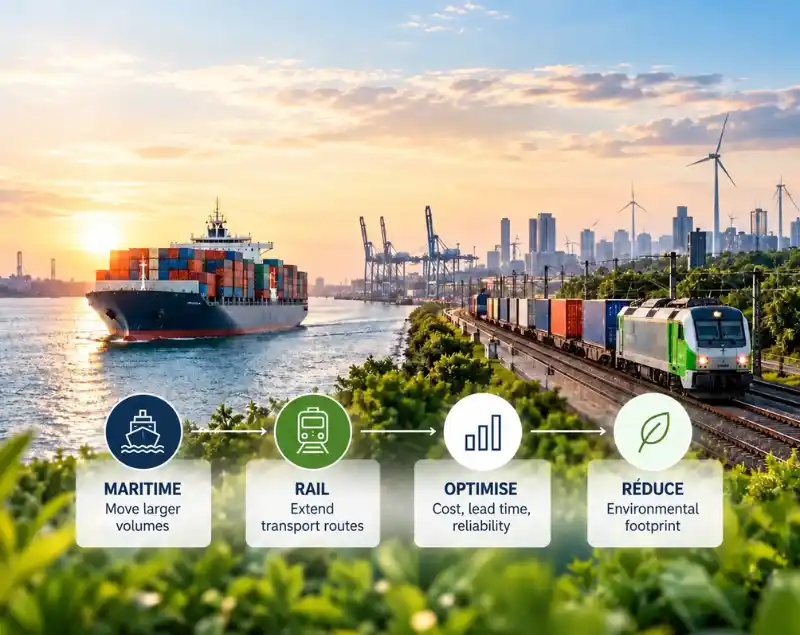
Rail freight can help reduce the environmental impact of certain logistics flows, particularly when it is used to transport large volumes over long distances.
However, its overall environmental performance depends on the entire journey: distance, load factor, energy used, as well as the pre- and post-carriage required to connect terminals with the shipping and delivery locations.
This is another reason why a multimodal approach can be relevant: rail can handle a significant part of the journey, while road transport covers the first and last miles.
Rail freight also has structural advantages in terms of energy efficiency and emissions on many types of flows. The French Ministry responsible for transport identifies the development of rail freight as one of the levers for decarbonising freight transport.
Nexline’s perspective
For a logistics decision-maker, the question should therefore not simply be:
“Rail or road?”
but rather:
“How can we build the most coherent transport solution for this particular shipment?”
The same shipper may need different solutions depending on its flows: road for some shipments, sea freight for others, air freight in urgent situations, and rail freight when the corridor, volume and transit time make it suitable.
The ability to combine transport modes rather than treating them as competing alternatives can help create a supply chain that is genuinely adapted to the company’s requirements.
At Nexline, the objective is to assess the flow as a whole: origin, destination, volumes, frequency, time constraints, customs, terminals and final delivery.
Rail freight then becomes not an end in itself, but one possible component of a tailored logistics strategy.
DISCOVER OUR TRANSPORT SERVICES
FAQ
How long does rail freight take?
On China–Europe routes, published rail freight transit times are generally around 15 to 25 days, depending on the origin, destination and corridor.
For comparison, some operators quote approximately 30 to 45 days by sea freight on these major routes, compared with a few days by air.
Is rail freight cheaper than road freight?
There is no answer that applies to every flow.
Over long distances, rail can be economically attractive because of its ability to consolidate large volumes. However, the result depends on the entire journey, particularly the distance between the shipper or consignee and the available rail terminals.
Why is a truck needed for rail freight?
Because the train generally does not depart directly from the shipper’s warehouse or arrive directly at the customer’s premises.
Road transport therefore usually handles pre-carriage and post-carriage, while the train covers part of the journey, often the longest section.
This is why rail freight is very often integrated into a multimodal transport solution.
How much does rail freight cost?
There is no single rail freight rate. The price depends on factors including the origin, destination, volume, container type, corridor and additional services required around the rail journey.
Request a personalised quote and speak directly with a Nexline expert to identify the most suitable solution for your logistics flow.
En brief