Importing from China can be a strong opportunity for European companies.
However, it also requires preparation.
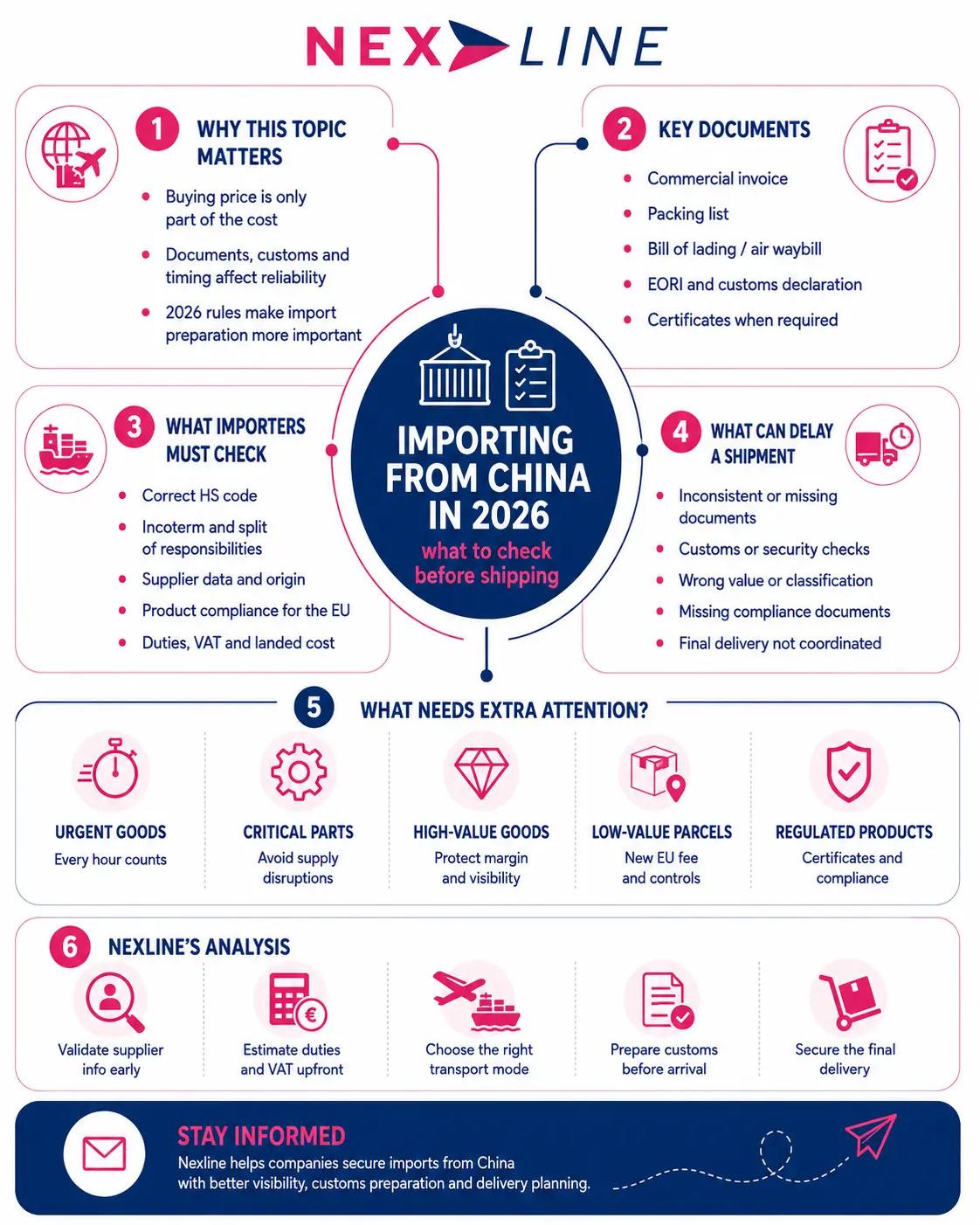
A product may be ready at the supplier’s factory, but that does not mean the shipment is ready to move. Before goods leave China, companies need to check documents, customs rules, transport times, VAT, product compliance and delivery constraints.
In 2026, this topic has become even more important. The European Union has introduced new customs measures for low-value parcels imported from outside the EU. From 1 July 2026, a temporary €3 customs duty applies to low-value consignments of up to €150. According to the European Commission, this measure aims to improve fairness, safety and customs compliance, especially for e-commerce imports.
Therefore, importing from China is no longer only a question of price or transport time.
In other words, it is also a question of control.
Why importing from China requires preparation
Many companies import from China because they want access to competitive prices, large production capacity or specific industrial know-how.
However, the real cost of an import operation does not stop at the purchase price.
A company must also consider:
- supplier reliability.
- production lead times.
- transport mode.
- customs documents.
- duties and VAT.
- product compliance.
- insurance.
- delivery deadlines.
- possible customs checks.
- final distribution in Europe.
In other words, the key question is not only: “How much does the product cost?”
Ultimately, the real question is: “Can the company import the goods safely, on time and with full visibility?”
This is why many companies work with a logistics partner able to manage international transport and multimodal flows from origin to final delivery.
What documents are needed when importing from China?
When importing from China, documents play a central role.
If one document is missing, incomplete or inconsistent, customs clearance can take longer. In some cases, the goods may remain blocked until the importer provides the correct information.
The main documents usually include:
- commercial invoice.
- packing list.
- bill of lading or air waybill.
- certificate of origin, when required.
- customs declaration.
- EORI number for the European importer.
- product certificates, depending on the goods.
- insurance documents, when applicable.
- import licences, if the product category requires them.
As a result, these documents must be consistent.
For example, the product description, quantity, weight, value, HS code and country of origin must match across the commercial invoice, packing list and transport documents.
Otherwise, customs authorities may ask for clarification.
For importers, this is also why customs declaration support can help reduce errors before the goods arrive.
Commercial invoice: the key customs document
The commercial invoice is one of the most important documents when importing from China.
It usually includes:
- seller details.
- buyer details.
- product description.
- quantity.
- unit price.
- total value.
- currency.
- Incoterm.
- country of origin.
- payment terms.
- HS code, when available.
Customs authorities use this document to assess the value of the goods, duties, VAT and possible controls.
Therefore, the importer should not treat the invoice as a simple accounting document.
In fact, it is also a customs document.
Packing list: why details matter
The packing list gives operational details about the shipment.
It usually shows:
- number of packages.
- gross weight.
- net weight.
- dimensions.
- pallet or carton details.
- product references.
- packaging type.
This document helps carriers, freight forwarders, warehouses and customs teams identify the goods.
In practice, a clear packing list can reduce confusion during handling, inspection or final delivery.
As a result, it can also help avoid unnecessary operational delays.
HS code: a small detail with major consequences
The HS code identifies the customs classification of the product.
It affects:
- customs duties.
- import restrictions.
- product controls.
- documentation requirements.
- statistical reporting.
A wrong HS code can create serious problems.
For example, the company may pay the wrong duty rate. It may also miss a specific certificate or face a customs correction later.
Therefore, importers should check the HS code before the goods leave China.
Bill of lading or air waybill
In addition, the transport document depends on the chosen mode of transport.
For sea freight, the main document is the bill of lading.
For air freight, the main document is the air waybill.
These documents confirm that the carrier has taken charge of the goods. They also provide essential transport information, such as origin, destination, shipper, consignee and shipment references.
As a result, they are essential for both logistics tracking and customs procedures.
Incoterms: who is responsible for what?
Incoterms define the responsibilities between the seller and the buyer.
More specifically, they clarify who manages transport, insurance, export clearance, import clearance and costs at each stage.
For imports from China, companies often use Incoterms such as FOB, CIF, EXW or DAP.
However, each option has different consequences.
For example, EXW gives the buyer more responsibility from the supplier’s premises. On the other hand, DAP may seem easier, but the buyer still needs to understand import duties, VAT and customs clearance at destination.
Therefore, the Incoterm must be chosen before the order is confirmed.
How long does it take to import from China?
Import lead times from China depend on the transport mode, origin, destination, season, customs process and final delivery requirements.
In general, companies can choose between:
- sea freight.
- air freight.
- rail freight.
- multimodal transport.
- express parcel delivery.
However, each option has advantages and limits.
Sea freight is often more cost-effective for large volumes. However, it takes longer.
Air freight is faster. However, it is more expensive and may be affected by capacity issues.
Rail freight can offer an intermediate option for some flows between China and Europe. However, routes, availability and geopolitical constraints must be checked carefully.
Therefore, the best option depends on the product, urgency, volume and budget.
In many cases, a multimodal transport solution can help companies combine cost control, flexibility and operational visibility.
Why customs clearance can delay an import
In many cases, customs clearance can delay an import when information is missing, inaccurate or inconsistent.
Common causes include:
- incorrect HS code.
- incomplete commercial invoice.
- unclear product description.
- mismatch between documents.
- missing certificate.
- undervalued goods.
- unclear origin.
- product compliance issue.
- customs inspection.
- unpaid duties or VAT.
In addition, EU import controls are becoming more data-driven. The Import Control System 2, known as ICS2, requires safety and security data before goods arrive. The European Commission explains that incomplete or inaccurate Entry Summary Declaration data may lead to rejection, requests for additional information or delays in the entry process.
As a result, companies should not wait until the goods arrive in Europe to prepare customs information.
They need to anticipate it earlier.
VAT and customs duties when importing from China
When a company imports goods from China into the European Union, it must consider customs duties and VAT.
Customs duties depend mainly on:
- HS code.
- customs value.
- origin of the goods.
- product category.
- trade measures or restrictions.
In addition, VAT depends on the country of import and the applicable tax rules.
In France, import VAT is generally handled through the French tax system for VAT-registered businesses. However, the company still needs accurate customs data, invoices and import records.
Therefore, import costs should be estimated before the shipment starts.
Otherwise, the landed cost may be higher than expected.
Low-value parcels: what changed in 2026?
Low-value e-commerce imports have become a major customs issue in Europe.
According to the European Commission, around 4.6 billion low-value consignments entered the EU market in 2024. That represented around 12 million parcels per day. The Commission also warned that many products did not comply with EU rules or raised safety concerns.
To address this situation, the EU introduced a temporary €3 customs duty on low-value consignments of up to €150 from outside the EU from 1 July 2026. According to the European Commission’s taxation and customs department, this temporary flat fee applies until 1 July 2028.
As a result, this change mainly affects e-commerce and small parcels.
However, it also sends a clear message to all importers: customs authorities expect more transparency, more reliable data and better product compliance.
Product compliance: a point importers often underestimate
Importing from China does not only mean moving goods from one country to another.
The importer must also make sure that the product can legally enter and be sold in the target market.
Depending on the product, this may involve:
- CE marking.
- safety standards.
- labelling rules.
- technical documentation.
- chemical restrictions.
- food contact rules.
- electrical safety requirements.
- textile labelling.
- product test reports.
Above all, this point is critical.
A product may be well manufactured, but still non-compliant with European rules.
In that case, the importer may face delays, additional costs, product withdrawal or legal risk.
Why supplier information must be checked early
A reliable import process starts before transport.
The company should ask the supplier for key information as early as possible.
This includes:
- exact product description.
- HS code proposal.
- unit value.
- origin.
- packaging details.
- weight and dimensions.
- certificates.
- production schedule.
- loading address.
- export licence, if needed.
Then, the importer or logistics partner can check whether the data is consistent.
Therefore, this step helps avoid last-minute corrections, especially before customs clearance.
Choosing the right transport mode from China
In practice, the right transport mode depends on the operational objective.
Sea freight may be suitable when the company imports large volumes and can accept longer lead times.
Air freight may be relevant for urgent goods, high-value products or critical parts.
Rail freight may be useful for some flows when the company needs a compromise between cost and speed.
Multimodal transport can also help combine different modes and improve flexibility.
However, the company should not choose a transport mode only because it is cheaper.
It should also consider reliability, customs timing, final delivery, storage and customer expectations.
This is where transport flow management can help connect planning, tracking, customs timing and final delivery.
Main risks when importing from China
Import operations from China can face several risks.
For example, the most common include:
- production delay.
- supplier error.
- incorrect documentation.
- customs inspection.
- wrong HS code.
- unexpected duties.
- product non-compliance.
- transport congestion.
- port or airport delay.
- damage during transport.
- delivery appointment missed.
- poor visibility after arrival.
These risks do not always come from transport itself.
In many cases, they come from a lack of preparation before shipment.
How to secure an import operation from China
To secure an import operation from China, the company should work step by step.
First, it should validate the supplier and product information.
Then, it should check the required documents.
Next, it should confirm the HS code, Incoterm and estimated landed cost.
After that, it should choose the right transport mode.
Finally, it should monitor the shipment until final delivery.
This approach helps reduce uncertainty.
It also helps the company avoid unnecessary costs and delays.
For more complex flows, an integrated logistics approach can help connect transport, warehousing, customs declaration and final distribution.
Checklist before importing from China
Before confirming a shipment from China, companies should check several points:
- Is the supplier reliable?
- Is the product description clear?
- Is the HS code correct?
- Are the commercial invoice and packing list complete?
- Is the Incoterm adapted to the operation?
- Are duties and VAT estimated?
- Are product certificates required?
- Is the product compliant with EU rules?
- Is the transport mode suitable?
- Is the delivery deadline realistic?
- Is customs clearance prepared?
- Is final delivery organised?
Of course, this checklist does not replace expert advice.
However, it helps identify weak points before the shipment starts.
Nexline’s analysis
Importing from China requires more than a purchase order and a transport booking.
The company must control the full chain: supplier information, documents, customs data, transport mode, VAT, duties, compliance and final delivery.
In 2026, this control becomes even more important.
The EU is strengthening customs supervision, especially for low-value imports, e-commerce flows and product compliance. The EU customs reform also reflects a broader move toward more digital and data-driven import processes.
In this context, Nexline helps companies secure their international transport operations and avoid unnecessary delays.
A well-prepared import flow can reduce customs friction, improve visibility and protect the final delivery schedule.
Nexline also follows international logistics developments through its Blog & News, where companies can find practical insights on customs, transport and supply chain management.
What your company should remember
In summary, importing from China can create real opportunities.
However, the operation must be prepared carefully.
The company needs accurate documents, a clear HS code, the right Incoterm, reliable supplier information, realistic lead times and strong customs preparation.
In addition, European customs rules are evolving.
Therefore, companies that import from China should not only focus on buying price. They should also focus on landed cost, compliance, customs visibility and operational reliability.
Do you import goods from China and want to secure your logistics process? Contact Nexline’s experts to analyse your import flows and organise the right transport solution.
EXPLORE OUR TRANSPORT SERVICES
FAQ
What documents are needed to import from China?
The main documents usually include the commercial invoice, packing list, transport document, customs declaration, EORI number and any product certificates required for the goods.
How long does importing from China take?
It depends on the transport mode, origin, destination, season, customs process and final delivery. Sea freight usually takes longer, while air freight is faster but more expensive.
What is the most important customs document?
The commercial invoice is one of the most important documents. Customs authorities use it to assess value, duties, VAT and possible controls.
Why can goods from China be blocked at customs?
Goods can be blocked because of missing documents, wrong HS codes, unclear descriptions, product compliance issues, customs inspection or inconsistent information between documents.
What changed for low-value imports in the EU in 2026?
From 1 July 2026, the EU introduced a temporary €3 customs duty on low-value consignments of up to €150 imported from outside the EU. This measure mainly affects e-commerce parcels.
How can a company reduce import risks?
A company can reduce import risks by checking supplier information early, confirming documents, validating the HS code, choosing the right Incoterm and preparing customs clearance before the goods arrive.
In summary