
Cross docking, fulfillment, warehousing: what’s the difference?
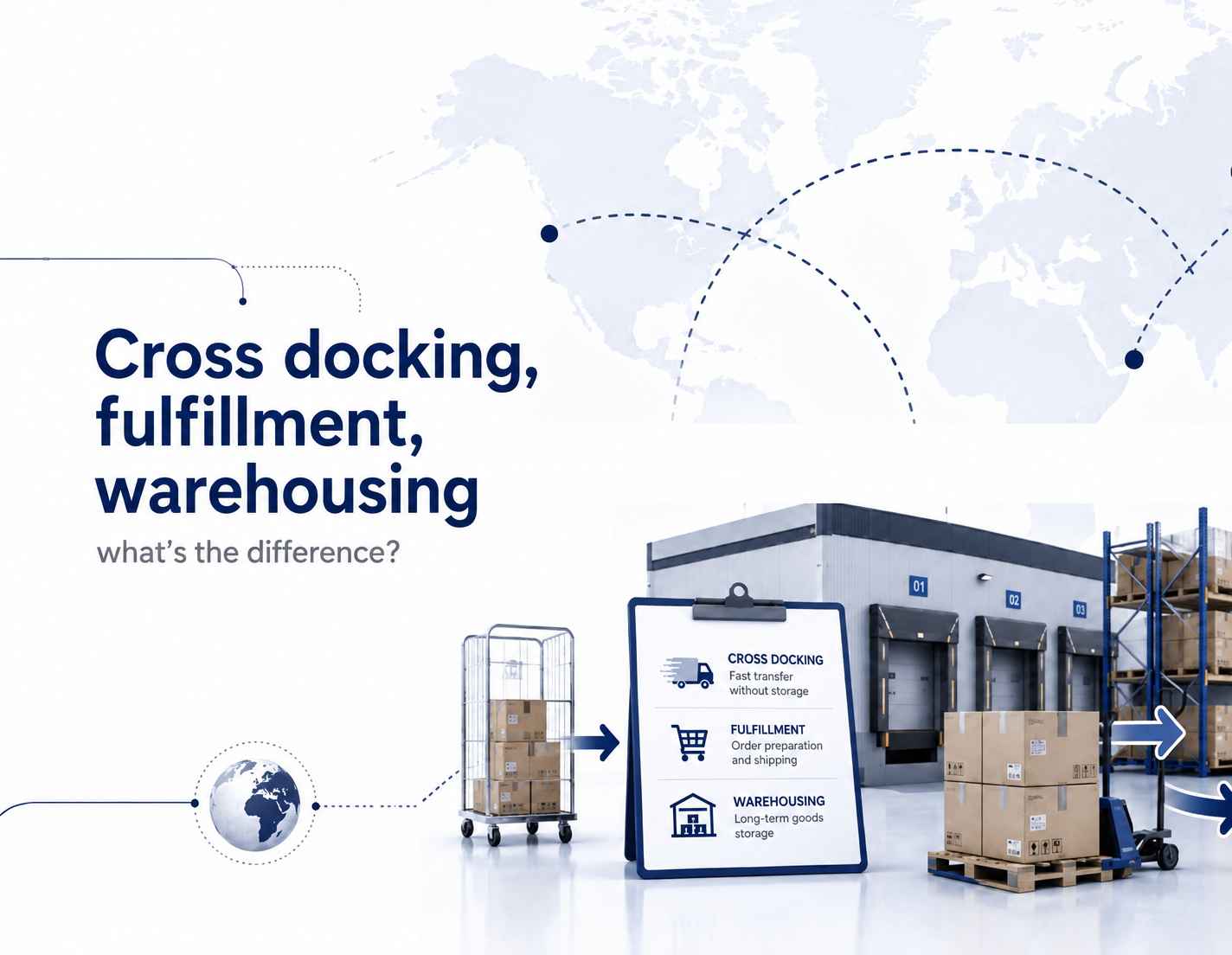
Cross docking, fulfillment, warehousing… These three terms often come up when a company wants to better organise its logistics. However, they do not mean the same thing. What is cross docking? Cross docking is a logistics method that moves goods from an inbound flow to an outbound flow, without prolonged storage. In practice, products arrive on a logistics platform. Teams receive them, check them, sort them, and then quickly reship them to their final destination. The objective is simple: reduce the time goods remain immobilised. In a cross docking operation, the company does not use the warehouse as a traditional storage space. Instead, it uses it as a transit point for sorting and redistribution. Cross docking can be useful when goods need to move quickly, when the company plans volumes properly or when orders are already known before the products arrive. How does cross docking work? The process relies on precise coordination between inbound and outbound flows. In general, it follows several steps: The key point is timing. If the goods arrive but the outbound transport is not ready, the flow gets blocked. In contrast, if the outbound transport is ready but the goods are not yet available, the truck waits. Therefore, cross docking works very well when the supply chain is properly synchronised. What is fulfillment? Fulfillment refers to all the operations needed to process a customer order. Indeed, it is not only about storing a product. Fulfillment can include: Companies often use fulfillment in e-commerce, distribution, marketplaces or activities that handle many individual orders. Here, the objective is not only to move goods. Above all, the goal is to turn available stock into an order ready to be delivered to the final customer. What is warehousing? Warehousing means storing goods in a warehouse for a given period of time. This can include pallets, boxes, finished products, raw materials, spare parts or safety stock. Therefore, warehousing answers a different need from cross docking. Here, the goods do not move through the platform immediately. Instead, they remain available for future use: production, replenishment, customer delivery, regional distribution or seasonal demand. The objective is to secure product availability. However, warehousing also has a cost: space, handling, insurance, stock immobilisation, inventory, possible order preparation and administrative management. Cross docking, fulfillment, warehousing: what’s the difference? In practice, these three solutions answer different needs in the supply chain. Solution Main function Storage duration Objective Cross docking Receive, sort and reship quickly Very short Speed up flows and reduce storage Fulfillment Prepare and ship orders Variable Process customer orders end to end Warehousing Store goods Medium or long Keep stock available Therefore, the main difference lies in how the platform is used. With cross docking, the goods move through. With fulfillment, teams prepare the order. In the case of warehousing, the goods wait for the right moment to move again. Why are cross docking and fulfillment often confused? Cross docking and fulfillment often cause confusion because both can take place on a logistics platform. In both cases, goods arrive, teams handle them, and then they leave for a customer, a store, a warehouse or another site. However, the logic is not the same. With cross docking, the priority is the flow. The goods do not stay on site for long. Teams receive them, sort them, consolidate them if necessary, and then reship them quickly. The objective is to avoid storage and speed up the movement of goods. With fulfillment, the priority is the order. The goods may remain in stock, and then teams prepare them when a customer places an order. This means managing picking, packaging, labelling, shipping, tracking and sometimes returns. The difference is therefore simple: Question to ask Cross docking Fulfillment Do the goods leave quickly after arrival? Yes Not necessarily Is there storage? Very little or none Yes, often Is the main objective to streamline flows? Yes Not only Is the main objective to prepare orders? No Yes Does the model strongly depend on customer orders? Sometimes Yes In other words, cross docking follows a fast transit logic. Fulfillment, on the other hand, follows an order processing logic. A company may need both. For example, part of the goods may leave immediately through cross docking to several sites, while another part remains in stock for fulfillment preparation according to customer orders. That is why the choice should not depend on the name of the solution, but on the real functioning of the supply chain: rotation speed, stock level, order type, expected lead time and preparation needs. When should you choose cross docking? Cross docking is relevant when a company works with predictable flows, short deadlines and planned outbound movements. It can be suitable in several cases: This solution is also useful when a company wants to avoid multiplying handling operations. The less time goods remain stored, the less space they occupy. However, this approach requires strong coordination between transport, receiving, sorting and shipping. When should you choose fulfillment? Fulfillment is more suitable when the company needs to manage many individual or personalised orders. For example, this is often the case for: In this case, value does not come only from storage. It also comes from the ability to prepare orders correctly, meet deadlines, manage errors, track shipments and maintain a good customer experience. Therefore, fulfillment is an operational order processing solution. When should you choose warehousing? Warehousing is relevant when the company needs to keep goods available over a longer period. This may be necessary to: Warehousing offers flexibility. However, it must be managed properly. A stock level that is too high immobilises capital. In addition, poorly monitored stock can create errors, shortages or unnecessary costs. What are the advantages of cross docking? Cross docking can bring several benefits to the supply chain. It can help to: However, cross docking is not a magic solution. It works only when the company prepares its flows properly. Without coordination, it can create the opposite effect: waiting time, delays, poor allocation of goods or
Importing from China in 2026: documents, delays and customs
Importing from China can be a strong opportunity for European companies. However, it also requires preparation. A product may be ready at the supplier’s factory, but that does not mean the shipment is ready to move. Before goods leave China, companies need to check documents, customs rules, transport times, VAT, product compliance and delivery constraints. In 2026, this topic has become even more important. The European Union has introduced new customs measures for low-value parcels imported from outside the EU. From 1 July 2026, a temporary €3 customs duty applies to low-value consignments of up to €150. According to the European Commission, this measure aims to improve fairness, safety and customs compliance, especially for e-commerce imports. Therefore, importing from China is no longer only a question of price or transport time. In other words, it is also a question of control. Why importing from China requires preparation Many companies import from China because they want access to competitive prices, large production capacity or specific industrial know-how. However, the real cost of an import operation does not stop at the purchase price. A company must also consider: In other words, the key question is not only: “How much does the product cost?” Ultimately, the real question is: “Can the company import the goods safely, on time and with full visibility?” This is why many companies work with a logistics partner able to manage international transport and multimodal flows from origin to final delivery. What documents are needed when importing from China? When importing from China, documents play a central role. If one document is missing, incomplete or inconsistent, customs clearance can take longer. In some cases, the goods may remain blocked until the importer provides the correct information. The main documents usually include: As a result, these documents must be consistent. For example, the product description, quantity, weight, value, HS code and country of origin must match across the commercial invoice, packing list and transport documents. Otherwise, customs authorities may ask for clarification. For importers, this is also why customs declaration support can help reduce errors before the goods arrive. Commercial invoice: the key customs document The commercial invoice is one of the most important documents when importing from China. It usually includes: Customs authorities use this document to assess the value of the goods, duties, VAT and possible controls. Therefore, the importer should not treat the invoice as a simple accounting document. In fact, it is also a customs document. Packing list: why details matter The packing list gives operational details about the shipment. It usually shows: This document helps carriers, freight forwarders, warehouses and customs teams identify the goods. In practice, a clear packing list can reduce confusion during handling, inspection or final delivery. As a result, it can also help avoid unnecessary operational delays. HS code: a small detail with major consequences The HS code identifies the customs classification of the product. It affects: A wrong HS code can create serious problems. For example, the company may pay the wrong duty rate. It may also miss a specific certificate or face a customs correction later. Therefore, importers should check the HS code before the goods leave China. Bill of lading or air waybill In addition, the transport document depends on the chosen mode of transport. For sea freight, the main document is the bill of lading. For air freight, the main document is the air waybill. These documents confirm that the carrier has taken charge of the goods. They also provide essential transport information, such as origin, destination, shipper, consignee and shipment references. As a result, they are essential for both logistics tracking and customs procedures. Incoterms: who is responsible for what? Incoterms define the responsibilities between the seller and the buyer. More specifically, they clarify who manages transport, insurance, export clearance, import clearance and costs at each stage. For imports from China, companies often use Incoterms such as FOB, CIF, EXW or DAP. However, each option has different consequences. For example, EXW gives the buyer more responsibility from the supplier’s premises. On the other hand, DAP may seem easier, but the buyer still needs to understand import duties, VAT and customs clearance at destination. Therefore, the Incoterm must be chosen before the order is confirmed. How long does it take to import from China? Import lead times from China depend on the transport mode, origin, destination, season, customs process and final delivery requirements. In general, companies can choose between: However, each option has advantages and limits. Sea freight is often more cost-effective for large volumes. However, it takes longer. Air freight is faster. However, it is more expensive and may be affected by capacity issues. Rail freight can offer an intermediate option for some flows between China and Europe. However, routes, availability and geopolitical constraints must be checked carefully. Therefore, the best option depends on the product, urgency, volume and budget. In many cases, a multimodal transport solution can help companies combine cost control, flexibility and operational visibility. Why customs clearance can delay an import In many cases, customs clearance can delay an import when information is missing, inaccurate or inconsistent. Common causes include: In addition, EU import controls are becoming more data-driven. The Import Control System 2, known as ICS2, requires safety and security data before goods arrive. The European Commission explains that incomplete or inaccurate Entry Summary Declaration data may lead to rejection, requests for additional information or delays in the entry process. As a result, companies should not wait until the goods arrive in Europe to prepare customs information. They need to anticipate it earlier. VAT and customs duties when importing from China When a company imports goods from China into the European Union, it must consider customs duties and VAT. Customs duties depend mainly on: In addition, VAT depends on the country of import and the applicable tax rules. In France, import VAT is generally handled through the French tax system for VAT-registered businesses. However, the company still needs accurate customs data,