The situation is gradually improving for air freight operations at Lille Airport.
However, operations have not yet returned to normal.
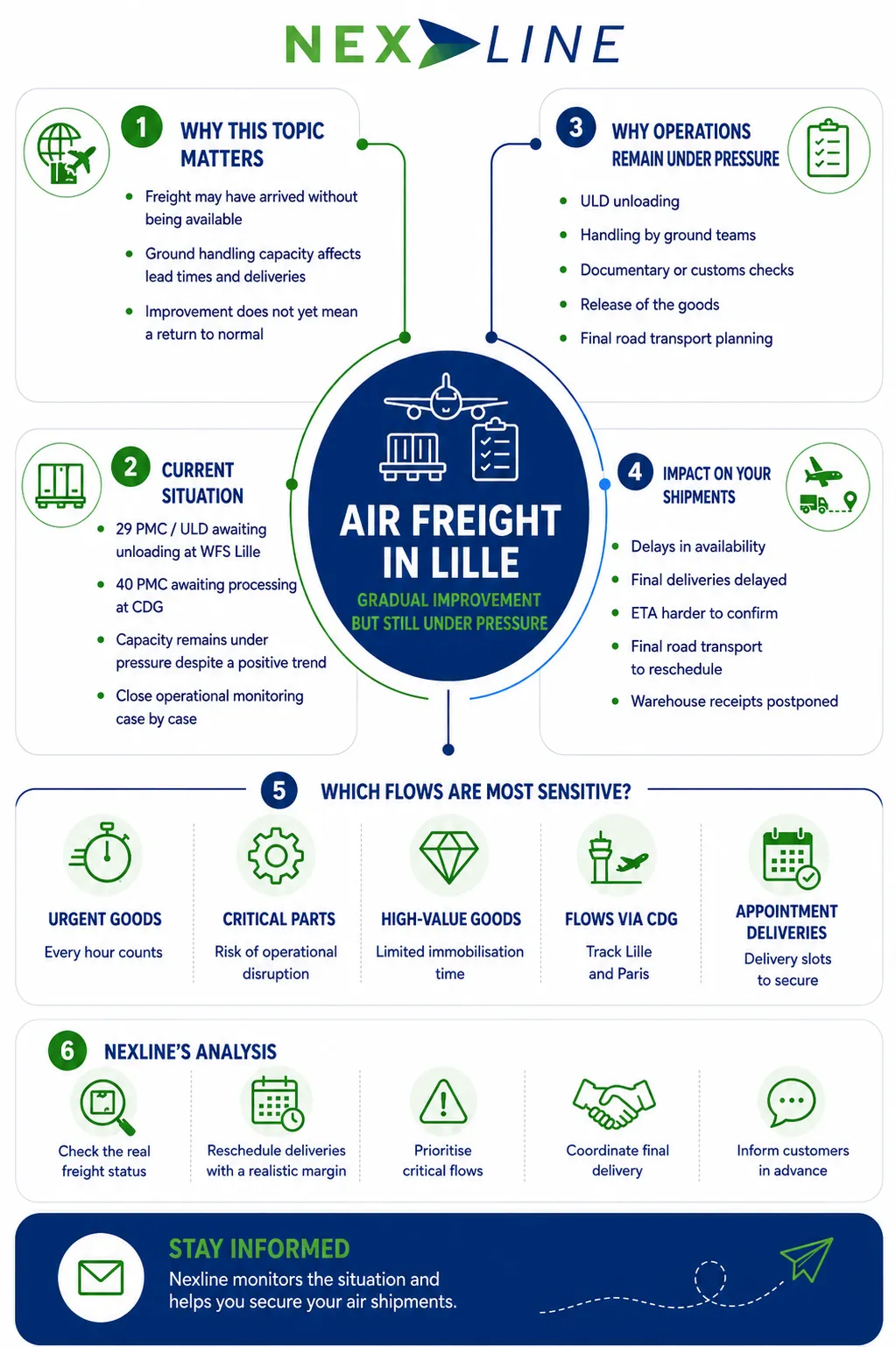
According to operational information monitored by the Nexline teams, several freight units are still awaiting unloading or processing between Lille and Paris-CDG.
At this stage:
- 29 PMC / ULD are still awaiting unloading at WFS Lille.
- 40 PMC are still awaiting processing at CDG.
These figures show a positive trend compared with recent days. However, handling capacity remains under pressure.
As a result, some shipments may still experience delays before they are made available for final delivery.
For companies, the issue is very concrete: goods may have arrived within the air freight network, but may not yet be immediately available for delivery.
The right question is therefore not only:
Has my freight arrived?
The real question is:
Has my freight been processed, released and made available for delivery??
Why can air freight in Lille remain blocked after arrival?
Air freight is often chosen for its speed.
It is used when deadlines are short, when goods are urgent or when the supply chain cannot afford a long transit time.
However, the arrival of an aircraft or an air freight flow does not necessarily mean that the operation is complete.
After arrival, several steps still need to be carried out:
- unloading of freight units.
- handling by ground teams.
- documentary or customs checks, if required.
- release and availability of the goods.
- organisation of the final road transport.
- delivery to the warehouse or final consignee.
When handling capacity is saturated, this post-arrival stage often becomes the bottleneck.
In this context, the goods are within the network, but they are not yet available.ge often becomes the bottleneck.
This is why air freight Lille operations must be monitored beyond the arrival stage.
Why is Lille Airport under pressure?
Lille Airport has infrastructure and services dedicated to cargo operations, including import/export handling, processing of cargo and mixed flights, freight security, consolidation and order preparation.
The airport also highlights its position at the crossroads of major European cargo hubs, including Paris, London, Brussels, Amsterdam, Frankfurt and Luxembourg.
In this type of environment, performance does not depend only on the flight or the air freight booking.
It also depends on the ability of ground teams to absorb volumes, process ULDs, organise priorities and release goods within the expected timeframes.
When this capacity is insufficient, even gradual improvement can leave operations under pressure for several days.
Therefore, the current situation at Lille Airport should be understood as an operational pressure point, not only as a transport delay.
What do PMC and ULD mean in air freight?
In air freight, goods are not always handled parcel by parcel.
They can be grouped into loading units called ULDs.
A ULD, or Unit Load Device, is a loading unit used to group air freight in order to facilitate transport, loading and unloading.
A PMC is a type of air cargo pallet used in cargo operations.
In practical terms, when several PMCs are awaiting unloading or processing, it means that complete freight units have not yet been fully handled.
For an importer or shipper, this can have a direct impact on the final availability of the goods.
This distinction is important because a shipment can be present in the air freight network without being ready for pickup or delivery.

What is the current air freight Lille situation?
The situation is showing early signs of improvement.
However, operations remain under pressure.
At this stage, the Nexline teams are monitoring two key points:
| Situation point | Volume concerned | Possible impact |
|---|---|---|
| PMC / ULD awaiting unloading at WFS Lille | 29 | Delay in availability at Lille |
| PMC awaiting processing at CDG | 40 | Possible delay on upstream or connecting flows |
These volumes remain significant.
They show that handling teams are continuing to clear the backlog, but that available capacity is not yet sufficient to immediately absorb all pending flows.
The key point is simple: improvement does not necessarily mean an immediate return to normal.
For companies with sensitive shipments, the air freight Lille situation still requires close monitoring.
What are the consequences for your air freight shipments?
The consequences may vary depending on the type of goods, their level of urgency and their processing status.
The main possible impacts include:
- unloading delays.
- slower availability of goods.
- delayed final delivery.
- difficulty confirming a reliable ETA.
- rescheduling of final road transport.
- delayed warehouse reception.
- pressure on urgent flows.
- need for case-by-case prioritisation.
For a company, these delays can create a domino effect.
For example, freight processed a few hours later may miss a delivery slot.
As a result, the truck may have to wait, the warehouse may need to reschedule reception, and the final customer may receive updated timing that differs from the initial plan.
In this context, the risk is not only an air freight issue.
It becomes an operational issue.
Which air freight flows are the most sensitive?
Not all shipments are exposed to the same level of risk.
The most sensitive flows are those that depend on a short deadline or fast availability.
| Type of flow | Why it is sensitive | Action to take |
|---|---|---|
| Urgent goods | Every hour of delay can affect production or the final customer | Reinforced monitoring and file prioritisation |
| Critical parts | A delay can block an intervention, repair or production line | Check real availability before organising delivery |
| High-value goods | Immobilisation time must be limited | Confirm processing status and release slot |
| Flows with warehouse appointments | A missed slot can delay reception | Reschedule the appointment with a realistic margin |
| Goods connecting via CDG | The delay may come from upstream, before Lille | Monitor CDG and Lille status in parallel |
| Customer deliveries already announced | The ETA may change if availability slips | Inform the customer before the delay is felt |
The aim is not to create unnecessary alarm.
Instead, the priority is to identify the flows that cannot tolerate uncertainty.
In the current air freight Lille context, urgent goods, critical parts and time-sensitive deliveries should receive reinforced monitoring.
Why should air freight ETAs be monitored carefully?
During a period of operational pressure, the ETA should not be treated as a fixed promise.
Instead, it must be adjusted according to the real status of the goods.
Several levels of information need to be distinguished:
- Freight arrived in the network.
- ULD awaiting unloading.
- Goods being processed.
- Freight released.
- Goods available for pickup.
- Final delivery scheduled.
This distinction is essential.
For example, freight may have arrived, but still not be usable for delivery.
As a result, a theoretical arrival date may not reflect the real delivery timeline.
Therefore, Nexline teams monitor files closely, in order to avoid communicating an ETA that does not reflect the operational reality.
How can you limit the impact on your air freight shipments?
1. Check the real status of the goods
Before confirming a delivery, it is important to know where the freight actually stands.
In practice, the key questions are simple:
Has it arrived?
Is unloading complete?
Has processing started or finished?
Is it available?
Can the freight be picked up?
These stages should not be confused.
Therefore, in air freight Lille operations, this distinction can make the difference between a realistic delivery plan and a last-minute rescheduling.
2. Reschedule deliveries with a realistic margin
When ground operations are under pressure, it is better to avoid overly tight schedules.
A delivery confirmed too early may need to be cancelled or rescheduled.
Therefore, it is better to secure a realistic ETA than to multiply last-minute changes.
This approach also helps warehouses, transport teams and final customers adjust their planning.
3. Prioritise critical flows
Not all files have the same level of urgency.
Critical goods, spare parts, flows with customer commitments or goods expected for production should be identified quickly.
This prioritisation allows teams to focus monitoring on the most sensitive files.
It also helps decide which shipments require immediate updates, alternative planning or reinforced coordination.
4. Coordinate the final road transport
Air freight often depends on a final road leg.
Once the goods are available, the pickup, vehicle, delivery slot and reception still need to be organised.
If road transport is booked too early, it may generate waiting time.
However, if it is booked too late, the delivery may slip.
Coordination between air freight and final road delivery is therefore essential.
In the current Lille context, the final road leg should only be confirmed once the freight status is reliable enough.
5. Inform customers in advance
During a period of operational pressure, communication becomes an operational tool.
Informing a customer before the delay is confirmed often helps limit the impact.
It also helps adjust receptions, teams and internal priorities.
As a result, communication should be proactive, clear and based on the real status of the shipment.
Nexline’s analysis
The situation at Lille Airport is showing gradual improvement.
However, air freight operations remain under pressure.
For companies, the issue is not only whether the freight has arrived.
It is also whether it has been unloaded, processed, released and made genuinely available for delivery.
At Nexline, operational teams monitor the situation hour by hour.
Each file is analysed according to its level of urgency, real status, delivery constraints and impact on the supply chain.
In this context, the goal is to anticipate delays before they create further disruption.
The objective is simple: inform customers at the right time and implement the most appropriate solutions to limit the impact on shipments.
For companies affected by the air freight Lille situation, close monitoring remains essential until operations fully return to normal.
FAQ
What is the current situation for air freight at Lille Airport?
The situation is showing signs of improvement, but remains under pressure. Several PMC / ULD are still awaiting unloading or processing between WFS Lille and CDG.
Why can air freight be delayed after arrival?
Freight may have arrived in the air network, but still be awaiting unloading, processing or release. Until these steps are completed, the final delivery cannot be properly organised.
What does ULD mean in air freight?
ULD stands for Unit Load Device. It is a loading unit used to group goods in air transport.
What are the impacts for companies?
The main impacts are delayed availability, postponed deliveries, ETAs that need to be adjusted, warehouse appointments that may need to be rescheduled and pressure on urgent goods.
How does Nexline monitor the situation?
Nexline teams monitor the situation hour by hour, in contact with the different stakeholders, in order to anticipate impacts on shipments and inform customers at the right time.
EXPLORE OUR TRANSPORT SERVICES
In summary