
Customs Formalities for Export: Understanding Export Followed by Transit
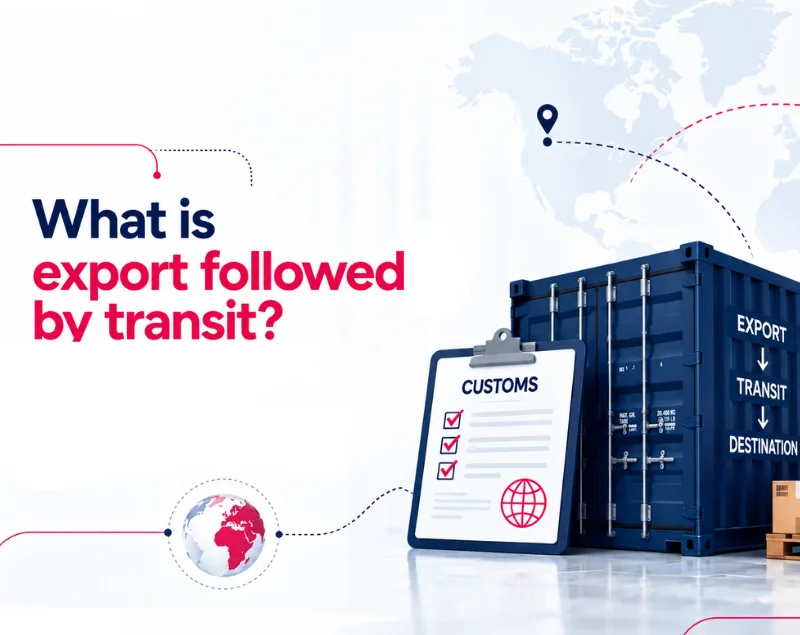
When a French company sells goods to a customer outside the European Union, it is not enough to load a truck and send it to the destination country. The goods must also follow a customs process. Customs declaration, documents, possible customs controls, release of goods, transport, exit from the European Union, electronic tracking… For a company already familiar with international flows, these steps are part of everyday operations. But for a company starting to export, the terminology can quickly become difficult to understand. What is an export declaration? What is customs transit used for? What is the difference between export and transit? Why does the exit of the goods need to be monitored? And, above all, what is export followed by transit, one of the latest developments in the French customs system? Since 2025, the export component of DELTA IE and the SDS – Exit Monitoring system have been operational in France. In September 2026, a new development enables SDS and DELTA T to work together for export followed by transit. The purpose of this article is to explain the subject from the ground up, using practical examples. What are the customs formalities for export? Let’s start with the basics. A French company sells goods to a company located in the United Kingdom, Morocco, Brazil or China. The goods must leave the customs territory of the European Union. This exit must be declared to customs. French Customs explains that exported goods are subject to export and exit formalities. The export declaration is submitted electronically and may be subject to customs controls before customs grants the release of the goods, allowing the shipment to continue. Why is an export declaration required? The customs declaration is the electronic document used to provide the authorities with the information required for the operation. It specifies, among other things: Customs may then carry out the necessary controls and grant release of the goods, allowing the shipment to continue. A practical example : A French company sells €50,000 worth of industrial components to a customer in Morocco. The goods are ready at its warehouse. The carrier has been booked. But before the goods can continue on their export journey, the required information must be correctly declared. If the data is incomplete or inconsistent, the operation may be delayed. This is why customs formalities should not be treated as an administrative task carried out at the last minute. They are part of transport planning. What does customs release mean? The term may sound technical. Release of the goods simply means that the goods are authorised to continue their journey after the customs declaration has been processed. It can be simplified as follows: -> Declaration submitted -> Customs processes the declaration -> Possible customs control -> Release of the goods -> Goods authorised to continue their journey Release does not necessarily mean that the goods have already left the European Union. It means that the relevant stage of the customs process allows the goods to continue their journey. What is the difference between export and customs transit? This is one of the first concepts to understand when discovering customs procedures. The two terms are linked to international trade, but they do not mean the same thing. Export Export refers to goods leaving the customs territory of the European Union for a non-EU country. Example: France → Morocco The goods leave the European Union. The required export formalities must therefore be completed and the actual exit of the goods must be monitored. Transit Customs transit concerns the movement of goods under a specific customs procedure. It allows goods to move under certain conditions without immediately paying the duties and taxes that would normally become payable during their movement. In France, transit declarations are managed through DELTA T. Export = the goods leave the European Union. Transit = the goods move under a specific customs procedure. This is precisely why the combination of the two becomes important when dealing with export followed by transit. What is export followed by transit? To understand export followed by transit, it is first necessary to distinguish between two customs operations: Export allows goods to leave the customs territory of the European Union. Transit allows goods to move under a transit customs procedure to their destination, with customs monitoring throughout the movement. In France, transit declarations are managed through DELTA T, which is connected to the European NCTS system. Export followed by transit combines these two operations. French Customs defines it as a simplification allowing goods intended for export to move under the transit customs procedure to the transit destination, without exit formalities being carried out at that stage. On 15 September 2026, French Customs deployed version 1.1.1 of SDS – Exit Monitoring. One of the key developments introduced by this version is: In other words, SDS and DELTA T can now be interconnected to manage this type of export + transit journey. This development is part of the broader modernisation of the French customs IT systems. Before September 2026 The systems used for export and transit were already evolving, but the specific interconnection required to manage export followed by transit had not yet been deployed in its current configuration. Since 15 September 2026 The new version of SDS enables the connection with DELTA T for export followed by transit. French Customs has also published a specific official bulletin, BOD 7691 “Export followed by transit”, covering the regulatory and declaration procedures applicable to the system. When is export followed by transit used? Export followed by transit is particularly relevant when goods are declared for export in France but must continue their journey under transit to their point of exit from the customs territory of the European Union. A practical example : A French company sells a machine to a customer in Canada. The machine is prepared in Lyon, but it must travel to the port of Antwerp, Belgium, where it will be loaded onto a vessel bound for Canada. The journey is therefore: Lyon
Importing from China in 2026: documents, delays and customs
Importing from China can be a strong opportunity for European companies. However, it also requires preparation. A product may be ready at the supplier’s factory, but that does not mean the shipment is ready to move. Before goods leave China, companies need to check documents, customs rules, transport times, VAT, product compliance and delivery constraints. In 2026, this topic has become even more important. The European Union has introduced new customs measures for low-value parcels imported from outside the EU. From 1 July 2026, a temporary €3 customs duty applies to low-value consignments of up to €150. According to the European Commission, this measure aims to improve fairness, safety and customs compliance, especially for e-commerce imports. Therefore, importing from China is no longer only a question of price or transport time. In other words, it is also a question of control. Why importing from China requires preparation Many companies import from China because they want access to competitive prices, large production capacity or specific industrial know-how. However, the real cost of an import operation does not stop at the purchase price. A company must also consider: In other words, the key question is not only: “How much does the product cost?” Ultimately, the real question is: “Can the company import the goods safely, on time and with full visibility?” This is why many companies work with a logistics partner able to manage international transport and multimodal flows from origin to final delivery. What documents are needed when importing from China? When importing from China, documents play a central role. If one document is missing, incomplete or inconsistent, customs clearance can take longer. In some cases, the goods may remain blocked until the importer provides the correct information. The main documents usually include: As a result, these documents must be consistent. For example, the product description, quantity, weight, value, HS code and country of origin must match across the commercial invoice, packing list and transport documents. Otherwise, customs authorities may ask for clarification. For importers, this is also why customs declaration support can help reduce errors before the goods arrive. Commercial invoice: the key customs document The commercial invoice is one of the most important documents when importing from China. It usually includes: Customs authorities use this document to assess the value of the goods, duties, VAT and possible controls. Therefore, the importer should not treat the invoice as a simple accounting document. In fact, it is also a customs document. Packing list: why details matter The packing list gives operational details about the shipment. It usually shows: This document helps carriers, freight forwarders, warehouses and customs teams identify the goods. In practice, a clear packing list can reduce confusion during handling, inspection or final delivery. As a result, it can also help avoid unnecessary operational delays. HS code: a small detail with major consequences The HS code identifies the customs classification of the product. It affects: A wrong HS code can create serious problems. For example, the company may pay the wrong duty rate. It may also miss a specific certificate or face a customs correction later. Therefore, importers should check the HS code before the goods leave China. Bill of lading or air waybill In addition, the transport document depends on the chosen mode of transport. For sea freight, the main document is the bill of lading. For air freight, the main document is the air waybill. These documents confirm that the carrier has taken charge of the goods. They also provide essential transport information, such as origin, destination, shipper, consignee and shipment references. As a result, they are essential for both logistics tracking and customs procedures. Incoterms: who is responsible for what? Incoterms define the responsibilities between the seller and the buyer. More specifically, they clarify who manages transport, insurance, export clearance, import clearance and costs at each stage. For imports from China, companies often use Incoterms such as FOB, CIF, EXW or DAP. However, each option has different consequences. For example, EXW gives the buyer more responsibility from the supplier’s premises. On the other hand, DAP may seem easier, but the buyer still needs to understand import duties, VAT and customs clearance at destination. Therefore, the Incoterm must be chosen before the order is confirmed. How long does it take to import from China? Import lead times from China depend on the transport mode, origin, destination, season, customs process and final delivery requirements. In general, companies can choose between: However, each option has advantages and limits. Sea freight is often more cost-effective for large volumes. However, it takes longer. Air freight is faster. However, it is more expensive and may be affected by capacity issues. Rail freight can offer an intermediate option for some flows between China and Europe. However, routes, availability and geopolitical constraints must be checked carefully. Therefore, the best option depends on the product, urgency, volume and budget. In many cases, a multimodal transport solution can help companies combine cost control, flexibility and operational visibility. Why customs clearance can delay an import In many cases, customs clearance can delay an import when information is missing, inaccurate or inconsistent. Common causes include: In addition, EU import controls are becoming more data-driven. The Import Control System 2, known as ICS2, requires safety and security data before goods arrive. The European Commission explains that incomplete or inaccurate Entry Summary Declaration data may lead to rejection, requests for additional information or delays in the entry process. As a result, companies should not wait until the goods arrive in Europe to prepare customs information. They need to anticipate it earlier. VAT and customs duties when importing from China When a company imports goods from China into the European Union, it must consider customs duties and VAT. Customs duties depend mainly on: In addition, VAT depends on the country of import and the applicable tax rules. In France, import VAT is generally handled through the French tax system for VAT-registered businesses. However, the company still needs accurate customs data,
Anti-dumping law: what importers of Chinese tyres need to check
What is anti-dumping law? Anti-dumping law allows the European Union to apply additional duties to certain imported products. The objective is to correct a situation where goods are exported at prices considered abnormally low. When these prices cause injury to European industry, the EU can impose anti-dumping duties. In other words, this is not a general tax on all Chinese products. It is a targeted measure. It applies to specific products, specific origins and, in some cases, specific producers. To better understand this regulation, we will use a concrete and current example: the anti-dumping measures targeting certain new tyres originating from China. Why are Chinese tyres concerned? The European Union opened an investigation in May 2025 into Chinese tyres for passenger cars and light commercial vehicles. The investigation followed a complaint from the European tyre industry, which considered that these imports were being sold at unfairly low prices and were causing injury to European producers. Reuters reported that the European market for passenger car and light commercial vehicle tyres was worth more than €18 billion in 2024. Another anti-subsidy investigation was also launched in November 2025 into certain Chinese tyres. According to Reuters, the complaint mentioned a 51% increase in Chinese imports since 2021, with prices 30% to 65% lower than those of European producers. The objective of the measure is therefore to restore fairer competitive conditions. Which tyres are concerned? Anti-dumping law targets new rubber tyres originating from China. The products concerned include tyres for: The customs codes mentioned are: The key point is the real origin of the tyre. A tyre purchased from an intermediary outside China may still be concerned if it was manufactured in China. By contrast, used tyres, retreaded tyres or products outside the scope of the measure must be analysed separately. What are the anti-dumping rates? The duties vary depending on the Chinese producer. Producer category Anti-dumping duty Hankook producers concerned in China 4.3% Cooperating Chinese producers 24.4% Non-cooperating or not clearly identified producers 45.3% The rate can therefore vary significantly depending on the manufacturer. For an importer, this is not a detail. On a customs value of €100,000, this represents: The difference can completely change the margin of an operation. Why is the Chinese producer so important? This is the most sensitive point. The anti-dumping rate does not depend only on the seller. It depends on the actual producer of the tyre. If the importer buys through a trading company, distributor or intermediary, they must still be able to clearly identify the production plant. Otherwise, the maximum rate may apply. To reduce this risk, the documents must clearly indicate: A vague commercial name is not always enough. Customs authorities must be able to understand who actually manufactured the tyres. Which documents should be prepared before shipment? Anti-dumping law should not be managed only when the goods arrive. It must be anticipated before the purchase and before shipment. To secure the file, the importer should check several documents: The most important point is consistency. The invoice, packing list, origin and producer information must all tell the same story. If the invoice only mentions a seller, without identifying the actual manufacturer, the file may become fragile. What is the impact on import costs? Anti-dumping duties are added to other costs. They do not replace standard customs duties. The full landed cost must therefore be simulated before confirming the order. Mini-diagnosis: are your imports exposed? Your company should ask the right questions before placing an order. Answer yes or no: If several answers are uncertain, the file should be reviewed before shipment. Common mistakes to avoid What should importers do now? Companies concerned by these measures should act before the next shipment. The right method is to start by identifying all Chinese tyre flows. Then, check the actual producers. Next, simulate the financial impact based on the applicable rate. Finally, update purchasing documents, invoices and sales conditions. For some importers, it may also be necessary to review: In some cases, an alternative source outside China may be relevant. But it must be assessed carefully: price, availability, quality, compliance, lead time and production capacity all matter. SECURE YOUR IMPORTS Nexline’s analysis For a company, the risk is not limited to paying an additional duty. The real risk is discovering too late that the actual cost of the operation is no longer the cost expected at the beginning. That is why the file must be secured before shipment. The producer must be identified.The rate must be simulated.The documents must be consistent.The impact on the margin must be anticipated. At Nexline, the objective is to help importers make the right decisions before the goods are exported. This includes analysing flows, checking documentation and simulating the customs impact. The goal is simple: to prevent a poorly anticipated anti-dumping duty from becoming a cost, delay or profitability issue. In brief
Who is responsible in an international shipment?
Several parties are involved in an international shipment. There is usually a seller, a buyer, a carrier, a freight forwarder, a customs representative and, in some cases, an insurer or a warehouse. But when a document is missing, when a declaration is incorrect or when goods are held by customs, one question quickly arises: Who is responsible? The answer depends on several factors: the commercial contract, the chosen Incoterm, the role of each party, the documents provided and the type of customs representation used. For a company, this is a key issue. An international shipment is not secured only by choosing the right transport solution. It is also secured by clearly defining responsibilities. Why does this matter? Customs is not just an administrative formality. It is a step that can directly affect the timing, cost and compliance of an international shipment. Before goods can enter or leave a territory, they must be declared according to the applicable rules. In the European Union, a customs declaration is an official document that provides details of the goods being imported or exported. In France, customs authorities also specify that customs formalities can be carried out by a customs representative, either under direct or indirect representation. The problem is that many companies do not always know who is responsible for what. As a result, documents arrive too late, the customs code is not properly validated, the Incoterm is misunderstood or the role of the freight forwarder is overestimated. In these situations, the shipment can slow down. The key parties in an international shipment To understand responsibilities, you first need to identify the roles. In most operations, five parties are at the centre of the process. 1. The exporter The exporter is the company that sells or ships the goods from the country of departure. They normally know the product, its origin, composition, value and commercial documents. In an international shipment, the exporter generally has to provide the information required for the goods to leave the country. This may include: Depending on the chosen Incoterm, the exporter may also be responsible for export customs clearance. 2. The importer The importer is the company that brings the goods into the country of destination. Its role is often underestimated. However, the importer is generally responsible for ensuring that the import operation is compliant in its own country. It must check that the goods can legally enter the country, that the documents are consistent and that duties and taxes are correctly handled. The importer must specifically check: If this information is incorrect or incomplete, the declaration may be corrected, delayed or subject to customs control. 3. The carrier The carrier is responsible for the physical movement of the goods. This may be a shipping line, an airline, a road haulier, a rail operator or a multimodal transport provider. Its role is to transport the goods according to the agreed conditions. The carrier may also provide certain transport-related data: However, the carrier is not automatically responsible for the commercial or customs content of the goods. It does not always know the exact composition of the product, its customs classification or the specific regulatory obligations that may apply. 4. The freight forwarder The freight forwarder organises the international shipment. It coordinates the different parts of the chain: transport, documents, partners, formalities, tracking and, in some cases, insurance or storage. Its role is operational. It can help the company choose a route, compare transport modes, anticipate lead times and prepare documents. But the freight forwarder does not replace the company in all its responsibilities. It works with the information provided by the client, the supplier and the other parties involved. If the initial data is incorrect or incomplete, the freight forwarder can alert the company, but it cannot invent the correct product information. This is an essential point. 5. The customs representative The customs representative carries out customs formalities. In France, a customs representative can act in two ways: This distinction is important, because it can affect the level of responsibility of both the representative and the company being represented. How do Incoterms influence customs responsibilities? Incoterms define how costs, risks and obligations are divided between the seller and the buyer in an international shipment. They specify who organises the transport, who handles certain formalities, who bears the risks and who pays the costs related to the operation. Choosing the right Incoterm is therefore essential to avoid misunderstandings. Responsibilities are not the same under EXW, FOB, CIF, DAP or DDP. The Incoterm must be confirmed before shipment, based on the goods, the countries involved, the transport mode, the experience of the parties and the customs constraints. What are the most common Incoterms in an international shipment? Each Incoterm distributes responsibilities differently between the seller and the buyer. Here are the most common cases to know. EXW: the buyer takes on almost the entire organisation Under EXW, the seller simply makes the goods available at its premises. The buyer must then organise collection, inland transport in the country of departure, export formalities, international transport, import customs clearance, duties and taxes, and final delivery. For a French buyer, EXW may look attractive because the purchase price is often lower. But it is also one of the most demanding Incoterms. Its main advantage is control. The buyer can choose its providers, negotiate transport and manage the operation from end to end. But the limits are significant. The buyer must handle formalities in the country of departure, coordinate collection from the supplier, manage export documents and take on more operational risk. In practice, EXW can be risky if the buyer does not have a reliable partner locally. Example: a French company buys goods under EXW Shenzhen. The supplier prepares the products at its factory. But the French buyer must organise everything else: collection, export documents, international freight, import into France and final delivery. FOB: the seller manages the goods until loading on board the vessel Under FOB, the seller is responsible for the goods