International maritime transport relies on the involvement of numerous professionals. Shipping companies, freight forwarders, port authorities and maritime agents work together to move goods between ports around the world.
According to UN Trade and Development (UNCTAD), around 80% of international trade in goods by volume is carried by sea.
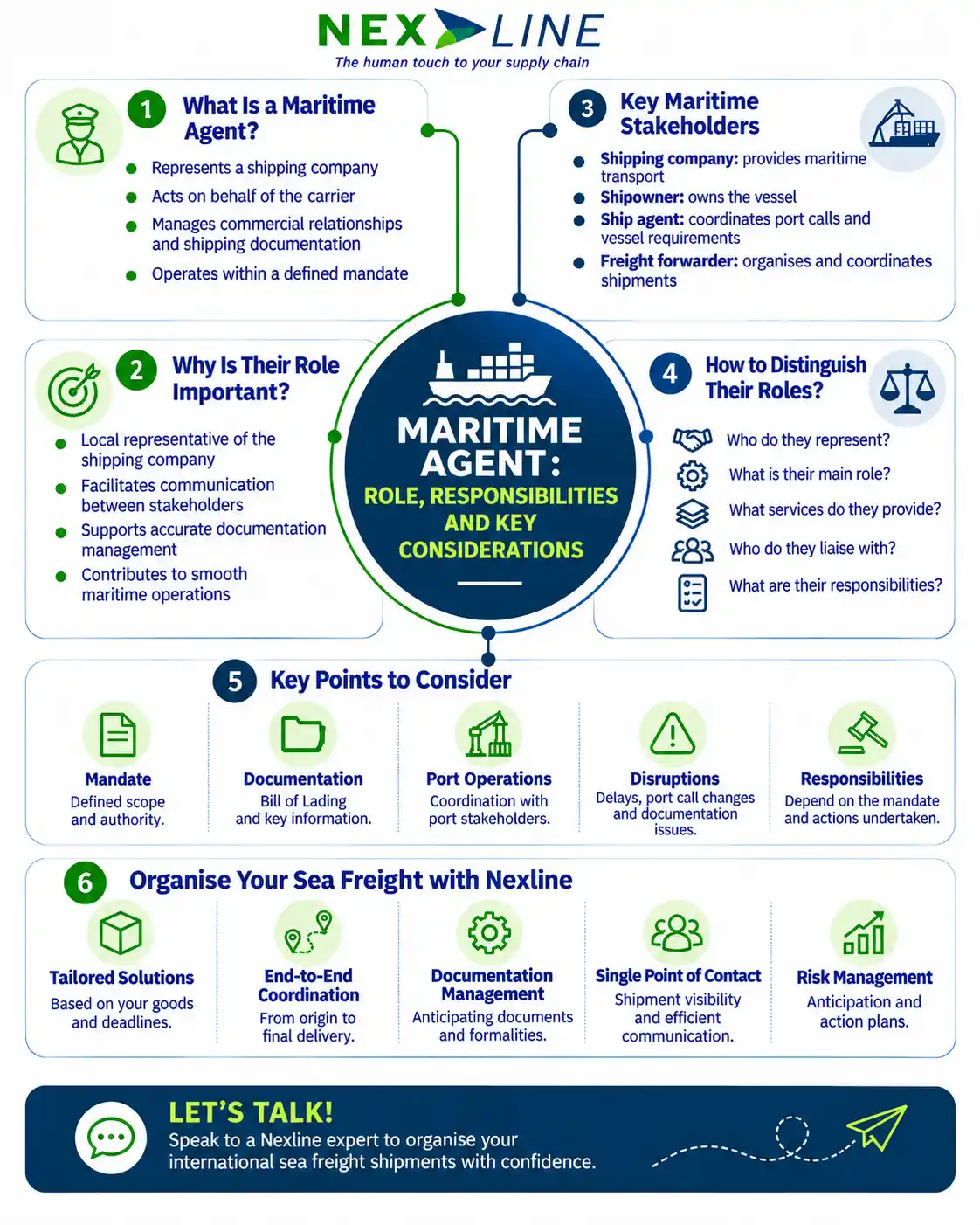
Within this complex organisation, the maritime agent, also commonly referred to as a shipping agent, plays an essential role. Acting on behalf of a shipping company, they facilitate commercial relationships, manage shipping documentation and contribute to the coordination of maritime operations.
But what exactly are their responsibilities? What is the difference between a maritime agent, a ship agent and a freight forwarder? And how do these professionals contribute to an international shipment?
This guide explains the role of a maritime agent in sea freight, their responsibilities and how the different stakeholders work together throughout the international supply chain.
1. What Is a Maritime Agent and What Is Their Role?
A maritime agent is a professional or company appointed to represent a shipping company or another maritime principal within a defined geographical area or scope of activities. Their responsibilities depend on the authority and instructions granted by their principal.
Their role may involve managing commercial relationships, shipping documentation and operational communications between the shipping company and its various stakeholders.
According to the French Association of Maritime Agents and Ship Agents (AMCF), a maritime agent representing a liner shipping company may negotiate transport contracts, provide freight quotations, collect freight payments and issue Bills of Lading when authorised to do so.
What Is the Main Role of a Maritime Agent?
The main role of a maritime agent is to represent the shipping company in its dealings with local and commercial stakeholders.
They facilitate communication between the carrier, its customers and other transport professionals, contributing to the operation of maritime services without necessarily carrying out the transport or cargo handling themselves.
Depending on their appointment, a maritime agent may also perform vessel agency duties. However, commercial representation and the organisation of a vessel’s port call are not necessarily the same function.
Why Do Shipping Companies Work with Maritime Agents?
A shipping company may serve numerous ports and geographical markets without directly managing all its commercial and operational activities in each location.
Working with a maritime agent gives the company access to a local representative familiar with market conditions, port procedures and relevant service providers.
Depending on their mandate, the agent may manage customer relationships, communicate information about available shipping services and assist with the administrative aspects of shipments.
A shipping agency may operate independently and represent several shipping lines. Alternatively, it may form part of an organisation owned or controlled by a shipping company.
This structure facilitates local representation. However, it does not mean that the maritime agent is responsible for every operation carried out at a port.
2. What Are the Main Responsibilities of a Shipping Agent?
The responsibilities of a shipping agent vary depending on the company they represent, the geographical area concerned and the scope of their appointment.
Their activities generally involve commercial representation, documentation management and operational coordination. Where vessel agency services are included, their responsibilities may also extend to port call arrangements.
Commercial Representation of the Shipping Company
A maritime agent may be responsible for promoting and managing the shipping services offered by their principal.
Depending on their authority, they may provide freight quotations, negotiate commercial terms and communicate with customers regarding available transport services.
They may also assist with shipping bookings and provide information required to prepare a shipment.
For an importing or exporting business, the maritime agent therefore acts as a representative of the shipping company concerned.
This role differs from that of a freight forwarder, who organises transport services for their own customer according to the agreed contractual arrangements.
Shipping Documentation and Cargo Tracking
International sea freight requires accurate and timely communication between stakeholders.
A shipping agent may participate in preparing, issuing or managing documents relating to maritime transport.
One example is the Bill of Lading (B/L), which serves as evidence of the contract of carriage, acknowledges receipt of the goods and may, depending on its type, serve as a document of title.
A maritime agent may issue or sign a Bill of Lading on behalf of the carrier when authorised to do so.
Their responsibilities may also involve communicating information relating to:
- Shipping bookings and confirmations.
- Container movements and availability.
- Vessel schedules.
- Estimated arrival and departure times.
- Shipping documentation and cargo release procedures.
The precise scope of these activities depends on the shipping company’s procedures and the authority granted to the agency.
Coordination with Port Authorities and Service Providers
An international shipment involves several stakeholders, including terminal operators, cargo handling companies, port authorities, customs representatives and inland transport providers.
A maritime agent may communicate with these professionals as part of their assigned responsibilities.
However, there is a distinction between representing a shipping line commercially and coordinating the operational requirements of a vessel during a port call.
When appointed to perform vessel agency duties, an agent may help arrange:
- Pre-arrival reporting to relevant authorities.
- Berth reservations and vessel arrival arrangements.
- Pilotage and tugboat services.
- Vessel clearance documentation.
- Communication with terminals and cargo handling providers.
- Departure formalities.
As explained by the Federation of National Associations of Ship Brokers and Agents (FONASBA), a ship agent represents the vessel’s owner or charterer locally and assists with the services required during a port call.
These activities may be performed by a dedicated port agent or by a maritime agency offering both commercial and vessel agency services.
Managing Disruptions and Unexpected Events
Maritime operations may be affected by schedule changes, amended port calls, delays or documentation issues.
In these situations, the shipping agent helps communicate information from the shipping company and directs requests to the relevant stakeholders.
For example, when a vessel arrives later than expected, the updated information needs to reach the professionals responsible for the next stages of the shipment.
The freight forwarder can then adjust on-carriage arrangements, inform the consignee or reschedule delivery appointments where necessary.
Although a maritime agent cannot guarantee that delays will not occur, their role contributes to effective communication and the coordination of operations within their scope of responsibility.
At Nexline, we organise your international shipments by coordinating the different stakeholders, from the supplier to the final consignee. Our integrated logistics approach allows us to combine transport services, port operations and complementary logistics activities according to the needs of each business.
One objective: ensuring the continuity of your cargo flows, from end to end.
EXPLORE OUR TRANSPOR SERVICES
3. Maritime Agent, Ship Agent and Freight Forwarder: What Are the Differences?
A maritime agent, a ship agent and a freight forwarder may all contribute to the same international shipment. However, they do not necessarily represent the same interests or hold the same responsibilities.
Understanding these differences is particularly useful for businesses importing or exporting goods.
Although the terms maritime agent, shipping agent and ship agent can overlap in international practice, the following distinction focuses on three different functions: commercial representation, vessel agency and freight forwarding.
The Maritime Agent Represents the Shipping Company
In the context of liner shipping, the maritime agent acts on behalf of the carrier that has appointed them.
Their responsibilities may include commercial representation, customer relationships, freight quotations and shipping documentation.
For example, they may communicate the rates and conditions offered by a shipping company for transporting a container between two ports.
Their primary role is to represent their principal rather than independently select the most suitable carrier for an importer or exporter.
The Ship Agent Represents the Shipowner During Port Calls
A ship agent, also known as a vessel agent or port agent, acts on behalf of the shipowner or, depending on the appointment, the charterer.
Their responsibilities focus on the requirements of the vessel during its stay at a port.
In addition to coordinating arrival and departure arrangements, a ship agent may organise crew changes, vessel supplies, bunkering, maintenance or other services required by the ship.
In France, the role of the consignataire de navire is specifically defined under Article L5413-1 of the French Transport Code.
The same company may perform both maritime agency and vessel agency activities. Nevertheless, these functions should be distinguished according to the scope of the services provided.
The Freight Forwarder Organises International Shipments
An international freight forwarder organises and coordinates transport services on behalf of their customer.
Depending on the agreed requirements, a freight forwarder may select suitable sea freight solutions, organise pre-carriage, coordinate documentation and arrange onward transport at the destination.
Their objective is to build a transport solution adapted to the customer’s goods, delivery requirements and operational constraints.
In France, it is also necessary to distinguish freight forwarding activities from the specific legal status of a commissionnaire de transport. The applicable responsibilities depend on the legal nature of the services performed and the contractual arrangements.
Comparison Table: Maritime Agent vs Ship Agent vs Freight Forwarder
| Criteria | Maritime Agent / Shipping Agent | Ship Agent / Port Agent | Freight Forwarder |
|---|---|---|---|
| Who do they represent? | Shipping company or ocean carrier | Shipowner or charterer | Importer, exporter or other customer, depending on the contract |
| Main responsibility | Commercial representation of the shipping company | Coordinating and representing vessel-related interests during port calls | Organising international shipments |
| Typical activities | Freight quotations, bookings, customer relationships and shipping documents | Vessel arrival and departure, port formalities and vessel services | Transport bookings, logistics coordination, shipment tracking and complementary services |
| Relationship with importers and exporters | Through the services of the shipping company represented | Generally indirect, depending on the operation | Direct relationship based on the agreed logistics services |
| Legal responsibilities | Depend on the mandate and actions undertaken | Depend on the appointment and applicable regulations | Depend on the contract and legal status of the services performed |
Practical example: A French company wants to import goods from China to its warehouse in Lyon.
The company can entrust the organisation of the shipment to a freight forwarder, who coordinates the agreed services and communicates with the relevant stakeholders.
Meanwhile, the maritime agent represents the shipping company carrying the goods by sea. The ship agent coordinates the vessel’s requirements during its port call according to their appointment.
Each professional therefore contributes to a specific part of the international shipment.
4. How Does a Maritime Agent Contribute to an International Shipment?
To understand the role of a maritime agent in practice, consider a French company importing a container from Shanghai to Le Havre.
This fictional example illustrates how the responsibilities of different maritime and logistics professionals may be distributed throughout a shipment.
Step 1: The Importer Defines Their Requirements
The company needs to transport goods from its Chinese supplier to its warehouse in France.
It identifies the volume and nature of the goods, the required delivery dates and the commercial terms agreed with its supplier.
This information helps determine which transport and logistics services are needed.
Step 2: The Freight Forwarder Organises the Transport Solution
The freight forwarder evaluates the available shipping options and coordinates the services included in the agreed scope of work.
Depending on the requirements, this may include pre-carriage to the port of Shanghai, sea freight bookings and arrangements for the destination.
Documentation, customs requirements and final delivery constraints must also be taken into account.
Step 3: The Shipping Company Carries the Goods
The shipping company provides the maritime transport service under the applicable contractual conditions.
The container is transported according to the booked shipping service, which may include intermediate port calls or transhipment operations.
Step 4: The Maritime Agent Represents the Carrier
The maritime agent acts on behalf of the shipping company within the scope of their mandate.
They may assist with booking information, shipping documentation and communication relating to the vessel’s schedule or the shipment.
The precise responsibilities depend on the organisational structure established by the carrier.
Step 5: Port Service Providers Handle Arrival Operations
When the vessel arrives at Le Havre, several stakeholders become involved in vessel-related and cargo-related operations.
The ship agent coordinates the vessel services included in their appointment, while terminals and port handling companies carry out their respective operations.
Vessel clearance and customs declaration requirements must also be addressed by the appropriate authorised parties.
Although maritime agents may contribute to the exchange of documentation, the completion of customs formalities for the goods is not automatically part of their responsibilities.
Step 6: The Freight Forwarder Coordinates Final Delivery
Once the container is available and the necessary formalities have been completed, on-carriage can be organised.
The container is then transported to the agreed delivery location.
Depending on the shipment’s requirements, this stage may involve road freight, rail freight or a combination of different modes.
This is one of the principles behind multimodal transport.
What Happens When Logistics Stakeholders Are Poorly Coordinated?
A vessel delay may affect container availability, while missing or inaccurate documentation can interrupt subsequent operations.
The consequences are not necessarily limited to the port.
Poor coordination may lead to missed delivery appointments, additional storage charges, equipment-related costs or disruptions to the customer’s supply chain.
Effective communication between stakeholders therefore helps identify potential issues and adjust transport arrangements when necessary.
Nexline’s Advice
For importing businesses, port-to-port transit time represents only one part of the overall supply chain lead time.
Pre-carriage, port operations, customs requirements, shipping documentation, potential inspections and final delivery must also be considered.
At Nexline, we take a comprehensive approach to international freight transport. By selecting and coordinating the right partners for each operation, we help businesses organise the different stages of their supply chain.
Discover our sea freight solutions.
5. What Is the Legal Framework for Maritime Agents in France?
In France, the legal framework applicable to a maritime agent depends on their activities, professional status and the authority granted by their principal.
It is therefore necessary to distinguish their responsibilities from those of the shipping company, ship agent and other logistics professionals.
Internationally, the precise terminology and legal obligations associated with maritime agency activities may vary.
The Agent’s Mandate Determines Their Authority
A maritime agent acts on behalf of a principal, typically a shipping company in the context of commercial liner representation.
The authority granted to the agent determines which actions they can undertake on the principal’s behalf.
This may include negotiating commercial terms, managing shipping documents or entering into agreements falling within the scope of their appointment.
As the AMCF explains, a maritime agent may operate through an independent agency or as part of an organisation integrated into a shipping company.
However, the scope of the agent’s responsibilities must still be assessed according to the applicable contractual and legal arrangements.
What Are the Legal Responsibilities of a Maritime Agent?
The legal responsibilities of a shipping agent cannot be determined solely by their professional title.
They depend on several factors, including:
- The scope of their authority.
- The actions undertaken.
- Their contractual obligations.
- The applicable legal framework.
An agent acting within the authority granted by their principal is not necessarily in the same legal position as a company entering into contractual commitments in its own name.
Consequently, the maritime agent should not automatically be considered responsible for every problem arising during a shipment.
In the event of a dispute, the relevant contracts, shipping documents and obligations of each party must be examined.
How Do These Responsibilities Differ from Those of a Ship Agent?
In France, the ship agent performing the function of a consignataire de navire is subject to a specific legal framework.
Article L5413-1 of the French Transport Code defines this professional as a remunerated representative of the shipowner.
They perform operations required for the vessel and its voyage that are not undertaken by the ship’s master.
This legal definition should not automatically be applied to all commercial maritime agency activities.
A company may perform both functions, but its responsibilities must be assessed in relation to the particular services undertaken.
For an importer or exporter, the practical objective is to identify clearly which professional is contractually responsible for each stage of the shipment.

The Nexline Approach: Tailored Logistics Solutions
At Nexline, we organise international freight transport according to the characteristics of your goods, their destinations and your operational requirements.
We select and coordinate the different partners involved throughout the shipment.
Our objective is to build a logistics solution adapted to each project, rather than offering the same organisation to every business.
Maritime agents and freight forwarders perform different functions. However, their activities can complement one another within an international supply chain.
By combining transport expertise with a comprehensive approach to logistics, we help businesses manage their cargo flows from origin to destination.
The human touch to your supply chain.
FAQ: Frequently Asked Questions About Maritime Agents
What Are the Main Responsibilities of a Shipping Agent?
A shipping agent’s responsibilities may include representing a shipping company, managing customer relationships, providing freight quotations, handling bookings and coordinating shipping documentation. Depending on their appointment, they may also assist with vessel-related operations and communication with port service providers. Their authority and responsibilities are defined by the applicable agency arrangements.
What Does a Maritime Agent Do for a Vessel Arriving at Port?
When appointed to carry out vessel agency duties, a maritime agent helps prepare the vessel’s arrival by coordinating required notifications, berth arrangements, port services and communication with local authorities. They may also assist with clearance documentation and departure preparations. These responsibilities typically fall within the function of a ship agent or port agent.
What Services Does a Ship Agent Provide During a Port Call?
A ship agent coordinates the local services required by a vessel during its port call. Depending on their appointment, these may include pilotage, tugboat arrangements, vessel supplies, crew changes, bunkering, maintenance and communication with terminal operators. Their responsibilities may therefore extend beyond basic vessel clearance and include a range of operational support services.
Can Maritime Agents Arrange Port Clearance and Customs Documentation?
A maritime agent performing vessel agency duties may coordinate port clearance and submit relevant vessel documentation to the appropriate authorities. They may also provide cargo-related information. However, vessel clearance and customs clearance of the goods are distinct processes. Cargo customs declarations must be handled by the parties legally entitled to perform them.
How Can Businesses Assess the Reliability of a Maritime Agency?
Businesses should assess a maritime agency’s relevant experience, local port knowledge, service coverage, communication practices and transparency regarding costs and responsibilities. The suitability of an agency also depends on the vessel, cargo and services required. For importers and exporters, a freight forwarder can help coordinate the relevant maritime service providers within the wider shipment.
Why Work with a Freight Forwarder to Organise Your Sea Freight?
A freight forwarder organises and coordinates the different stages of an international shipment, beyond the ocean crossing itself. Their responsibilities may include selecting transport solutions, booking sea freight, coordinating logistics partners, preparing shipping documentation and arranging final delivery.
Through effective transport flow management, a freight forwarder helps businesses anticipate operational and customs requirements, identify potential disruptions and improve control over overall transport costs and lead times.
In Summary