
Marked by numerous public holidays, the month of May represents a real challenge for companies in France. Activity slows down, delivery times increase, and planning becomes more complex.
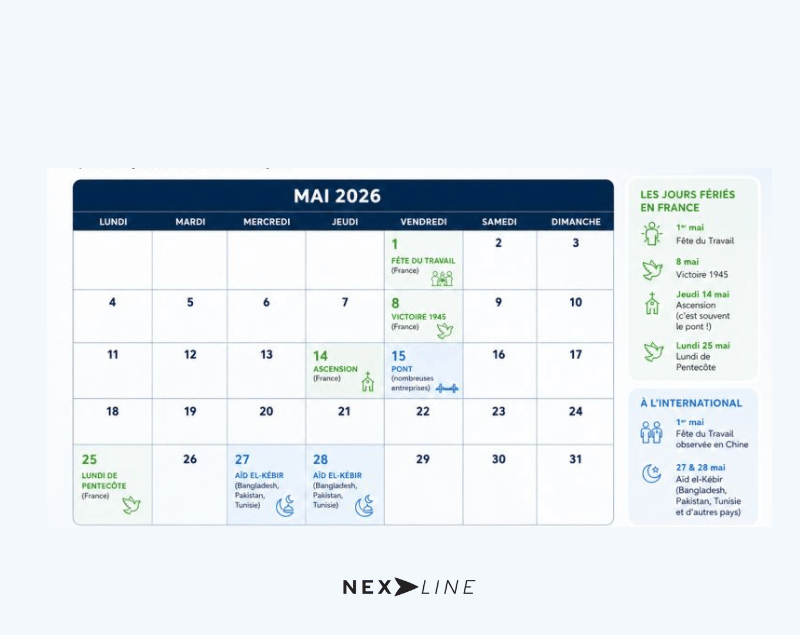
In theory, only 17 working days are available out of 31. This figure does not even include “bridge days,” which further reduce productivity when public holidays fall on a Thursday.
As a result, the entire logistics chain is impacted.
Public holidays slowing down activity in France
In France, May includes several key dates that disrupt business activity. Labour Day on May 1st, Victory Day on May 8th, Ascension Day, and Whit Monday create multiple slow periods throughout the month.
These disruptions affect not only companies but also administrations, customs services, and logistics providers. Even when operations do not stop completely, they often run at a slower pace, which leads to delays at every stage.
A global impact on logistics
In a globalized environment, the effects of public holidays go beyond French borders. International logistics depends on multiple countries, each with its own calendar.
For example, May 1st is also a public holiday in China, a major player in global trade. At the end of the month, Eid al-Adha slows down activity in several strategic countries such as Bangladesh, Pakistan, and Tunisia.
When several regions operate at a reduced pace simultaneously, the effects accumulate. Production, shipping, and delivery times can be significantly impacted.
The entire supply chain is affected
This slowdown does not impact a single link but the entire logistics chain. Factories may produce more slowly, warehouses often operate with reduced staff, and transport providers must adapt their schedules.
Customs and administrative processes can also take longer. Even though each actor continues to operate, coordination becomes more complex, increasing the risk of delays and bottlenecks.
Anticipation is essential
In this context, anticipation is key to maintaining smooth operations.
- anticipating shipments helps reduce delays
- adapting schedules secures logistics flows
- coordinating stakeholders prevents bottlenecks
Anticipating these critical periods allows companies to maintain performance, even when overall activity slows down.
Key takeaways
The logistics sector in May faces a sensitive period. Public holidays in France and international slowdowns can disrupt supply chains. To minimize delays, companies must anticipate shipments and plan operations carefully.
DISCOVER OUR SERVICES