Organising a road freight shipment involves more than finding an available truck. Businesses need to select a suitable carrier, check loading requirements, coordinate delivery schedules and monitor the shipment.
This is where a freight forwarder can help. By working with transport partners, freight forwarding professionals organise shipments according to the type of goods, destination and operational requirements.
But when should a business use a freight forwarder for road transport? What is the difference between a freight forwarder, a freight broker and a carrier? And in which situations does outsourcing road freight organisation make sense?
What Does a Freight Forwarder Do in Road Transport?
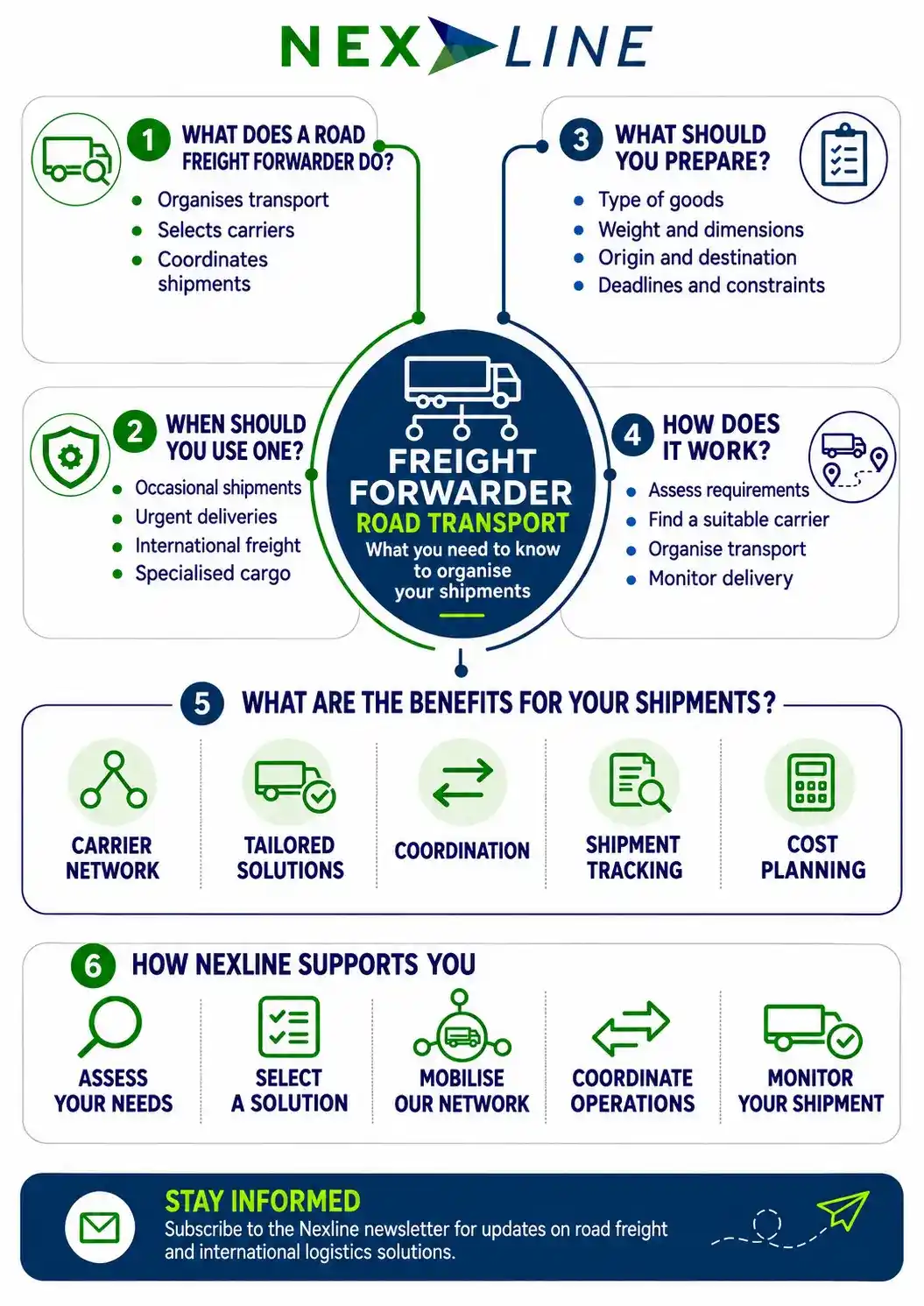
A freight forwarder organises the movement of goods by coordinating the transport services required for a shipment.
In road transport, this involves identifying suitable carriers, arranging collection and delivery, and coordinating the information needed to complete the journey.
The freight forwarder considers several factors, including shipment volumes, destinations, delivery deadlines and specific cargo requirements.
Unlike the carrier performing the journey, a freight forwarder does not necessarily operate the vehicles used to move the goods.
Instead, its role is to organise transport and coordinate the different parties involved.
For a broader explanation of the profession, see our guide: What Is an International Freight Forwarder?
What Are the Main Responsibilities in Road Freight Forwarding?
The precise scope of a freight forwarder’s responsibilities depends on the services provided and the contractual arrangements.
For road shipments, these responsibilities may include:
- Assessing transport requirements: identifying the cargo, volumes, collection points and delivery locations.
- Selecting a suitable carrier: finding a transport provider with the necessary vehicles and capabilities.
- Reviewing transport conditions: comparing availability, rates and operational requirements.
- Organising the shipment: coordinating instructions, loading schedules and delivery arrangements.
- Monitoring transport operations: following shipment progress and helping resolve unexpected issues.
The objective is to organise a solution that meets the shipper’s requirements without relying on the same carrier or vehicle for every shipment.
Freight Forwarder vs Freight Broker vs Carrier: What’s the Difference?
These terms are closely related, but they do not always describe the same role.
The distinctions are particularly important when a business wants to outsource its road transport operations.
| Professional | Main role | Key distinction |
|---|---|---|
| Freight forwarder | Organises shipments and coordinates transport providers | May manage several stages of a shipment and different transport modes |
| Freight broker | Arranges transport by connecting shippers with carriers | Responsibilities and legal status vary by jurisdiction |
| Road carrier | Physically transports the goods | Operates the vehicles used to perform the transport |
A carrier performs the physical transport operation. Meanwhile, a freight broker generally focuses on arranging capacity between shippers and transport providers.
A freight forwarder can coordinate a broader range of logistics activities, depending on the services and contracts involved.
However, these definitions are not interchangeable in every country.
For example, freight brokerage is subject to specific regulatory requirements in the United States. In France, the profession of commissionnaire de transport also operates within a defined legal framework, explained by the French Ministry responsible for Transport.
At Nexline, we organise logistics operations through our network of transport partners.
We do not position ourselves as a road carrier operating our own truck fleet. Our added value lies in understanding transport requirements, selecting suitable solutions and coordinating the different stakeholders.
EXPLORE OUR TRANSPOR SERVICES
When Should You Use a Freight Forwarder for Road Transport?
Using a freight forwarder can be particularly useful when a company lacks the time, transport network or internal resources needed to organise shipments directly.
Several situations may justify outsourcing road freight coordination.
When Shipping Large or Occasional Loads
A business may need to transport several pallets, a full truckload or bulky goods on a specific date.
A freight forwarder can help identify suitable transport capacity without the company needing to operate its own vehicles.
Different transport arrangements may be considered depending on the shipment.
Full Truckload (FTL) is suitable when a dedicated truck is required. Less Than Truckload (LTL) can be considered when the shipment does not justify reserving an entire vehicle.
The choice depends on the cargo, its dimensions, delivery requirements and available services.
For a detailed comparison, read our article about road freight costs, lead times and groupage.
When Transport Is Urgent
A production delay, unexpected order or stock shortage may require goods to be collected quickly.
In these situations, a freight forwarder can look for available transport capacity and assess the options according to the required delivery schedule.
However, freight forwarding does not automatically guarantee immediate collection.
Vehicle availability, distance, loading conditions and operational constraints all affect what can realistically be arranged.
When Organising Domestic or International Shipments
Cross-border road freight operations may involve additional requirements, including transport regulations, driving restrictions, shipping documents and coordination between collection and delivery locations.
For companies shipping goods regularly across Europe, outsourcing transport organisation can simplify day-to-day operations.
The freight forwarder must consider the route, destination and applicable requirements.
For international road carriage, the UNECE’s guidance on CMR and electronic consignment notes provides useful information about transport documentation.
When Goods Require Special Transport Conditions
Some products require specific vehicles or handling arrangements.
Examples include temperature-sensitive products, industrial equipment and goods requiring additional precautions during transport.
In these cases, selecting a carrier involves more than comparing prices.
The chosen transport solution must also be compatible with the cargo’s technical and operational requirements.
How Does Road Freight Forwarding Work?
Organising a road shipment generally involves four main stages.
1. Assessing the Shipment Requirements
Before looking for a carrier, the freight forwarder needs accurate information about the goods and the required transport.
This usually includes:
- Nature and packaging of the goods.
- Number of pallets, weight and dimensions.
- Collection and delivery addresses.
- Preferred dates and delivery time slots.
- Special handling or transport requirements.
The more precise this information is, the easier it becomes to assess suitable options.
2. Finding a Suitable Transport Solution
The freight forwarder identifies available transport capacity and compares possible arrangements.
This may involve examining vehicle types, routes, delivery schedules and pricing conditions.
The aim is not simply to find the lowest quoted rate.
Transport reliability and compatibility with the shipment’s requirements also need to be considered.
3. Confirming and Organising the Shipment
Once a solution has been selected, the relevant information is shared with the transport provider and other parties involved.
Collection and delivery locations, loading arrangements and time slots must be confirmed to reduce misunderstandings.
Depending on the shipment, specific transport documentation may also be required.
4. Monitoring the Shipment Until Delivery
The organisation of a road freight shipment does not end when the truck leaves the collection point.
Teams must be able to monitor progress, communicate relevant updates and respond when unexpected issues arise.
This is particularly important when goods are being delivered to industrial facilities, warehouses or terminals operating with scheduled receiving appointments.
At Nexline, transport flow management is an integral part of our approach to coordinating logistics operations.
Road Freight Forwarding: Benefits and Limitations for Businesses
Using a freight forwarder can offer several advantages, provided the solution matches the company’s requirements.
| Potential advantages | Points to verify |
|---|---|
| Access to a network of carriers | Actual vehicle availability |
| Organisation of occasional or regular shipments | Booking lead times |
| Transport adapted to the cargo | Vehicle and loading requirements |
| Coordination between different parties | Contractual responsibilities |
| Comparison of transport options | Total cost and included services |
Freight forwarding is not necessarily the cheapest solution.
Its value depends on the circumstances, including shipment volumes, frequency, destinations and the transport resources already available to the company.
For highly regular and predictable shipments, a direct transport contract with a carrier may also be suitable.
The best approach is therefore to compare the available arrangements rather than assuming that outsourcing transport is always the right choice.
Practical Example: Shipping Pallets from France to Germany
Consider a French industrial company that needs to deliver several pallets of goods to a customer in Germany.
The delivery must take place within a specific time slot, but the company does not have an existing transport agreement suitable for this occasional shipment.
It therefore contacts a logistics provider to organise the transport.
The first step is to verify the characteristics of the pallets: dimensions, weight, loading conditions and any specific requirements.
Next, the provider assesses whether a full truckload or a shared transport solution would be more appropriate.
Carrier availability, the required delivery date and the destination’s receiving conditions are then used to compare the options.
Once the transport is arranged, the relevant parties receive the necessary instructions for collection and delivery.
This is an illustrative example. It shows how a business can use freight forwarding services for an occasional road shipment without having to find and coordinate each transport provider independently.
Businesses shipping smaller quantities can also explore Nexline’s pallet transport solutions.
How Nexline Organises Your Road Freight Shipments
At Nexline, we believe that every transport operation should be organised around the company’s actual requirements.
Our role is not to systematically recommend the same carrier or route.
Instead, we assess the goods, volumes, destinations and operational constraints before exploring suitable transport solutions.
Through our network of partners, we provide road freight solutions for domestic and international shipments.
Depending on the requirements, we can assess full truckload, less-than-truckload, temperature-controlled transport and specific project needs.
Our support can also form part of a broader logistics arrangement.
For example, road transport may need to be coordinated with sea freight, air freight or rail transport.
In these situations, our multimodal transport solutions allow different modes of transport to be considered within the same logistics operation.
This reflects our approach to tailor-made logistics: organising transport around the goods rather than forcing every shipment into a standard solution.
What Information Do You Need to Request a Quote?
To help us assess your road freight requirements, prepare the following information whenever possible:
- Collection and delivery locations.
- Nature, weight and volume of the goods.
- Number of pallets or shipment dimensions.
- Preferred collection and delivery dates.
- Any temperature, handling or delivery restrictions.
These details help our teams assess the available options more efficiently.
Are you looking for a road freight solution for your goods?
Contact the Nexline team to discuss your requirements and explore transport arrangements adapted to your operations.
FAQ: Frequently Asked Questions About Road Freight Forwarding
What Is Road Freight Forwarding and Who Is It For?
Road freight forwarding involves organising the transport of goods by working with carriers suited to the requirements of each shipment.
It is particularly relevant for industrial, commercial and logistics companies that need to ship goods occasionally or regularly, domestically or internationally.
Services may cover full truckloads, part loads or shipments requiring specific vehicles and handling arrangements.
How Much Does a Freight Forwarder Cost for Road Transport?
The cost depends on the distance, shipment volume, weight, vehicle type, carrier availability and required delivery schedule.
Special handling, loading requirements and additional services may also influence the final quote.
For more information about pricing factors, consult our guide to road freight costs and groupage.
How Do You Choose a Reliable Freight Forwarder for Road Transport?
Start by assessing the provider’s experience with your type of shipment, the quality of its carrier network and its ability to coordinate transport operations.
Clear quotations, reliable communication and suitable contractual arrangements are also important.
At Nexline Group, we organise road freight shipments through our transport partners. Our teams assess each company’s logistics requirements before recommending suitable solutions.
Can a Freight Forwarder Arrange International Road Transport?
Yes. Freight forwarders can organise international road freight shipments, depending on their services and partner network.
However, each shipment must comply with the transport regulations and documentation requirements applicable to the countries involved.
For European cross-border shipments, planning collection and delivery conditions is particularly important.
What Is the Difference Between a Freight Forwarder and a Freight Broker?
A freight broker generally arranges transport by connecting shippers with carriers.
A freight forwarder may take responsibility for organising a broader set of transport and logistics services, depending on its contractual role.
The legal distinction depends on the jurisdiction. In particular, freight brokerage in the United States has a specific regulatory meaning.
Why Choose Nexline for Road Freight Forwarding?
Nexline offers road freight solutions tailored to different types of goods and operational constraints.
Our teams coordinate shipments through a network of transport partners. We can also integrate road transport into a broader international logistics organisation when several transport modes or logistics providers are involved.
In Summary