When a French company sells goods to a customer outside the European Union, it is not enough to load a truck and send it to the destination country.
The goods must also follow a customs process.
Customs declaration, documents, possible customs controls, release of goods, transport, exit from the European Union, electronic tracking…
For a company already familiar with international flows, these steps are part of everyday operations.
But for a company starting to export, the terminology can quickly become difficult to understand.
What is an export declaration?
What is customs transit used for?
What is the difference between export and transit?
Why does the exit of the goods need to be monitored?
And, above all, what is export followed by transit, one of the latest developments in the French customs system?
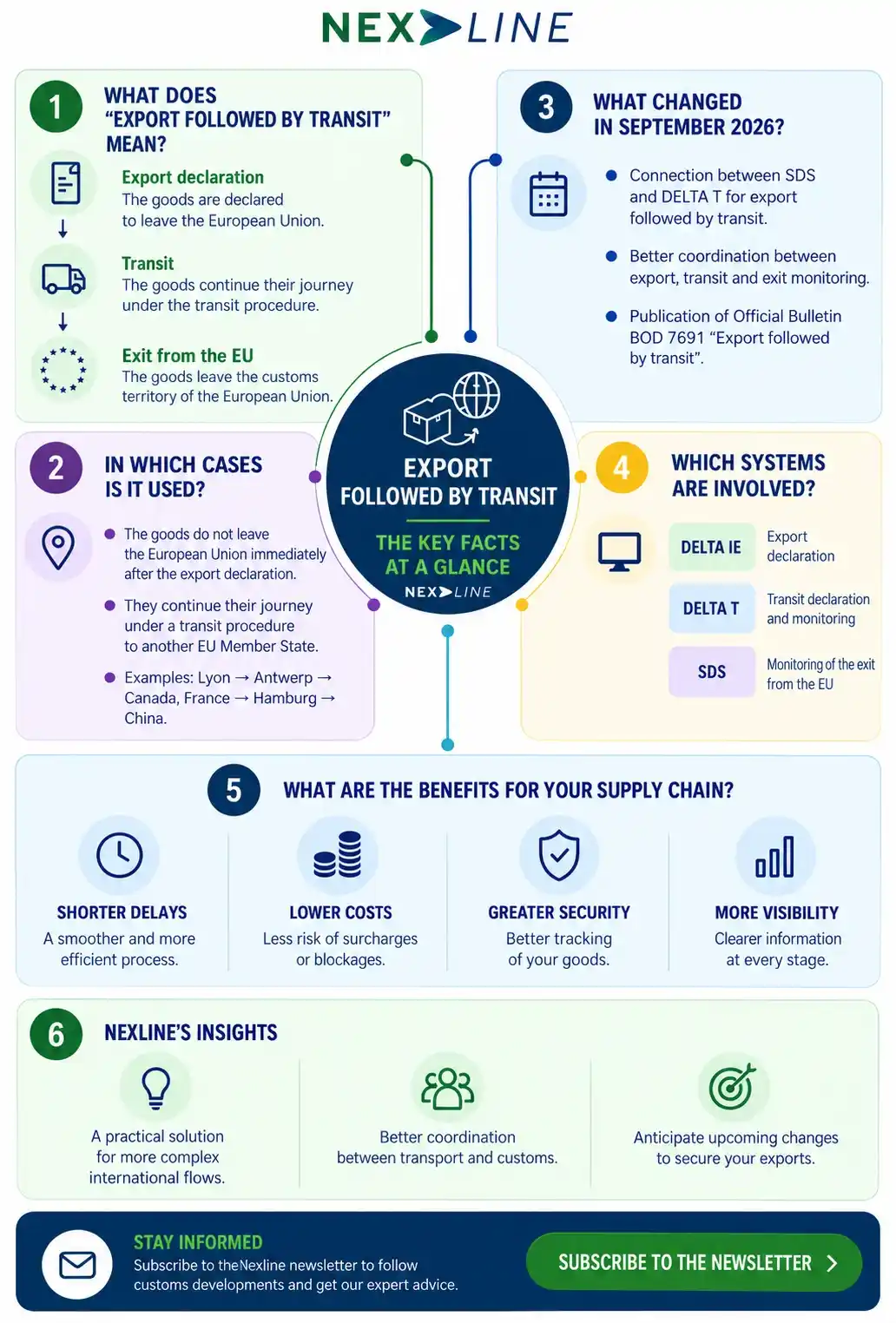
Since 2025, the export component of DELTA IE and the SDS – Exit Monitoring system have been operational in France. In September 2026, a new development enables SDS and DELTA T to work together for export followed by transit.
The purpose of this article is to explain the subject from the ground up, using practical examples.
What are the customs formalities for export?
Let’s start with the basics.
A French company sells goods to a company located in the United Kingdom, Morocco, Brazil or China.
The goods must leave the customs territory of the European Union.
This exit must be declared to customs.
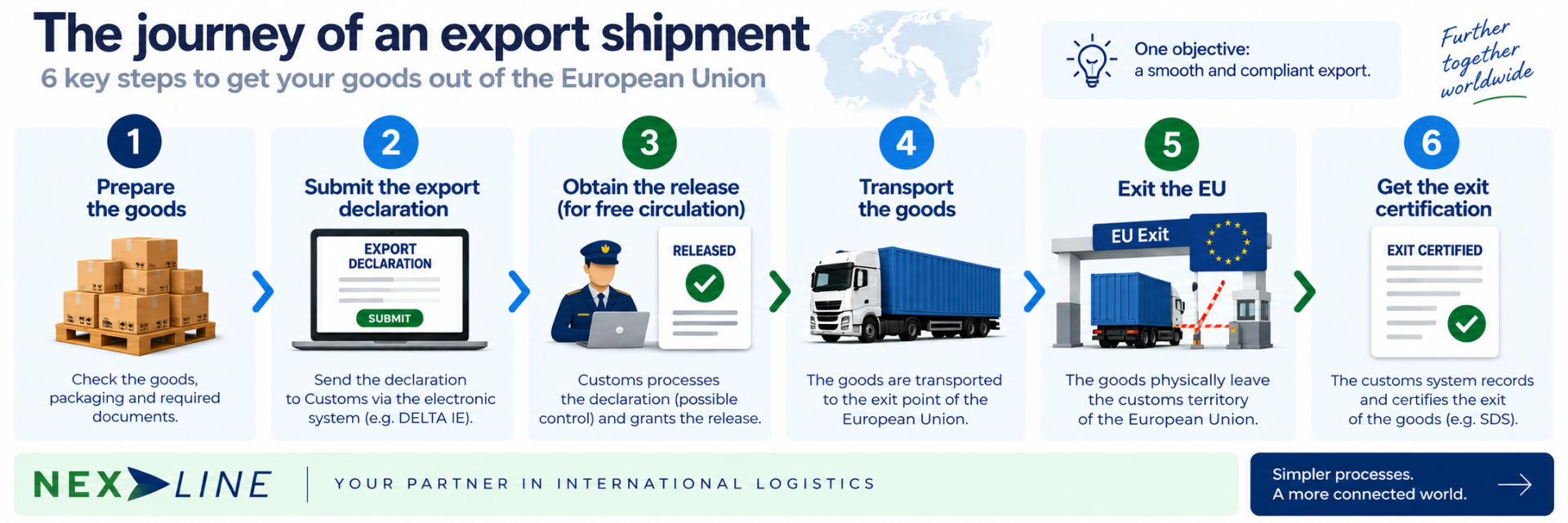
French Customs explains that exported goods are subject to export and exit formalities. The export declaration is submitted electronically and may be subject to customs controls before customs grants the release of the goods, allowing the shipment to continue.
Why is an export declaration required?
The customs declaration is the electronic document used to provide the authorities with the information required for the operation.
It specifies, among other things:
- who is exporting the goods;
- what goods are being exported;
- their value;
- their origin;
- where they are going;
- how they will be transported;
- which customs procedure applies.
Customs may then carry out the necessary controls and grant release of the goods, allowing the shipment to continue.
A practical example :
A French company sells €50,000 worth of industrial components to a customer in Morocco.
The goods are ready at its warehouse.
The carrier has been booked.
But before the goods can continue on their export journey, the required information must be correctly declared.
If the data is incomplete or inconsistent, the operation may be delayed.
This is why customs formalities should not be treated as an administrative task carried out at the last minute.
They are part of transport planning.
What does customs release mean?
The term may sound technical.
Release of the goods simply means that the goods are authorised to continue their journey after the customs declaration has been processed.
It can be simplified as follows:
-> Declaration submitted
-> Customs processes the declaration
-> Possible customs control
-> Release of the goods
-> Goods authorised to continue their journey
Release does not necessarily mean that the goods have already left the European Union.
It means that the relevant stage of the customs process allows the goods to continue their journey.
What is the difference between export and customs transit?
This is one of the first concepts to understand when discovering customs procedures.
The two terms are linked to international trade, but they do not mean the same thing.
Export
Export refers to goods leaving the customs territory of the European Union for a non-EU country.
Example:
France → Morocco
The goods leave the European Union.
The required export formalities must therefore be completed and the actual exit of the goods must be monitored.
Transit
Customs transit concerns the movement of goods under a specific customs procedure.
It allows goods to move under certain conditions without immediately paying the duties and taxes that would normally become payable during their movement.
In France, transit declarations are managed through DELTA T.
Export = the goods leave the European Union.
Transit = the goods move under a specific customs procedure.
This is precisely why the combination of the two becomes important when dealing with export followed by transit.
What is export followed by transit?
To understand export followed by transit, it is first necessary to distinguish between two customs operations:
Export allows goods to leave the customs territory of the European Union.
Transit allows goods to move under a transit customs procedure to their destination, with customs monitoring throughout the movement. In France, transit declarations are managed through DELTA T, which is connected to the European NCTS system.
Export followed by transit combines these two operations.
French Customs defines it as a simplification allowing goods intended for export to move under the transit customs procedure to the transit destination, without exit formalities being carried out at that stage.
On 15 September 2026, French Customs deployed version 1.1.1 of SDS – Exit Monitoring. One of the key developments introduced by this version is:
- the connection with DELTA T for export followed by transit.
In other words, SDS and DELTA T can now be interconnected to manage this type of export + transit journey.
This development is part of the broader modernisation of the French customs IT systems.
Before September 2026
The systems used for export and transit were already evolving, but the specific interconnection required to manage export followed by transit had not yet been deployed in its current configuration.
Since 15 September 2026
The new version of SDS enables the connection with DELTA T for export followed by transit. French Customs has also published a specific official bulletin, BOD 7691 “Export followed by transit”, covering the regulatory and declaration procedures applicable to the system.
When is export followed by transit used?
Export followed by transit is particularly relevant when goods are declared for export in France but must continue their journey under transit to their point of exit from the customs territory of the European Union.
A practical example :
A French company sells a machine to a customer in Canada.
The machine is prepared in Lyon, but it must travel to the port of Antwerp, Belgium, where it will be loaded onto a vessel bound for Canada.
The journey is therefore:
Lyon
- Goods declared for export
Antwerp
- Physical exit from the European Union
Canada
- Final destination
The goods therefore do not leave the European Union immediately after the export declaration.
They first have to cross part of the European Union’s customs territory.
This is precisely the type of situation in which export followed by transit can connect the two operations.
Export: the goods are declared for export from the European Union.
Transit: the goods move under customs supervision to the transit destination.
Exit: the goods then physically leave the customs territory of the European Union.
French Customs specifies that, under this arrangement, goods intended for export move under the transit procedure to the transit destination, without exit formalities being carried out at that stage.
What are the roles of DELTA IE, DELTA T and SDS?
To understand export followed by transit, it is important to distinguish between the three systems. They do not perform the same function.
| System | Main function | When it is used |
|---|---|---|
| DELTA IE – Export | Submit and process the export declaration | At the beginning of the export operation |
| DELTA T | Manage customs transit | When the goods are placed under transit |
| SDS | Monitor the physical exit of goods from the customs territory of the European Union | When the goods actually leave the EU |
The logic is therefore quite simple:
DELTA IE = export
DELTA T = transit
SDS = exit
The specific feature of export followed by transit is that information relating to transit and exit monitoring is connected. The export declaration’s MRN is used to link the export and transit operations.
In our Lyon → Antwerp → Canada example
“The machine” is first declared for export in DELTA IE.
When the journey continues under transit, the corresponding declaration is managed through DELTA T.
The transit procedure then allows the goods to be monitored until the destination specified for the operation.
When the goods physically leave the customs territory of the European Union, the exit information is handled through SDS.
The connection between the systems allows these different stages to be matched.
DELTA IE records the export, DELTA T manages the transit and SDS monitors the exit.
Why is the connection between export and transit important?
It is easy to think of transport and customs as two separate subjects.
In reality, they describe the same movement of goods from two different perspectives.
Transport tells you where the goods physically are.
Customs needs to know under which procedure the goods are moving and at which stage of their journey they are.
Let’s take our machine again:
Lyon
- The goods are available and declared for export.
Antwerp
- They continue their journey under transit to the designated destination.
Canada
- They ultimately leave the customs territory of the European Union.
For the operation to be properly monitored, the customs information must correspond to the actual journey of the goods.
This is precisely the value of the connection between DELTA T and SDS for export followed by transit. French Customs indicates that this functionality relies on their interconnection.
What are the benefits of export followed by transit?
The main benefit of the system is to better coordinate the customs journey of goods that do not leave the European Union immediately.
For companies, this can help to:
- link the export declaration to the movement under transit;
- ensure continuity in customs monitoring;
- better align information between export and transit;
- facilitate the monitoring of a journey involving several stages before the goods leave the EU;
- avoid treating transit as an operation completely separate from the export.
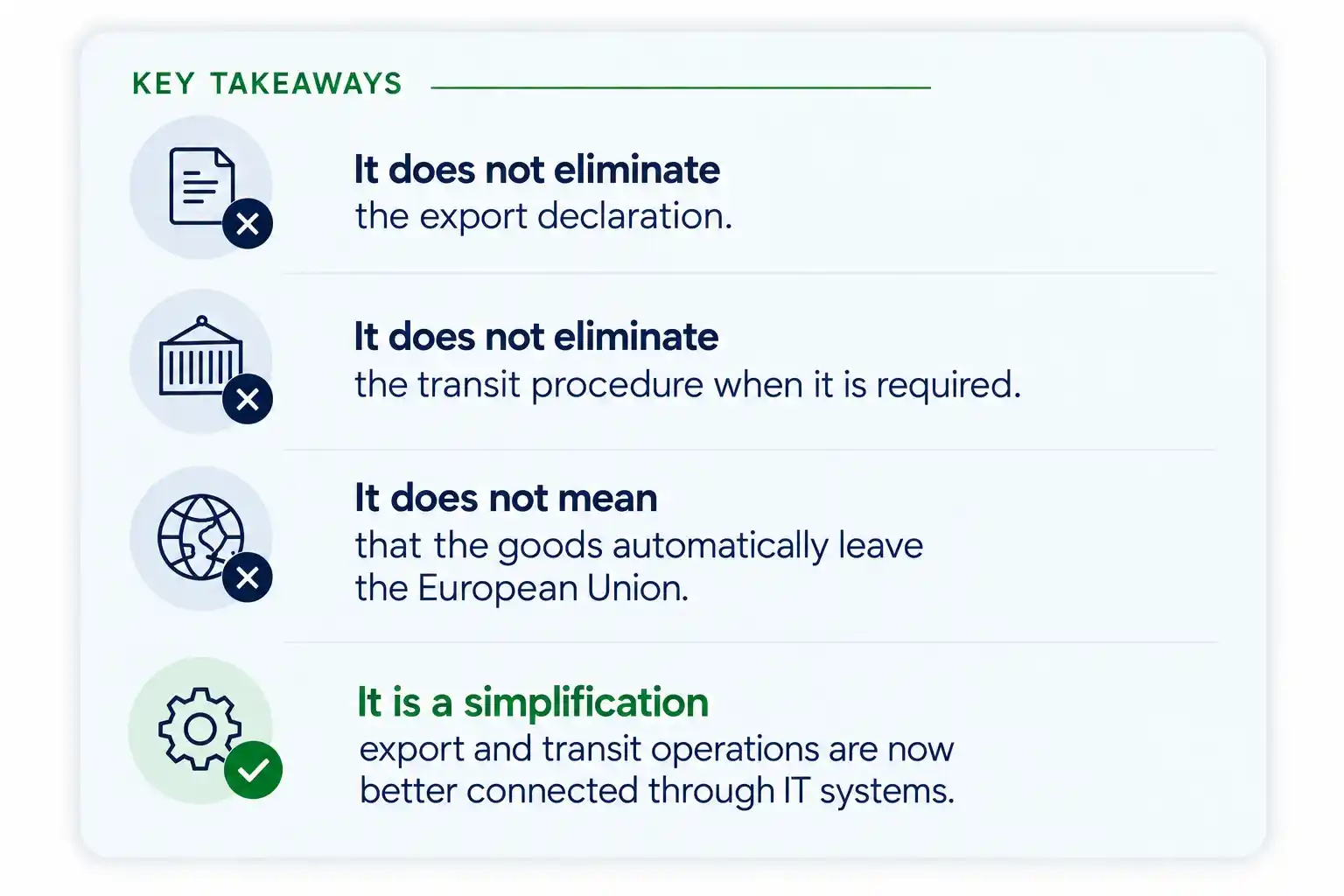
However, this does not mean that companies no longer have customs formalities to complete.
The simplification concerns the coordination of the customs journey, not the removal of customs obligations.
Which information must be consistent between export and transit?
Export followed by transit relies on an important principle: the transit declaration must be linked to the corresponding export declaration.
The MRN of the export declaration must, in particular, be included in the transit declaration when transit follows an export operation.
This creates the link between the two operations.
For teams preparing the shipment, this means checking in particular:
- the identification of the export declaration;
- the planned route for the goods;
- the office of departure and transit destination;
- the information relating to the goods;
- the consistency between export and transit data;
- the reference used to link the two declarations.
An error in this information can have a very practical consequence: it can complicate or delay customs processing.

Nexline analysis
Export followed by transit illustrates a broader evolution in international trade: the physical journey of goods and their customs journey are increasingly connected through data.
A shipment can physically be travelling between two European countries while already being involved in an export operation to a non-EU country.
For companies, the right approach is therefore to prepare simultaneously:
the physical journey of the goods,
the customs formalities,
and the information required to monitor them.
At Nexline, this coordination is an integral part of managing international shipments.
The objective is not simply to get goods moving.
It is to secure their journey from collection through to final destination, while taking into account transport, customs and transit requirements.
Do you have an export flow to organise?
DISCOVER OUR TRANSPORT SERVICES
FAQ – Export Followed by Transit
What is export followed by transit?
Export followed by transit allows goods intended for export to move under the transit customs procedure to the transit destination, without exit formalities being carried out at that stage.
What is the difference between DELTA IE, DELTA T and SDS?
DELTA IE – Export is used to manage the export declaration. DELTA T manages customs transit. SDS monitors the physical exit of goods from the customs territory of the European Union.
When is export followed by transit used?
It is used when goods intended for export must continue their journey under transit to the transit destination before their exit from the European Union is completed.
Why is the export MRN important?
When transit follows an export declaration, the MRN of the export declaration is used in the transit declaration to link the two operations.
Does export followed by transit replace the export declaration?
No. The export declaration remains necessary. Export followed by transit allows this declaration to be connected with the movement under transit.
What is the role of SDS?
SDS stands for Exit Monitoring. It is the system used to monitor the physical exit of goods and certify their actual exit from the customs territory of the European Union.
What changed in 2026 for export followed by transit?
On 15 September 2026, version 1.1.1 of SDS introduced, among other changes, the connection with DELTA T for export followed by transit.
En brief