
Customs Formalities for Export: Understanding Export Followed by Transit
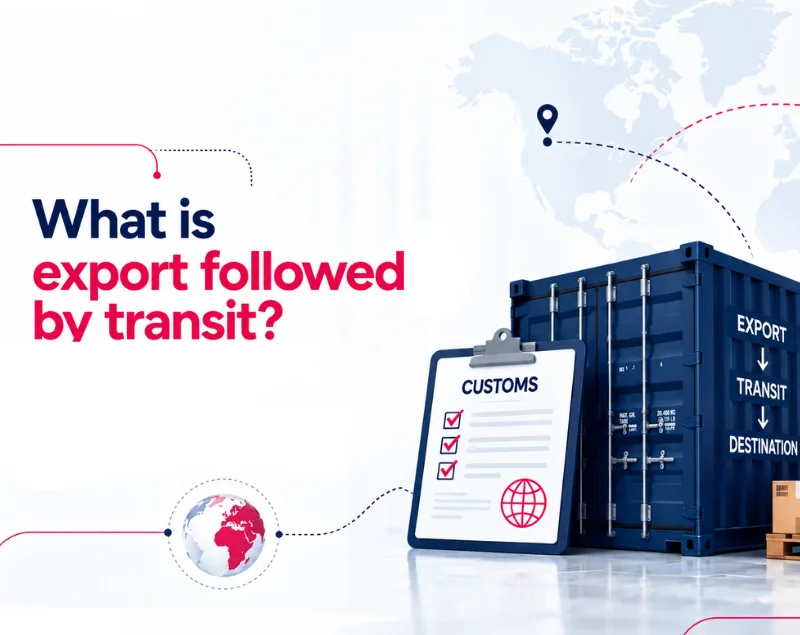
When a French company sells goods to a customer outside the European Union, it is not enough to load a truck and send it to the destination country. The goods must also follow a customs process. Customs declaration, documents, possible customs controls, release of goods, transport, exit from the European Union, electronic tracking… For a company already familiar with international flows, these steps are part of everyday operations. But for a company starting to export, the terminology can quickly become difficult to understand. What is an export declaration? What is customs transit used for? What is the difference between export and transit? Why does the exit of the goods need to be monitored? And, above all, what is export followed by transit, one of the latest developments in the French customs system? Since 2025, the export component of DELTA IE and the SDS – Exit Monitoring system have been operational in France. In September 2026, a new development enables SDS and DELTA T to work together for export followed by transit. The purpose of this article is to explain the subject from the ground up, using practical examples. What are the customs formalities for export? Let’s start with the basics. A French company sells goods to a company located in the United Kingdom, Morocco, Brazil or China. The goods must leave the customs territory of the European Union. This exit must be declared to customs. French Customs explains that exported goods are subject to export and exit formalities. The export declaration is submitted electronically and may be subject to customs controls before customs grants the release of the goods, allowing the shipment to continue. Why is an export declaration required? The customs declaration is the electronic document used to provide the authorities with the information required for the operation. It specifies, among other things: Customs may then carry out the necessary controls and grant release of the goods, allowing the shipment to continue. A practical example : A French company sells €50,000 worth of industrial components to a customer in Morocco. The goods are ready at its warehouse. The carrier has been booked. But before the goods can continue on their export journey, the required information must be correctly declared. If the data is incomplete or inconsistent, the operation may be delayed. This is why customs formalities should not be treated as an administrative task carried out at the last minute. They are part of transport planning. What does customs release mean? The term may sound technical. Release of the goods simply means that the goods are authorised to continue their journey after the customs declaration has been processed. It can be simplified as follows: -> Declaration submitted -> Customs processes the declaration -> Possible customs control -> Release of the goods -> Goods authorised to continue their journey Release does not necessarily mean that the goods have already left the European Union. It means that the relevant stage of the customs process allows the goods to continue their journey. What is the difference between export and customs transit? This is one of the first concepts to understand when discovering customs procedures. The two terms are linked to international trade, but they do not mean the same thing. Export Export refers to goods leaving the customs territory of the European Union for a non-EU country. Example: France → Morocco The goods leave the European Union. The required export formalities must therefore be completed and the actual exit of the goods must be monitored. Transit Customs transit concerns the movement of goods under a specific customs procedure. It allows goods to move under certain conditions without immediately paying the duties and taxes that would normally become payable during their movement. In France, transit declarations are managed through DELTA T. Export = the goods leave the European Union. Transit = the goods move under a specific customs procedure. This is precisely why the combination of the two becomes important when dealing with export followed by transit. What is export followed by transit? To understand export followed by transit, it is first necessary to distinguish between two customs operations: Export allows goods to leave the customs territory of the European Union. Transit allows goods to move under a transit customs procedure to their destination, with customs monitoring throughout the movement. In France, transit declarations are managed through DELTA T, which is connected to the European NCTS system. Export followed by transit combines these two operations. French Customs defines it as a simplification allowing goods intended for export to move under the transit customs procedure to the transit destination, without exit formalities being carried out at that stage. On 15 September 2026, French Customs deployed version 1.1.1 of SDS – Exit Monitoring. One of the key developments introduced by this version is: In other words, SDS and DELTA T can now be interconnected to manage this type of export + transit journey. This development is part of the broader modernisation of the French customs IT systems. Before September 2026 The systems used for export and transit were already evolving, but the specific interconnection required to manage export followed by transit had not yet been deployed in its current configuration. Since 15 September 2026 The new version of SDS enables the connection with DELTA T for export followed by transit. French Customs has also published a specific official bulletin, BOD 7691 “Export followed by transit”, covering the regulatory and declaration procedures applicable to the system. When is export followed by transit used? Export followed by transit is particularly relevant when goods are declared for export in France but must continue their journey under transit to their point of exit from the customs territory of the European Union. A practical example : A French company sells a machine to a customer in Canada. The machine is prepared in Lyon, but it must travel to the port of Antwerp, Belgium, where it will be loaded onto a vessel bound for Canada. The journey is therefore: Lyon
Imports from South Korea: the Logistics Behind K-Beauty

The product is Korean. The trend has gone global. K-Beauty perfectly illustrates a reality of international trade: when demand accelerates, the supply chain needs to keep up. A product may be designed, manufactured and packaged in South Korea. However, its success on the European market also depends on everything that happens before it reaches the shelves. For companies managing imports from South Korea, logistics therefore plays a key role. Flow planning, coordination at origin, transport mode selection, consolidation and customs procedures: every stage matters. Imports from South Korea require careful planning Importing goods from South Korea is not simply about organising transport between two points. Before departure, suppliers need to be coordinated, the necessary information checked and the shipment prepared. The right transport mode must then be selected according to volumes, lead times and product requirements. In some cases, air freight may be preferred for its speed. In others, ocean freight may be more suitable for larger volumes or shipments that can be planned further in advance. Each flow therefore needs to be assessed according to the actual business requirement. K-Beauty: a good example of a fast-growing market K-Beauty clearly shows what can happen when a trend gains momentum quickly. Demand increases. Volumes evolve. Restocking needs become more frequent. In this environment, the supply chain needs to adapt. A transport delay can directly affect product availability. On the other hand, good planning can help companies respond more effectively to market growth. For imports from South Korea, this ability to adapt becomes particularly important. Choosing the right transport between South Korea and Europe Not every product has the same requirements. Some shipments need to arrive quickly. Others can follow a longer transport plan that is better suited to their volume. The choice between air freight and ocean freight therefore depends on several factors: The objective is not simply to choose the fastest or cheapest transport option. It is about finding the solution that best matches the flow. Logistics may be invisible, but it makes the difference Once a product reaches the shelves, all this organisation almost disappears from view. You see the brand. You see the product. You see the trend. The logistics behind it is far less visible. Yet it is involved at every stage. Coordination with suppliers in South Korea, transport bookings, consolidation, shipment tracking, customs procedures and arrival in Europe all need to work together. This organisation is what allows a product manufactured thousands of kilometres away to reach the right place at the right time. Nexline Group supports your imports from South Korea At Nexline Group, we support companies in managing their logistics flows between South Korea and Europe. Our role is to build a solution adapted to each requirement: planning flows, coordinating operations at origin, selecting the right transport mode and monitoring the shipment through to destination. K-Beauty is a good example of this today. However, the same logic applies to many other industries. When a market grows quickly, the supply chain needs to evolve with it. Are you managing imports from South Korea? Contact Nexline Group to review your flows and build a transport solution adapted to your needs. The Human Touch to Your Supply Chain. DISCOVER OUR TRANSPORT SERVICES
Terminal des Flandres Dunkirk: On Board the CMA CGM PANTHÉON
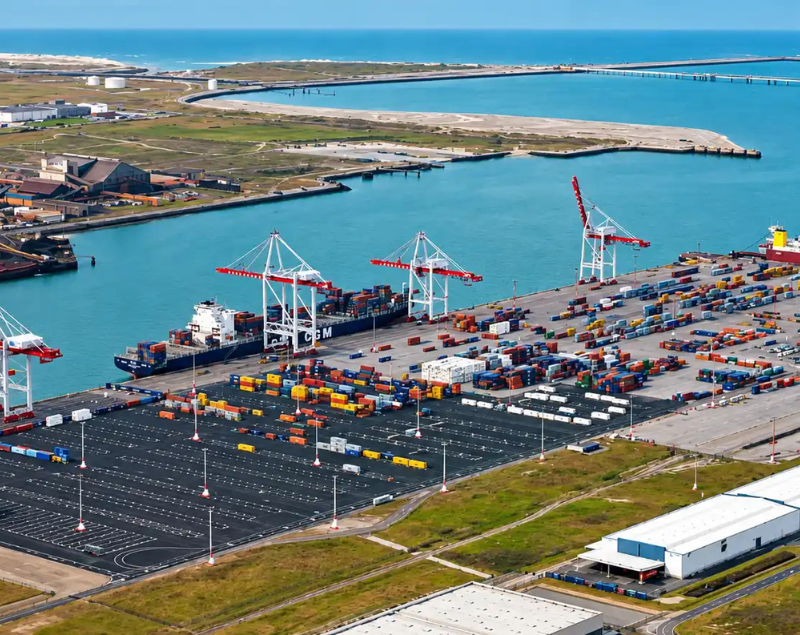
On Wednesday, Karima Z. Habacha, Managing Director France, and Rislene Ochan El Khattabi, Head of Operations France, represented Nexline Group on board the CMA CGM PANTHÉON during its first call at the Terminal des Flandres in Dunkirk. This call had a particular significance for Nexline Group. Dunkirk is part of our history. Nexline Group developed its roots in the Hauts-de-France region, and our teams regularly work with the port through the flows we manage between Asia and Europe. This visit was therefore an opportunity to complement our operational expertise with a direct experience on the ground. A first call at the Terminal des Flandres Dunkirk The CMA CGM PANTHÉON has a capacity of 24,212 TEUs, approximately 82,600 horsepower, and a dual-fuel LNG propulsion system. During its first call at the Terminal des Flandres Dunkirk, nearly 4,300 container moves were carried out. These are figures our teams are familiar with in their daily operations. However, seeing the organisation behind them directly on board and at the terminal brings a different perspective. That is exactly the value of this kind of field experience. Seeing what happens behind a port call The visit included the bridge, technical areas, crew living spaces and, of course, the engine room. At Nexline Group, we work with these vessels every day through their rotations, capacities, bookings, departures and port operations. Being on board adds another layer of understanding. It gives a clearer view of the environment in which crews operate, the coordination required between different teams and the physical reality behind the operations we manage from our offices. The engine room, in particular, highlights the technical and human organisation behind every port call. Field experience complements operational expertise In ocean freight, expertise naturally depends on understanding flows, shipping lines, capacity and operational constraints. But it is also strengthened by experience on the ground. Seeing an operation first-hand helps us better understand certain challenges, exchange with the professionals managing them every day and maintain a concrete view of the supply chain we coordinate for our clients. This is an important part of the Nexline Group approach. Our teams manage Asia–Europe flows from planning through to port operations. Experiences like this simply add another perspective to that expertise. Behind every flow, a chain of expertise This visit also reminds us that a port call never depends on a single player. Crews, port teams, terminal operators, shipping lines, freight forwarders and hauliers all play their part. Nexline Group’s role is to coordinate these different links so that our clients’ flows can move forward under the best possible conditions. This visit aboard the PANTHÉON therefore brought the operational reality back to the centre of processes we manage every day. Thank you to CMA CGM for the invitation and for this opportunity to experience the vessel from the inside. And thank you to Karima and Rislene for representing Nexline Group during this first call in Dunkirk. The Human Touch to Your Supply Chain. DISCOVER OUR TRANSPORT SERVICES