Are you shipping goods by truck between France and another country? One of the documents you will generally need to prepare is the CMR consignment note.
It accompanies international road freight shipments and contains the information required for the collection and delivery of goods.
This document also plays an important role in the event of a dispute between the parties involved in the transport operation.
For businesses importing or exporting goods, understanding how the CMR consignment note works helps them prepare shipments more effectively and understand the responsibilities of each party.
What exactly is this document used for? When is a CMR consignment note required, and what information should you check before the truck departs?
1. What is a CMR consignment note and what is it used for?
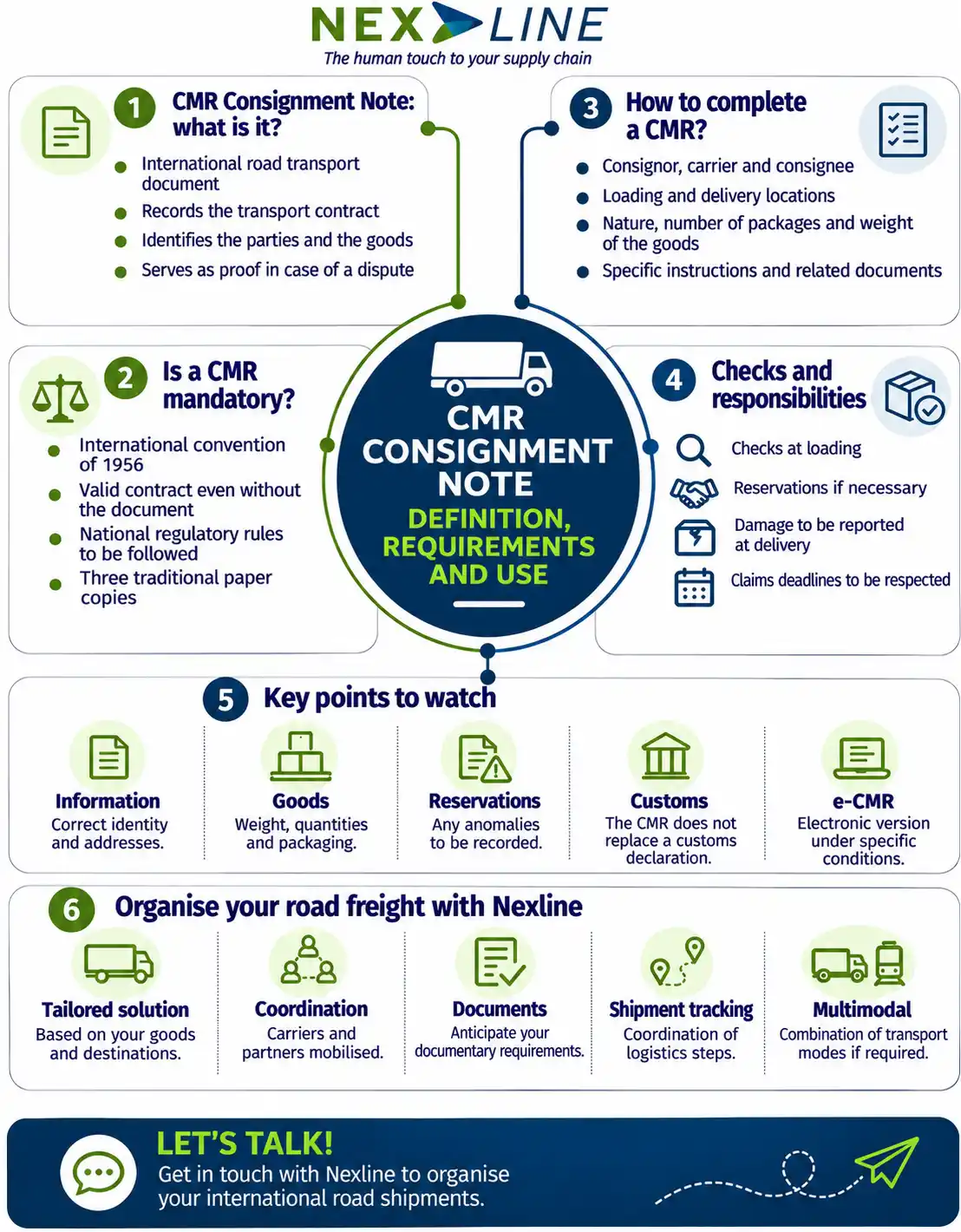
The CMR consignment note is a document that records the terms of the contract for the international carriage of goods by road and provides evidence that the carrier has taken possession of the goods.
CMR stands for the Convention on the Contract for the International Carriage of Goods by Road, signed in Geneva on 19 May 1956.
This convention establishes common rules for certain international road freight operations, particularly regarding transport contracts, carrier liability and claims.
Subject to the exclusions set out in the Convention, it applies when the places of collection and delivery are located in two different countries, at least one of which is a contracting party to the Convention.
The CMR Convention, available through UNIDROIT, sets out its scope of application and the rules governing the consignment note.
What is the purpose of a CMR consignment note?
The CMR consignment note records the terms of the transport contract and provides evidence that the carrier has received the goods.
It identifies the three main parties involved:
- The consignor (sender): the party handing over the goods for transport.
- The carrier: the party responsible for transporting the goods under the contract.
- The consignee (recipient): the party receiving the goods at the agreed delivery location.
The document also specifies the collection and delivery locations, as well as the nature and quantities of the goods being transported.
In the event of a dispute, the consignment note serves as prima facie evidence of the terms of the contract and the receipt of the goods by the carrier, in accordance with Article 9 of the Convention.
It therefore plays an important role in the documentation and management of international road freight operations.
What is the difference between a CMR consignment note and a delivery note?
These two documents serve different purposes.
The CMR consignment note relates to the contract and conditions of international carriage. A delivery note is generally used to document the handover of goods to the consignee.
In practice, information confirming receipt of the goods may also be recorded directly on the CMR consignment note.
A delivery note does not, therefore, automatically replace the transport documents required under the applicable regulations.
2. Is a CMR consignment note mandatory?
It is necessary to distinguish between the international Convention and national regulations governing transport documentation.
Article 4 of the CMR Convention states that the contract of carriage must be confirmed by a consignment note. However, it also specifies that the absence, irregularity or loss of this document does not, in itself, affect the existence or validity of the contract.
This does not mean that carriers can operate without complying with national documentation requirements.
What are the requirements in France?
In France, the Order of 9 November 1999 on transport documents requires a consignment note to be issued for the relevant road freight contracts involving carriage for hire or reward, whether domestic or international.
The document may be issued in paper or electronic format, provided that the applicable regulatory requirements are met.
During an inspection, it must be possible to present or communicate the document to the competent authorities.
An international transport document may serve as a French consignment note if it contains the required information.
Businesses organising international road freight shipments must therefore consider both the applicability of the CMR Convention and the documentation requirements of the countries through which the goods are transported.
Who prepares and signs the CMR consignment note?
In its traditional paper format, Article 5 of the Convention requires three original copies, signed by the consignor and the carrier:
- The first copy is given to the consignor.
- The second copy accompanies the goods.
- The third copy is retained by the carrier.
Depending on the arrangements in place, different parties may be involved in preparing the document. This does not automatically alter the responsibilities established under the Convention.
It is advisable to establish in advance who will complete the document and who will verify the accuracy of the information provided.
3. How to complete a CMR consignment note correctly
Article 6 of the CMR Convention specifies the information that must be included in the consignment note. These details identify the parties to the contract, the goods being transported and the conditions of carriage.
Before the truck departs, check that the information provided accurately reflects the goods being transported and the agreed shipping conditions.
Information to include in a CMR consignment note
| Field | Information to provide | What to check |
|---|---|---|
| Consignor | Name and address of the sender | Check that the contact details are accurate. |
| Carrier | Name and address of the carrier | Correctly identify the carrier involved. |
| Consignee | Name and address of the recipient | Verify the identity of the consignee. |
| Collection | Place and date of collection of the goods | Distinguish between the registered address and the actual loading location. |
| Delivery | Designated place of delivery | Check consistency with the transport instructions. |
| Goods | Nature of the goods and method of packing | Provide an accurate description. |
| Packages and quantities | Number of packages, marks, numbers and gross weight or other quantity | Check that the information matches the actual shipment. |
| Special instructions | Customs instructions, accompanying documents and other applicable details | Identify any specific requirements for the shipment. |
| Reservations | Observations regarding the goods or their packaging | Clearly describe any discrepancies or damage identified. |
| Signatures | Signatures of the consignor and carrier | Follow the requirements applicable to the document format. |
What is the difference between a CMR consignment note and a customs declaration?
The CMR consignment note may include instructions relating to customs formalities and details of the documents handed over to the carrier.
However, it does not replace a customs declaration. Depending on the countries involved and the applicable customs procedure, additional documents, authorisations or supporting evidence may be required.
When a shipment requires customs clearance, businesses must anticipate the relevant customs formalities and prepare the necessary documentation alongside the CMR consignment note.
At Nexline, we coordinate customs declaration services with the other stages of your international transport operations.
EXPLORE OUR TRANSPOR SERVICES
4. Goods inspections, reservations and liability: what to look out for
The accuracy of the information recorded on the CMR consignment note is particularly important when the goods received do not match the declared shipment.
What must the carrier check during loading?
When taking over the goods, Article 8 of the Convention requires the carrier to check the number of packages, their marks and numbers, as well as the apparent condition of the goods and their packaging.
If the carrier has no reasonable means of checking certain information, they must enter reservations and state the reasons for them.
For example, if packages are enclosed in a sealed unit that prevents them from being counted, this limitation should be recorded appropriately.
In the absence of reasoned reservations, the Convention establishes certain presumptions regarding the apparent condition of the goods and the information relating to the packages.
What should you do if goods are damaged upon delivery?
Upon receipt, the consignee should inspect the goods wherever possible.
If visible damage or shortages are identified, they should be reported no later than the time of delivery, in accordance with the conditions set out in Article 30.
For concealed loss or damage, written reservations must be submitted within seven days of delivery, excluding Sundays and public holidays.
In the event of a delay, written reservations must be submitted within 21 days from the date on which the goods were placed at the consignee’s disposal for compensation for the delay to be considered under the Convention.
These deadlines relate specifically to reservations under the CMR Convention. They should not be confused with other claims deadlines or limitation periods.
Providing a detailed description of any discrepancies, together with the available supporting evidence, helps facilitate the assessment of the claim.
5. Electronic consignment notes: how does e-CMR work?
The electronic consignment note, or e-CMR, is a digital version of the international road freight transport document.
An Additional Protocol to the CMR Convention was adopted in 2008 to establish a legal framework for its use.
The e-CMR can simplify document exchanges between the parties involved and reduce the need for repeated manual data entry.
Its use depends on the applicable legal framework and the technical resources available. In particular, it must ensure the authentication of the parties and the integrity of the data.
For further information, the United Nations Economic Commission for Europe (UNECE) provides a dedicated guide to electronic consignment notes (e-CMR)
Digitalisation represents an important development in transport documentation management, but it does not remove the obligation to verify the accuracy of the information provided.

The Nexline approach: logistics tailored to your needs
At Nexline, we organise your international road freight shipments, taking into account the nature of your goods, your destinations and your delivery requirements.
We select and coordinate the carriers and logistics partners required for each shipment, while anticipating documentation requirements and any necessary customs formalities.
Our objective is to provide a solution tailored to your freight flows, with a dedicated point of contact overseeing the coordination of each stage of transport.
The CMR consignment note plays an essential role in this process. It accompanies the goods and formally records the information relating to their transport.
Discover how we can support your business with our international road freight solutions.
FAQ: Frequently asked questions about CMR consignment notes
Where can I buy pre-printed CMR consignment note forms?
Pre-printed CMR consignment note forms are available from specialist transport document printers and professional stationery suppliers. In France, suppliers such as Argraco and Papeterie Gouchon offer pre-printed forms, some of which can be customised with company details.
Before placing an order, check the format, the number of copies and whether the forms contain the information required for your transport operations.
What software can be used to create electronic CMR consignment notes?
Several providers offer electronic consignment note management solutions, including Dashdoc, TransFollow and Pionira.
These tools can simplify the creation, signing, tracking and archiving of transport documents.
When choosing an e-CMR solution, consider its features, its integration with existing systems and its compliance with the regulations applicable in the countries involved.
Where can I download a CMR consignment note template?
CMR consignment note templates are available from websites specialising in transport and document management.
The IRU provides guidance on how to complete its international CMR consignment note model. Websites such as Zervant also offer downloadable CMR consignment note templates.
Before using a template, check that it contains the information required under the CMR Convention.
In summary