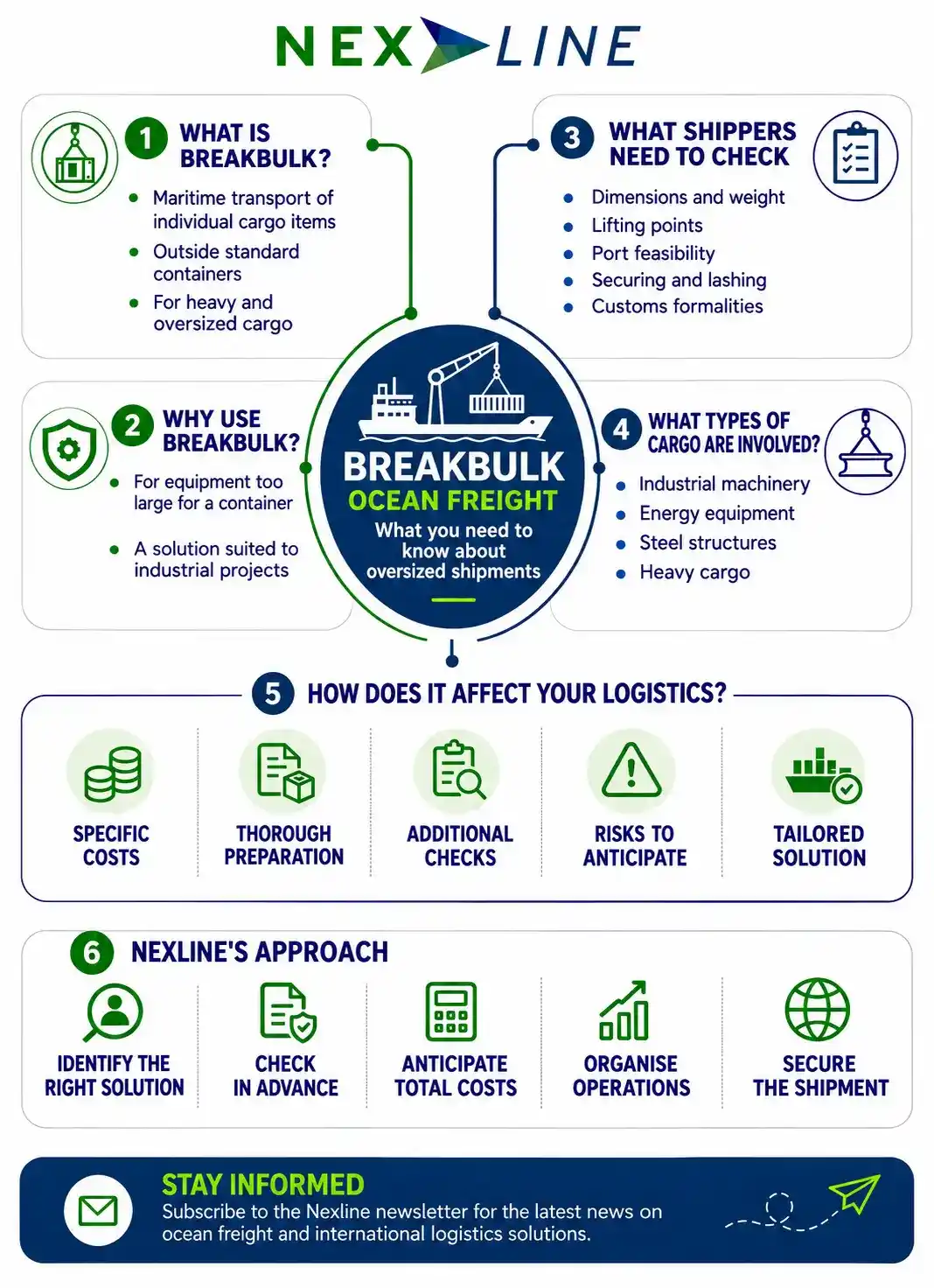
Shipping an industrial machine, a transformer or a large steel structure may require a different solution from conventional containerised sea freight.
Breakbulk allows goods to be loaded individually onto a vessel without placing them inside a standard container. How does this type of shipping work? What types of cargo can it handle, and how should companies prepare an oversized cargo shipment?
What Is Breakbulk Shipping?
Breakbulk, also known as conventional cargo shipping, involves loading and transporting goods as individual cargo units, either in a vessel’s hold or on deck, without using standard shipping containers.
These shipments may include machinery, steel structures, packaged goods or particularly large industrial equipment.
Unlike bulk shipping, where homogeneous commodities are transported without individual packaging, breakbulk involves handling separate cargo units.
Key point: Breakbulk cargo is not necessarily oversized. The term describes the method of transport, whereas oversized cargo refers to the dimensions or specific handling requirements of a shipment.
For industrial companies, breakbulk is one of several options to consider when organising international sea freight.
What Types of Cargo Can Be Transported as Breakbulk?
Breakbulk shipping handles a wide range of equipment that requires individual cargo handling.
Common examples include:
- Industrial machinery: presses, machine tools and manufacturing equipment.
- Energy equipment: transformers, generators and electrical installation components.
- Steel structures: beams, structural frames and prefabricated components.
- Rolling stock: certain industrial vehicles and railway equipment.
- Heavy-lift cargo: mechanical components and assemblies requiring specialised lifting equipment.
The Port of Sète lists wind turbines, transformers, generators and tunnel-boring machines among the cargo types handled at its breakbulk terminal.
In practice, the choice of transport depends on the cargo’s dimensions, weight, centre of gravity and handling requirements.
How Does Breakbulk Shipping Work?
Each shipment requires preparation tailored to the characteristics of the cargo.
1. Technical Assessment of the Cargo
Before booking transport, the parties involved need accurate dimensions, weight, technical drawings, lifting points and information about the centre of gravity.
This information helps them assess transport equipment compatibility, port constraints and loading feasibility.
2. Cargo Handling and Loading
Port handling teams load individual cargo units using shore cranes, shipboard cranes or other suitable equipment.
They must check lifting capacity, terminal accessibility and vessel configuration beforehand.
3. Blocking and Securing the Cargo
Handling teams position the cargo on suitable supports and secure it against vessel movements.
The International Maritime Organization’s CSS Code provides recommendations for cargo stowage and securing, particularly for heavy-lift cargo and shipments with specific handling requirements.
4. Unloading at the Destination
The destination port must have the facilities required to receive the cargo.
The teams must also coordinate unloading with inland transport, particularly when the equipment requires a specialised trailer or an abnormal-load route.
Breakbulk, Standard Containers and Flat Racks: What Are the Differences?
Breakbulk is not always necessary for transporting oversized cargo.
| Solution | Characteristics | Typical use |
|---|---|---|
| Dry container | Standard enclosed shipping container | Goods that fit within the container’s limits |
| Flat rack | Platform without side walls | Wide or bulky equipment |
| Open-top container | Container with an open top | Cargo requiring loading from above |
| Breakbulk | Individually loaded cargo units | Conventional cargo or equipment that is difficult to containerise |
Equipment exceeding the width of a standard dry container may sometimes travel on a flat rack, subject to technical approval and acceptance by the shipping line.
However, when specialised container solutions are unsuitable, companies can consider conventional cargo shipping.
The choice therefore depends on technical constraints, availability along the route and the shipment’s overall cost.
EXPLORE OUR TRANSPOR SERVICES
What Are the Advantages and Limitations of Breakbulk Shipping?
Breakbulk shipping enables companies to organise shipments that do not fit conventional containerised transport solutions.
Transporting Complex Equipment
Some industrial machines can travel without being dismantled, provided technical conditions and handling equipment allow it.
This can reduce the preparation work required before departure and the reassembly work needed at the destination.
Adapting Loading Operations to the Cargo
Technical teams assess cargo positioning, lifting equipment and securing arrangements according to each shipment’s characteristics.
However, this flexibility requires more individualised preparation.
Anticipating Port Constraints
Not all ports have the same cargo-handling capabilities.
Companies must therefore check available equipment, access conditions, storage facilities and loading restrictions.
Additional operations may also affect costs and transit times.
How Do You Organise Oversized Cargo Shipping?
Preparing a breakbulk shipment involves five essential steps:
- Assess the cargo: dimensions, weight, packaging, technical drawings and lifting points.
- Compare transport solutions: specialised containers, flat racks, open-top containers or breakbulk.
- Check port facilities: handling capacity, access conditions and available equipment.
- Prepare the shipment: packaging, loading, cargo securing and transport documentation.
- Organise delivery: inland transport, cargo reception and coordination between the parties involved.
A freight forwarder can help centralise the communication required to assess and organise the shipment.
For shipments involving several transport modes, Nexline also offers multimodal transport solutions.
Example: Exporting Industrial Machinery as Breakbulk Cargo
A French company wants to ship a production machine to a factory abroad.
The machine’s dimensions exceed those of a standard shipping container.
Before choosing breakbulk, the company must determine whether a flat rack or open-top container would be suitable. If neither option meets the requirements, it can consider conventional cargo shipping.
The operation then requires confirmation of lifting equipment, sea freight availability and delivery conditions at the industrial site.
The company must also anticipate export formalities. Nexline provides support with customs declarations for international shipments.
Nexline Supports Your Oversized Maritime Shipments
Organising a complex shipment begins with assessing the cargo’s characteristics and the constraints involved in transporting it.
Through its sea freight services, Projects / charter offering and international partner network, Nexline Group provides support tailored to the needs of importing and exporting companies.
Its solutions help businesses assess different transport options, coordinate the necessary logistics services and, where required, integrate multimodal transport and customs formalities.
To prepare your enquiry, gather the cargo’s dimensions and weight, available technical drawings, origin and destination details, and your preferred delivery dates.
Do you need to ship industrial machinery or oversized cargo?
Contact Nexline to discuss your project and identify a suitable sea freight solution.

FAQ: Frequently Asked Questions About Breakbulk Shipping
What Are the Main Services Offered by Breakbulk Shipping Companies in France?
Companies specialising in breakbulk shipping provide maritime transport solutions for heavy, oversized or difficult-to-containerise cargo.
Their services may include technical cargo assessments, vessel chartering, coordination of port operations, loading, cargo securing and transport arrangements through to the final destination.
Through its sea freight solutions, including its Projects / charter offering, Nexline Group supports companies in assessing and organising their international shipments.
Who Are the Main Shipping Companies Specialising in Conventional Cargo Transport from France?
Several international shipping companies, including BBC Chartering, Spliethoff and Chipolbrok, specialise in conventional cargo, heavy-lift shipments and industrial cargo.
The choice depends on the ports served, cargo characteristics, lifting capacity and vessel availability. These operators do not necessarily offer direct services from every French port.
A freight forwarder such as Nexline Group can assess suitable maritime transport solutions based on the shipment’s technical requirements and route.
How Do You Choose a Reliable Breakbulk Shipping Provider in Europe?
When choosing a breakbulk shipping provider, companies should examine its experience in transporting complex cargo, its ability to coordinate port operations and its knowledge of technical and regulatory requirements.
It is also advisable to check quotation transparency, insurance arrangements, proposed cargo-handling solutions and shipment tracking procedures.
A reliable provider should be able to explain the stages of the shipment and identify the main risks before loading.
How Do You Choose a Freight Forwarder Specialising in Project Logistics for International Shipments?
A freight forwarder specialising in project logistics should be able to assess cargo characteristics, compare transport solutions and coordinate the different parties involved through to delivery.
Companies should also evaluate its international network, knowledge of customs formalities and ability to organise multimodal transport.
Nexline Group offers a Projects / charter service, international transport solutions and customs services to support companies in organising complex shipments. Each project’s feasibility must be assessed individually.
In Summary